Gutscheinbedingungen

**Gültig bis 06.07.2026 auf fremdsprachige Bücher online auf thalia.at, in der Thalia App ab einem Mindestbestellwert von 30€ und in allen Thalia Buchhandlungen in Österreich. In den Buchhandlungen nur gültig auf lagernde Ware. Einzelne Artikel können ausgeschlossen sein. Ausgenommen sind preisgebundene Artikel & eBooks. Pro Einkauf einmal einlösbar. Nur gültig gegen Vorlage oder im Onlineshop hinterlegter Bonuscard. Infos zur Einlösung in der Buchhandlung sind auf der Bonuscard-Vorteilspreisseite zu finden. Click & Collect nur bei Onlinevorabzahlung möglich. Keine Einlösung bei Scan & Go-Bezahlung. Keine Barauszahlung. Nicht kombinierbar mit anderen Aktionen und Gutscheinen. Gutschein wird auf max. 500€ Bestellwert angerechnet. Nicht gültig für Versandkosten und Services.

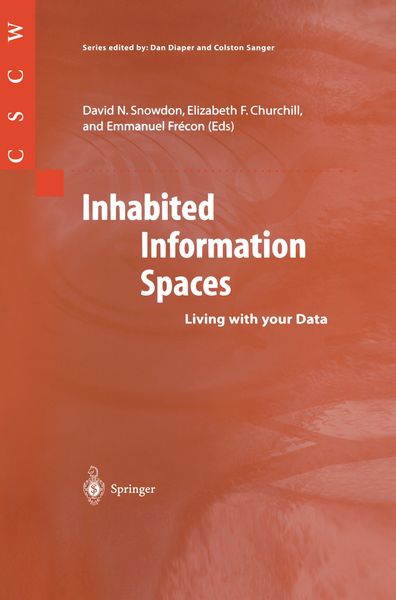
  • Produktbild: Inhabited Information Spaces
  • Produktbild: Inhabited Information Spaces
- 12%

Inhabited Information Spaces Living with your Data

12% sparen

95,99 € UVP 109,99 €

inkl. gesetzl. MwSt., Versandkostenfrei


Beschreibung

Produktdetails

Einband

Taschenbuch

Erscheinungsdatum

15.01.2004

Herausgeber

David N. Snowdon + weitere

Verlag

Springer London

Seitenzahl

329

Maße (L/B/H)

23,5/15,7/2 cm

Gewicht

499 g

Auflage

2004

Sprache

Englisch

ISBN

978-1-85233-728-5

Beschreibung

Produktdetails

Einband

Taschenbuch

Erscheinungsdatum

15.01.2004

Herausgeber

Verlag

Springer London

Seitenzahl

329

Maße (L/B/H)

23,5/15,7/2 cm

Gewicht

499 g

Auflage

2004

Sprache

Englisch

ISBN

978-1-85233-728-5

Herstelleradresse

Libri GmbH
Europaallee 1
36244 Bad Hersfeld
DE

Email: gpsr@libri.de

Noch keine Bewertungen vorhanden

Verfassen Sie die erste Bewertung zu diesem Artikel

Helfen Sie anderen Kundinnen und Kunden durch Ihre Meinung.

Kundinnen und Kunden meinen

Bewertungen (0)

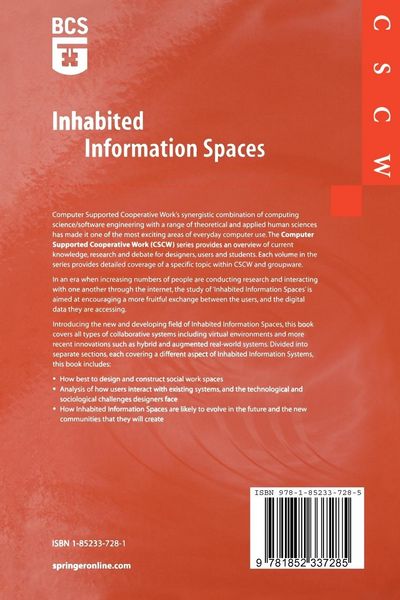
  • Produktbild: Inhabited Information Spaces
  • Produktbild: Inhabited Information Spaces
  • Contents
    List of Contributors Part 1. Introduction
    1. Inhabited Information Spaces: An Introduction
    Elizabeth Churchill, David Snowdon and Emmanuel Frécon
    1.1 Introduction
    1.2 Chapters in this Volume
    1.2.1 Pure Virtual Environments
    1.2.2 Mixed Reality Environments
    1.2.3 Communication
    1.2.4 Construction
    1.2.5 Community
    1.3 Summary Part 2. Pure Virtual Environments
    2. WWW3D and the Web Planetarium
    Mårten Stenius and David Snowdon
    2.1 Introduction
    2.2 Producing a 3D Representation of a Web Page
    2.3 Browsing the Web Using WWW3D
    2.4 Improving Scalability
    2.5 The Web Planetarium: Creating a Richer Visualisation
    2.5.1 Visual Differentiation of Nodes
    2.5.2 The Web as a Road Network
    2.5.3 Hybrid Browsing
    2.6 Conclusion 3. PlaceWorld, and the Evolution of Electronic Landscapes
    Steve Pettifer, Jon Cook and James Marsh
    3.1 Introduction
    3.2 Background: The Physical and the Abstract
    3.2.1 Watching a Cityscape
    3.2.2 The Distributed Legible City
    3.2.3 Finding 'Something to Do”
    3.2.4 Abstract In.uences: Nuzzle Afar
    3.3 PlaceWorld
    3.3.1 The Design of PlaceWorld
    3.3.2 The User Interface and Presentation System
    3.4 Technological Challenges for Electronic Landscapes
    3.4.1 Synchronising the Behaviour of Entities
    3.4.2 Distribution and Communications
    3.4.3 De.ning the Behaviour of Entities
    3.4.4 Methods and Filters
    3.4.5 The Distribution Architecture
    3.5 System Support for PlaceWorld
    3.5.1 Menus
    3.5.2 Access Model
    3.5.3 Exploiting Subjectivity
    3.5.4 Becoming a Place Where Places Meet
    3.6 Conclusions 4. Using a Pond Metaphor for Information Visualisation and Exploration
    Olov Ståhl and Anders Wallberg
    4.1 Introduction
    4.2 The Pond
    4.2.1 The Pond Ecosystem Metaphor
    4.2.2 The Pond Example Application
    4.2.3 The Hardware Platform
    4.2.4 The Software Platform
    4.3 Interaction
    4.4 The Pond Audio Environment
    4.5 Observations from Use
    4.6 Discussion
    4.7 Summary and Future Work Part 3. Mixed Reality Environments
    5. City: A Mixture of Old and New Media
    Matthew Chalmers
    5.1 Introduction
    5.2 Theory
    5.3 System
    5.4 Use
    5.5 Ongoing and Future Work
    5.6 Conclusion