KI-Beratung Beta

Gutscheinbedingungen

**Gültig bis 30.11.2026 auf Spielzeug, Schreibwaren, Filme, Geschenke & Trends, Musik, tolino eReader & Zubehör, Hörbücher und Hörbuch-Downloads, nicht preisgebundene Bücher und Kalender online auf thalia.at und in der Thalia App. Einzelne Artikel können ausgeschlossen sein. Aufgrund der Buchpreisbindung sind deutschsprachige Bücher und eBooks ausgenommen. Zusätzlich ausgenommen sind Abos & Flatrates, Games, Geschenkkarten/-boxen, Shelfies, Software, Zeitschriften sowie einzelne Artikel von tonies®. Pro Einkauf einmal einlösbar. Nur gültig mit im Onlineshop hinterlegter Bonuscard. Click & Collect nur bei Onlinevorabzahlung möglich. Keine Barauszahlung. Nicht kombinierbar mit anderen Aktionen und Gutscheinen. Gutschein wird auf max. 500€ Bestellwert angerechnet. Nicht gültig für Versandkosten und Services.

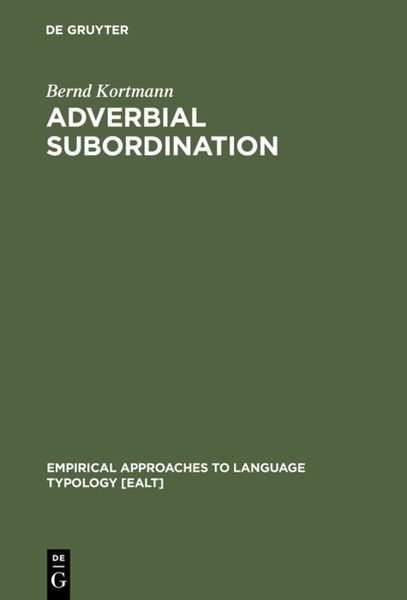
Produktbild: Adverbial Subordination
Band 18

Adverbial Subordination A Typology and History of Adverbial Subordinators Based on European Languages

206,99 €

inkl. gesetzl. MwSt., Versandkostenfrei


Beschreibung

Research on language universals and research on linguistic typology are not antagonistic, but rather complementary approaches to the same fundamental problem: the relationship between the amazing diversity of languages and the profound unity of language. Only if the true extent of typological divergence...

Beschreibung

Research on language universals and research on linguistic typology are not antagonistic, but rather complementary approaches to the same fundamental problem: the relationship between the amazing diversity of languages and the profound unity of language. Only if the true extent of typological divergence is recognized can universal laws be formulated. In recent years it has become more and more evident that a broad range of languages of radically different types must be carefully analyzed before general theories are possible. Typological comparison of this kind is now at the centre of linguistic research.


The series empirical approaches to language typology presents a platform for contributions of all kinds to this rapidly developing field. The distinctive feature of the series is its markedly empirical orientation. All conclusions to be reached are the result of a deepened study of empirical data. General problems are focused on from the perspective of individual languages, language families, language groups, or language samples. Special emphasis is given to the analysis of phenomena from little known languages, which shed new light on long-standing problems in general linguistics.


The series is open to contributions from different theoretical persuasions. It thus reflects the methodological pluralism that characterizes the present situation. Care is taken that all volumes be accessible to every linguist and, moreover, to every reader specializing in some domain related to human language.


A deeper understanding of human language in general, based on a detailed analysis of typological diversity among individual languages, is fundamental for many sciences, not only for linguists. Therefore, this series has proven to be indispensable in every research library, be it public or private, which has a specialization in language and the language sciences.


To discuss your book idea or submit a proposal, please contact Birgit Sievert.

Produktdetails

Einband

Gebundene Ausgabe

Erscheinungsdatum

14.11.1996

Abbildungen

Num.figs and tabs.

Verlag De Gruyter Oldenbourg

Produktdetails

Einband

Gebundene Ausgabe

Erscheinungsdatum

14.11.1996

Abbildungen

Num.figs and tabs.

Verlag De Gruyter Oldenbourg
Seitenzahl

425

Maße (L/B/H)

23,6/16/2,9 cm

Gewicht

806 g

Auflage

Reprint 2012

Sprache

Englisch

ISBN

978-3-11-015114-5

Herstelleradresse

de Gruyter Mouton
Genthiner Straße 13
10785 Berlin
DE

Email: productsafety@degruyterbrill.com

Noch keine Bewertungen vorhanden

Verfassen Sie die erste Bewertung zu diesem Artikel

Helfen Sie anderen Kundinnen und Kunden durch Ihre Meinung.

Kundinnen und Kunden meinen

Bewertungen (0)

  • Produktbild: Adverbial Subordination