Gutscheinbedingungen

**Gültig bis 06.07.2026 auf fremdsprachige Bücher online auf thalia.at, in der Thalia App ab einem Mindestbestellwert von 30€ und in allen Thalia Buchhandlungen in Österreich. In den Buchhandlungen nur gültig auf lagernde Ware. Einzelne Artikel können ausgeschlossen sein. Ausgenommen sind preisgebundene Artikel & eBooks. Pro Einkauf einmal einlösbar. Nur gültig gegen Vorlage oder im Onlineshop hinterlegter Bonuscard. Infos zur Einlösung in der Buchhandlung sind auf der Bonuscard-Vorteilspreisseite zu finden. Click & Collect nur bei Onlinevorabzahlung möglich. Keine Einlösung bei Scan & Go-Bezahlung. Keine Barauszahlung. Nicht kombinierbar mit anderen Aktionen und Gutscheinen. Gutschein wird auf max. 500€ Bestellwert angerechnet. Nicht gültig für Versandkosten und Services.

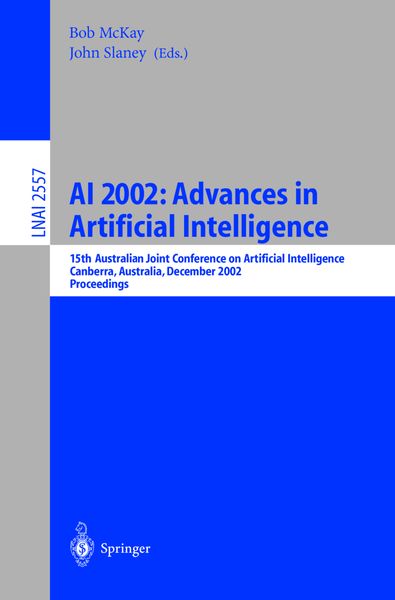
  • Produktbild: AI 2002: Advances in Artificial Intelligence
  • Produktbild: AI 2002: Advances in Artificial Intelligence

AI 2002: Advances in Artificial Intelligence 15th Australian Joint Conference on Artificial Intelligence, Canberra, Australia, December 2-6, 2002, Proceedings

99,99 €

inkl. gesetzl. MwSt., Versandkostenfrei


Beschreibung

Produktdetails

Einband

Taschenbuch

Erscheinungsdatum

20.11.2002

Herausgeber

Bob McKay + weitere

Verlag

Springer Berlin

Seitenzahl

736

Maße (L/B/H)

23,5/15,5/4,1 cm

Gewicht

2280 g

Auflage

2002

Sprache

Englisch

ISBN

978-3-540-00197-3

Beschreibung

Produktdetails

Einband

Taschenbuch

Erscheinungsdatum

20.11.2002

Herausgeber

Verlag

Springer Berlin

Seitenzahl

736

Maße (L/B/H)

23,5/15,5/4,1 cm

Gewicht

2280 g

Auflage

2002

Sprache

Englisch

ISBN

978-3-540-00197-3

Herstelleradresse

Springer-Verlag KG
Sachsenplatz 4-6
1201 Wien
AT

Email: GPSR Kontakt

Noch keine Bewertungen vorhanden

Verfassen Sie die erste Bewertung zu diesem Artikel

Helfen Sie anderen Kundinnen und Kunden durch Ihre Meinung.

Kundinnen und Kunden meinen

Bewertungen (0)

  • Produktbild: AI 2002: Advances in Artificial Intelligence
  • Produktbild: AI 2002: Advances in Artificial Intelligence
  • Natural Language and Information Retrieval.- A Controlled Language to Assist Conversion of Use Case Descriptions into Concept Lattices.- Preferred Document Classification for a Highly Inflectional/Derivational Language.- Experiments in Query Paraphrasing for Information Retrieval.- Knowledge Representation and Reasoning.- Dynamic Decision-Making in Logic Programming and Game Theory.- On a Linear Representation Theory for Quantitative Belief Change.- Trust in Secure Communication Systems - The Concept, Representations, and Reasoning Techniques.- Foundations for a Formalism of Nearness.- Deduction.- Semantic Selection for Resolution in Clause Graphs.- Machine-Checking the Timed Interval Calculus.- Modeling Programs with Unstructured Control Flow for Debugging.- Learning Theory I.- Message Length Formulation of Support Vector Machines for Binary Classification A Preliminary Scheme.- MML Inference of Decision Graphs with Multi-way Joins.- MML Clustering of Continuous-Valued Data Using Gaussian and t Distributions.- Optimizing Kernel-Based Nonlinear Subspace Methods Using Prototype Reduction Schemes.- Agents.- Intention and Rationality for PRS-Like Agents.- Modeling and Simulation for Detecting a Distributed Denial of Service Attack.- Knowledge-Driven Processes Can Be Managed.- Adaptive Multi-agent Decision Making Using Analytical Hierarchy Process.- Intelligent Systems.- Autonomous Planning and Scheduling on the TechSat 21 Mission.- Omni-drive Robot Motion on Curved Paths: The Fastest Path between Two Points Is Not a Straight-Line.- Indexing of Image Databases Using Untrained 4D Holographic Memory Model.- The Flux-Oriented Control of an Induction Machine Utilizing an Online Controller Parameter Adaptation Scheme.- Bayesian Reasoning and Classification.- Modelling the Acquisition of Colour Words.- Bayesian Information Reward.- Prediction of User Preference in Recommendation System Using Associative User Clustering and Bayesian Estimated Value.- Argument Interpretation Using Minimum Message Length.- Evolutionary Algorithms.- Genetic Programming for Classification: An Analysis of Convergence Behaviour.- Lineage and Induction in the Development of Evolved Genotypes for Non-uniform 2D CAs.- Evolution in the Orange Box — A New Approach to the Sphere-Packing Problem in CMAC-Based Neural Networks.- Finding Worst-Case Instances of, and Lower Bounds for, Online Algorithms Using Genetic Algorithms.- Neural Networks I.- An Adaptive Activation Function for Higher Order Neural Networks.- An Adaptive Learning Algorithm Aimed at Improving RBF Network Generalization Ability.- A Neural Network Online Training Algorithm Based on Compound Gradient Vector.- Applications of Wavelet Transform and Artificial Neural Networks to Pattern Recognition for Environmental Monitoring.- Reinforcement Learning.- Adapting Kernels by Variational Approach in SVM.- Learning to Reach the Pareto Optimal Nash Equilibrium as a Team.- Computational Models of the Amygdala and the Orbitofrontal Cortex: A Hierarchical Reinforcement Learning System for Robotic Control.- Constraints and Scheduling.- A General Approach for Building Constraint Languages.- Metric SCSPs: Partial Constraint Satisfaction via Semiring CSPs Augmented with Metrics.- A Hybrid Genetic Algorithm for School Timetabling.- Genetic Scheduling on Minimal Processing Elements in the Grid.- Neural Net Applications I.- Protein Sequences Classification Using Modular RBF Neural Networks.- Feature Extraction and Selection in Tool Condition Monitoring System.- A Robust Meaning Extraction Methodology Using Supervised Neural Networks.- Solving Regression Problems Using Competitive Ensemble Models.- Learning Theory II.- Learning of Finite Unions of Tree Patterns with Internal Structured Variables from Queries.- TreeITL-Mine: Mining Frequent Itemsets Using Pattern Growth, Tid Intersection, and Prefix Tree.- Convergency of Learning Process.- Structured Features from Concept Lattices for Unsupervised Learning and Classification.- Satisfiability Reasoning.- Towards Fewer Parameters for SAT Clause Weighting Algorithms.- An Investigation of Variable Relationships in 3-SAT Problems.- Modelling More Realistic SAT Problems.- A Two Level Local Search for MAX-SAT Problems with Hard and Soft Constraints.- Neural Net Applications II.- Strong Pseudorandom Bit Sequence Generators Using Neural Network Techniques and Their Evaluation for Secure Communications.- Surface Feature Recognition of Wear Debris.- Improved Defect Detection Using Novel Wavelet Feature Extraction Involving Principal Component Analysis and Neural Network Techniques..- Effectiveness for Machine Translation Method Using Inductive Learning on Number Representation.- Effectiveness for Machine Translation Method Using Inductive Learning on Number Representation.- Estimating Episodes of Care Using Linked Medical Claims Data.- Estimating Episodes of Care Using Linked Medical Claims Data.- Fuzzy Reasoning.- Adaptation of a Mamdani Fuzzy Inference System Using Neuro-genetic Approach for Tactical Air Combat Decision Support System.- Optimization of Recurrent NN by GA with Variable Length Genotype.- Neural Networks II and CBR.- Theoretical Foundation for Nonlinear Edge-Preserving Regularized Learning Image Restoration.- The Application of Case Based Reasoning on Q&A System.- Abstracts of Posters.- Development of an Intelligent Tutoring System on Design of Liquid Retaining Structures.- Real-Time Prediction of Water Stage with Artificial Neural Network Approach.- On the Design of Mathematical Concepts.- Consistency of Trust Theories.- An Artificially Intelligent Sports Tipper.- Selecting Semantics for Use with Semantic Pruning of Linear Deductions.- Calibration of Flow and Water Quality Modeling Using Genetic Algorithm.- A Comparison of Machine Learning Approaches for the Automated Classification of Dementia.- A Defeasible Logic of Policy-Based Intention (Extended Abstract).- A Self-Organizing Territorial Approach to Multi-robot Search and Surveillance.- Knowledge-Based Techniques for Constraints Satisfaction in Resource Allocation Problems.- Effective SAT Planning by Speculative Computation.