Gutscheinbedingungen

**Gültig bis 12.08.2026 auf fremdsprachige Bücher online auf thalia.at und in der Thalia App. Einzelne Artikel können ausgeschlossen sein. Ausgenommen sind preisgebundene Artikel & eBooks. Pro Einkauf einmal einlösbar. Click & Collect nur bei Onlinevorabzahlung möglich. Keine Barauszahlung. Nicht kombinierbar mit anderen Aktionen und Gutscheinen. Gutschein wird auf max. 500€ Bestellwert angerechnet. Nicht gültig für Geschenkkarten, Versandkosten und Services.

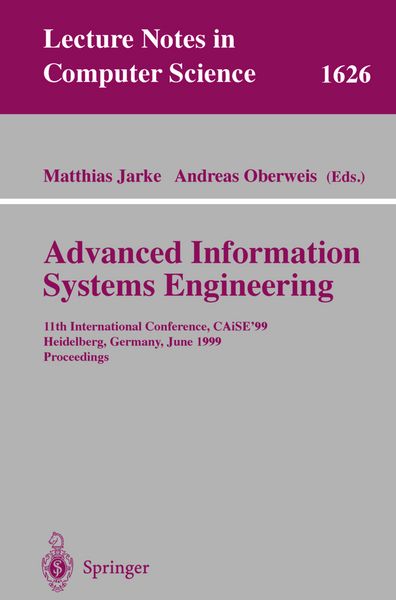
  • Produktbild: Advanced Information Systems Engineering
  • Produktbild: Advanced Information Systems Engineering
Band 1626

Advanced Information Systems Engineering 11th International Conference, Heidelberg, Germany, June 14-18, 1999, Proceedings

51,99 €

inkl. gesetzl. MwSt., Versandkostenfrei


Beschreibung

Produktdetails

Einband

Taschenbuch

Erscheinungsdatum

09.06.1999

Herausgeber

Matthias Jarke + weitere

Verlag

Springer Berlin

Seitenzahl

486

Maße (L/B/H)

23,5/15,5/2,6 cm

Gewicht

750 g

Auflage

1999

Sprache

Englisch

ISBN

978-3-540-66157-3

Beschreibung

Produktdetails

Einband

Taschenbuch

Erscheinungsdatum

09.06.1999

Herausgeber

Verlag

Springer Berlin

Seitenzahl

486

Maße (L/B/H)

23,5/15,5/2,6 cm

Gewicht

750 g

Auflage

1999

Sprache

Englisch

ISBN

978-3-540-66157-3

Herstelleradresse

Springer-Verlag KG
Sachsenplatz 4-6
1201 Wien
AT

Email: GPSR Kontakt

Noch keine Bewertungen vorhanden

Verfassen Sie die erste Bewertung zu diesem Artikel

Helfen Sie anderen Kundinnen und Kunden durch Ihre Meinung.

Kundinnen und Kunden meinen

Bewertungen (0)

  • Produktbild: Advanced Information Systems Engineering
  • Produktbild: Advanced Information Systems Engineering
  • Invited Talks.- The Unified Process for Component-Based Development.- From Business Process Model to Application System — Developing an Information System with the House of Business Engineering (HOBE).- Regular Papers.- CPAM, A Protocol for Software Composition.- A Process-Oriented Approach to Software Component Definition.- Configuring Business Objects from Legacy Systems.- Risk Management for IT in the Large.- Linking Business Modelling to Socio-technical System Design.- Towards Flexible and High-Level Modeling and Enacting of Processes.- Method Enhancement with Scenario Based Techniques.- Support for the Process Engineer: The Spearmint Approach to Software Process Definition and Process Guidance.- Managing Componentware Development – Software Reuse and the V-Modell Process.- Modelling Multidimensional Data in a Dataflow-Based Visual Data Analysis Environment.- Towards Quality-Oriented Data Warehouse Usage and Evolution.- Designing the Global Data Warehouse with SPJ Views.- Applying Graph Reduction Techniques for Identifying Structural Conflicts in Process Models.- A Multi-variant Approach to Software Process Modelling.- An Ontological Analysis of Integrated Process Modelling.- Design of Object Caching in a CORBA OTM System.- Constructing IDL Views on Relational Databases.- The Design of Cooperative Transaction Model by Using Client-Server Architecture.- A Multilevel Secure Workflow Management System.- Time Constraints in Workflow Systems.- TOGA—A Customizable Service for Data-Centric Collaboration.- A Practical Approach to Access Heterogeneous and Distributed Databases.- A Uniform Approach to Inter-model Transformations.- OTHY: Object To HYpermedia.- Modeling Dynamic Domains with ConGolog.- Towards an Object Petri Nets Model for Specifying and Validating Distributed Information Systems.- Relationship Reification: A Temporal View.- Towards a Classification Framework for Application Granularity in Workflow Management Systems.- Adaptive Outsourcing in Cross-Organizational Workflows.- Policy-Based Resource Management.- Modelling Method Heuristics for Better Quality Products.- Queries and Constraints on Semi-structured Data.- A Prototype for Metadata-Based Integration of Internet Sources.- Workflow Management Through Distributed and Persistent CORBA Workflow Objects.- Component Criteria for Information System Families.- TUML: A Method for Modelling Temporal Information Systems.- Beyond Goal Representation: Checking Goal-Satisfaction by Temporal Reasoning with Business Processes.- Design the Flexibility, Maintain the Stability of Conceptual Schemas.- Metrics for Active Database Maintainability.