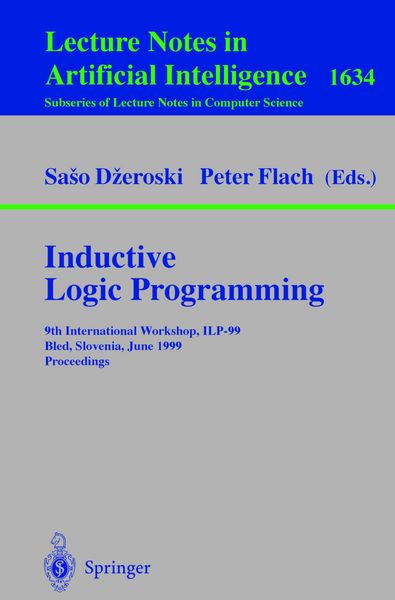
Inductive Logic Programming 9th International Workshop, ILP-99, Bled, Slovenia, June 24-27, 1999, Proceedings
-
- Englisch ausgewählt
-
Auflage:1999
- 1997 51,99 €
- 2008 51,99 €
- 1999 51,99 € ausgewählt
51,99 €
inkl. gesetzl. MwSt.,
Beschreibung
Produktdetails
Einband
Taschenbuch
Erscheinungsdatum
09.06.1999
Abbildungen
VIII, 312 p.
Herausgeber
Saso Dzeroski + weitereVerlag
Springer BerlinSeitenzahl
312
Maße (L/B/H)
23,5/15,5/1,8 cm
Gewicht
487 g
Auflage
1999
Sprache
Englisch
ISBN
978-3-540-66109-2
I Invited Papers.- Probabilistic Relational Models.- Inductive Databases.- Some Elements of Machine Learning.- II Contributed Papers.- Refinement Operators Can Be (Weakly) Perfect.- Combining Divide-and-Conquer and Separate-and-Conquer for Efficient and Effective Rule Induction.- Refining Complete Hypotheses in ILP.- Acquiring Graphic Design Knowledge with Nonmonotonic Inductive Learning.- Morphosyntactic Tagging of Slovene Using Progol.- Experiments in Predicting Biodegradability.- 1BC: A First-Order Bayesian Classifier.- Sorted Downward Refinement: Building Background Knowledge into a Refinement Operator for Inductive Logic Programming.- A Strong Complete Schema for Inductive Functional Logic Programming.- Application of Different Learning Methods to Hungarian Part-of-Speech Tagging.- Combining LAPIS and WordNet for the Learning of LR Parsers with Optimal Semantic Constraints.- Learning Word Segmentation Rules for Tag Prediction.- Approximate ILP Rules by Backpropagation Neural Network: A Result on Thai Character Recognition.- Rule Evaluation Measures: A Unifying View.- Improving Part of Speech Disambiguation Rules by Adding Linguistic Knowledge.- On Sufficient Conditions for Learnability of Logic Programs from Positive Data.- A Bounded Search Space of Clausal Theories.- Discovering New Knowledge from Graph Data Using Inductive Logic Programming.- Analogical Prediction.- Generalizing Refinement Operators to Learn Prenex Conjunctive Normal Forms.- Theory Recovery.- Instance based function learning.- Some Properties of Inverse Resolution in Normal Logic Programs.- An Assessment of ILP-assisted models for toxicology and the PTE-3 experiment.
Noch keine Bewertungen vorhanden
Verfassen Sie die erste Bewertung zu diesem Artikel
Helfen Sie anderen Kundinnen und Kunden durch Ihre Meinung.
Kurze Frage zu unserer Seite
Vielen Dank für Ihr Feedback
Wir nutzen Ihr Feedback, um unsere Produktseiten zu verbessern. Bitte haben Sie Verständnis, dass wir Ihnen keine Rückmeldung geben können. Falls Sie Kontakt mit uns aufnehmen möchten, können Sie sich aber gerne an unseren Kund*innenservice wenden.
zum Kundenservice