• Produktbild: Logics in Artificial Intelligence
  • Produktbild: Logics in Artificial Intelligence

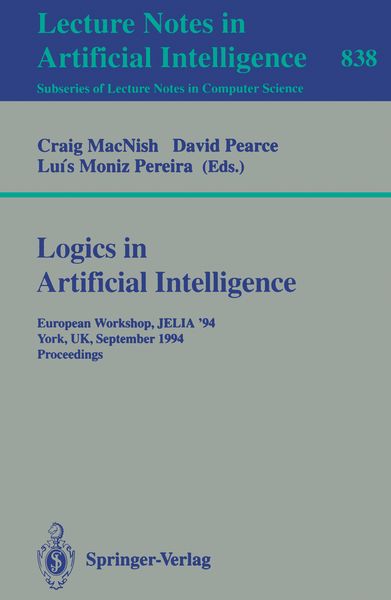
Logics in Artificial Intelligence European Workshop, JELIA '94, York, UK, September 5-8, 1994. Proceedings

51,99 €

inkl. gesetzl. MwSt., Versandkostenfrei


Beschreibung

Produktdetails

Einband

Taschenbuch

Erscheinungsdatum

10.08.1994

Herausgeber

Craig MacNish + weitere

Verlag

Springer Berlin

Seitenzahl

416

Maße (L/B/H)

23,5/15,5/2,3 cm

Gewicht

651 g

Auflage

1994

Sprache

Englisch

ISBN

978-3-540-58332-5

Beschreibung

Produktdetails

Einband

Taschenbuch

Erscheinungsdatum

10.08.1994

Herausgeber

Verlag

Springer Berlin

Seitenzahl

416

Maße (L/B/H)

23,5/15,5/2,3 cm

Gewicht

651 g

Auflage

1994

Sprache

Englisch

ISBN

978-3-540-58332-5

Herstelleradresse

Springer-Verlag KG
Sachsenplatz 4-6
1201 Wien
AT

Email: GPSR Kontakt

Noch keine Bewertungen vorhanden

Verfassen Sie die erste Bewertung zu diesem Artikel

Helfen Sie anderen Kundinnen und Kunden durch Ihre Meinung.

Kundinnen und Kunden meinen

Bewertungen (0)

  • Produktbild: Logics in Artificial Intelligence
  • Produktbild: Logics in Artificial Intelligence
  • From Carnap's modal logic to autoepistemic logic.- Compactness properties of nonmonotonic inference operations.- Around a powerful property of circumscriptions.- The computational value of joint consistency.- Belief dynamics, abduction, and databases.- On the logic of theory base change.- Belief, provability, and logic programs.- Revision specifications by means of programs.- Revision of non-monotonic theories.- A complete connection calculus with rigid E-unification.- Equality and constrained resolution.- Efficient strategies for Automated reasoning in modal logics.- TAS-D++: Syntactic trees transformations for Automated Theorem Proving.- A unification of ordering refinements of resolution in classical logic.- Two logical dimensions.- Prioritized autoepistemic logic.- Adding priorities and specificity to default logic.- Viewing hypothesis theories as constrained graded theories.- Temporal theories of reasoning.- Reasoning about knowledge on computation trees.- Prepositional state event logic.- Description Logics with inverse roles, functional restrictions, and n-ary relations.- On the concept of generic object: A nonmonotonic reasoning approach and examples.- Autoepistemic logic of minimal beliefs.- How to use modalities and sorts in Prolog.- Towards resource handling in logic programming: The PPL framework and its semantics.- Extending Horn clause theories by reflection principles.