Gutscheinbedingungen

**Gültig am 28.09.2026 auf fremdsprachige Bücher online auf thalia.at und in der Thalia App. Einzelne Artikel können ausgeschlossen sein. Ausgenommen sind preisgebundene Artikel & eBooks. Pro Einkauf einmal einlösbar. Click & Collect nur bei Onlinevorabzahlung möglich. Keine Barauszahlung. Nicht kombinierbar mit anderen Aktionen und Gutscheinen. Gutschein wird auf max. 500€ Bestellwert angerechnet. Nicht gültig für Geschenkkarten, Versandkosten und Services.

  • Produktbild: Conceptual Modeling - ER 2001
  • Produktbild: Conceptual Modeling - ER 2001
Band 2224

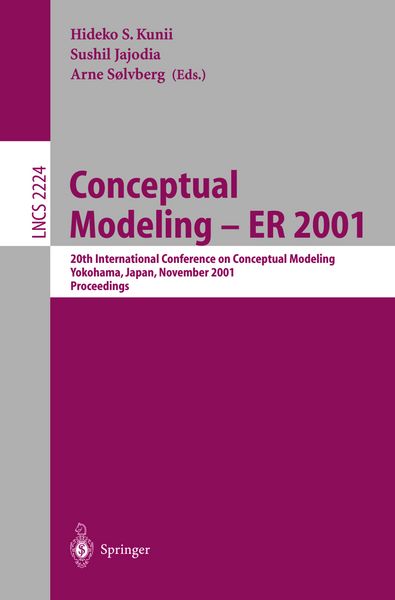
Conceptual Modeling - ER 2001 20th International Conference on Conceptual Modeling, Yokohama, Japan, November 27-30, 2001, Proceedings

99,99 €

inkl. gesetzl. MwSt., Versandkostenfrei


Beschreibung

Produktdetails

Einband

Taschenbuch

Erscheinungsdatum

14.11.2001

Abbildungen

XX, 620 p. 212 illus., 4 illus. in color.

Herausgeber

Hideko S. Kunii + weitere

Verlag

Springer Berlin

Seitenzahl

620

Maße (L/B/H)

23,5/15,5/3,9 cm

Gewicht

1072 g

Auflage

2001

Sprache

Englisch

ISBN

978-3-540-42866-4

Beschreibung

Produktdetails

Einband

Taschenbuch

Erscheinungsdatum

14.11.2001

Abbildungen

XX, 620 p. 212 illus., 4 illus. in color.

Herausgeber

Verlag

Springer Berlin

Seitenzahl

620

Maße (L/B/H)

23,5/15,5/3,9 cm

Gewicht

1072 g

Auflage

2001

Sprache

Englisch

ISBN

978-3-540-42866-4

Herstelleradresse

Springer-Verlag KG
Sachsenplatz 4-6
1201 Wien
AT

Email: ProductSafety@springernature.com

Noch keine Bewertungen vorhanden

Verfassen Sie die erste Bewertung zu diesem Artikel

Helfen Sie anderen Kundinnen und Kunden durch Ihre Meinung.

Kundinnen und Kunden meinen

Bewertungen (0)

  • Produktbild: Conceptual Modeling - ER 2001
  • Produktbild: Conceptual Modeling - ER 2001
  • Keynote.- Conceptual Modeling for Collaborative E-business Processes.- “i-mode”, Now & Future.- The Role of Research in the New Economy.- Panel.- Semantic B2B Integration: Is Modeling the Superior Approach over Programming?.- Spatial Database.- Modeling Topological Constraints in Spatial Part-Whole Relationships.- Source Description-Based Approach for the Modeling of Spatial Information Integration.- Topological Relationships of Complex Points and Complex Regions.- Spatial and Temporal Databases.- DISTIL: A Design Support Environment for Conceptual Modeling of Spatio-temporal Requirements.- Tripod: A Comprehensive Model for Spatial and Aspatial Historical Objects.- A Design of Topological Predicates for Complex Crisp and Fuzzy Regions.- XML.- A Semantic Approach to XML-based Data Integration.- A Rule-Based Conversion of a DTD to a Conceptual Schema.- Semantic Data Modeling Using XML Schemas.- Information Modeling.- Modelling Strategic Actor Relationships to Support Intellectual Property Management.- SiteLang: Conceptual Modeling of Internet Sites.- A Frame Work for Modeling Electronic Contracts.- Database Design.- CASE Tool Support for Temporal Database Design.- Domain-Specific Metadata a Key for Building Semantically-Rich Schema Models.- Coping with Inconsistent Constraint Specifications.- Data Integration.- Integration of Biological Data and Quality-Driven Source Negotiation.- Accessing Data Integration Systems through Conceptual Schemas.- Resolving Conflicts and Handling Replication during Integration of Multiple Databases by Object Deputy Model.- Data Warehouse.- Efficient Execution of Range-Aggregate Queries in Data Warehouse Environments.- A Pragmatic Approach to Conceptual Modeling of OLAP Security.- A Randomized Approach for the Incremental Design of anEvolving Data Warehouse.- UML.- Semantics of Stereotypes for Type Specification in UML: Theory and Practice.- Towards Ontologically Based Semantics for UML Constructs.- Developing Sequence Diagrams in UML.- Conceptual Models.- Translation of a High-Level Temporal Model into Lower Level Models: Impact of Modelling at Different Description Levels.- Relationship Type Refinement in Conceptual Models with Multiple Classification.- A Metamodel for Part ñ Whole Relationships for Reasoning on Missing Parts and Reconstruction.- System Design.- Developing XML Documents with Guaranteed “Good” Properties.- Dimension Hierarchies Design from UML Generalizations and Aggregations.- Minimize Mark-Up! Natural Writing Should Guide the Design of Textual Modeling Frontends.- Method Reengineering and Video Databases.- An Approach for Method Reengineering.- Modeling and Structuring Multiple Perspective Video for Browsing.- Modeling Dynamic Objects in Video Databases: A Logic Based Approach.- Workflows.- Pockets of Flexibility in Workflow Specification.- Agent-Oriented Enterprise Modeling Based on Business Rules.- A Three-Layer Model for Workflow Semantic Recovery in an Object-Oriented Environment.- Web Information System.- Recognizing Ontology-Applicable Multiple-Record Web Documents.- Querying Web Information Systems.- A Conceptual Modelling Framework for Standards-Driven Web-Based Distance Learning.- Applications.- XML-schema Dynamic Mapped Multimedia Content Description Tool.- Constructing a Data Map of Korea Telecom.- Competency of Set Analysis in CRM Closed Loop Marketing.- Software Engineering.- XML-based E2E Test Report Management.- A Framework for Reusing Business Objects by Multilevel Object Patterns.- A Mediation System Based on Universal Relation Modeling.