Gutscheinbedingungen

**Gültig bis 17.08.2026 auf Schreibwaren & Office-Artikel online auf thalia.at, in der Thalia App und in teilnehmenden Thalia Buchhandlungen in Österreich mit Schulsortiment. In den Buchhandlungen nur gültig auf lagernde Ware. Einzelne Artikel können ausgeschlossen sein. Ausgenommen sind preisgebundene Artikel. Pro Einkauf einmal einlösbar. Nur gültig gegen Vorlage oder im Onlineshop hinterlegter Bonuscard. Infos zur Einlösung in der Buchhandlung sind auf der Bonuscard-Vorteilspreisseite zu finden. Click & Collect nur bei Onlinevorabzahlung möglich. Keine Einlösung bei Scan & Go-Bezahlung. Keine Barauszahlung. Nicht kombinierbar mit anderen Aktionen und Gutscheinen. Gutschein wird auf max. 500€ Bestellwert angerechnet. Nicht gültig für Geschenkkarten, Versandkosten und Services.

  • Produktbild: Number Theory
  • Produktbild: Number Theory

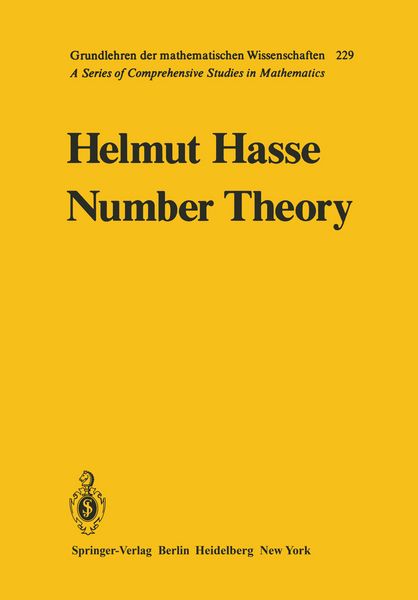
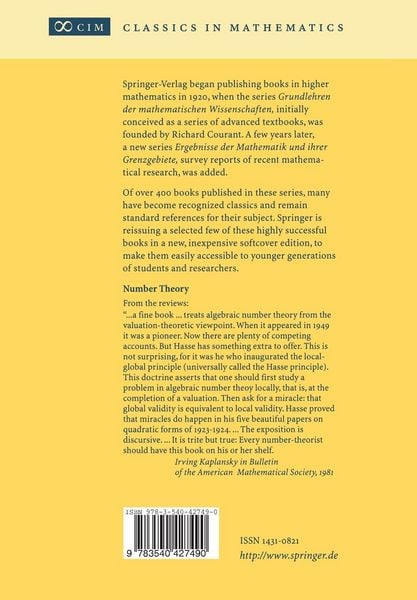
Number Theory

Aus der Reihe Classics in Mathematics

56,99 €

inkl. gesetzl. MwSt., Versandkostenfrei


Beschreibung

Produktdetails

Einband

Taschenbuch

Erscheinungsdatum

10.01.2002

Verlag

Springer Berlin

Seitenzahl

640

Maße (L/B/H)

24,4/17/3,6 cm

Gewicht

1126 g

Auflage

1980

Übersetzt von

H.G. Zimmer

Sprache

Englisch

ISBN

978-3-540-42749-0

Beschreibung

Produktdetails

Einband

Taschenbuch

Erscheinungsdatum

10.01.2002

Verlag

Springer Berlin

Seitenzahl

640

Maße (L/B/H)

24,4/17/3,6 cm

Gewicht

1126 g

Auflage

1980

Übersetzt von

H.G. Zimmer

Sprache

Englisch

ISBN

978-3-540-42749-0

Herstelleradresse

Springer-Verlag KG
Sachsenplatz 4-6
1201 Wien
AT

Email: GPSR Kontakt

Noch keine Bewertungen vorhanden

Verfassen Sie die erste Bewertung zu diesem Artikel

Helfen Sie anderen Kundinnen und Kunden durch Ihre Meinung.

Kundinnen und Kunden meinen

Bewertungen (0)

  • Produktbild: Number Theory
  • Produktbild: Number Theory
  • Part I. The Foundations of Arthmetic in the Rational Number Field:
    Chapter 1 Prime Decomposition
    Chapter 2 Divisibility
    Chapter 3 Congruences
    Chapter 4 The Structure of the Residue Class Ring mod m and the Reduces Residue Class Group mod m.
    Chapter 5 Quadratic Residues

    Part II. The Theory of Valued Fields
    Chapter 6 The Fundamental Concepts Regarding Valuations
    Chapter 7 Arithmetic in a Discrete Valued Field
    Chapter 8 The Completition of a Valued Field
    Chapter 9 The Completition of a Discrete Valued Field. The p-adic Number Fields
    Chapter 10 The Isomorphism Types of Complete Discrete Valued Fields with Perfect Residue Class Field
    Chapter 11 Prolongation of the Discrete Valuation to a Purely Transcendental Extension
    Chapter 12 Prolongation of the Valuation of a Complete Field to a Finite Algebraic Extension
    Chapter 13 The Isomorphism Types of Complete Archidemean Valued Fields
    Chapter 14 The Structure of a Finite-Algebraic Extension of a Complete Discrete Valued Field
    Chapter 15 The Structure of the Multiplicative Group of a Complete Discrete Valued Field with Perfect Residue Class Fields of Prime Characteristic
    Chapter 16 The Tamely Ramified Extension Types of a Complete Discrete Valued Fields with Finite Residue Class Field of Characteristic p
    Chapter 17 The Exponential Function, the Logarithm, and Powers in a Complete Non-Archimedean Valued Field of Characteristic 0
    Chapter 18 Prolongation of the Valuation of a Non-Complete Field to a Finite-Algebraic Extension

    Part III. The Foundations of Arithmetic Algebraic Number Fields
    Chapter 19 Relations Between the Complete System of Valuations and the Arithmetic of the Rational Number Field
    Chapter 20 Prolongation of the Complete System of Valuations to a Finite-Algebraic Extension
    Chapter 21 The Prime Spots of an Algebraic Number Field and their Completions
    Chapter 22 Decomposition into Prime Divisors, Integrality, and Divisibility
    Chapter 23 Congruences
    Chapter 24 The Multiples of a Divisor
    Chapter 25 Differents and Discriminants
    Chapter 26 Quadratic Number Fields
    Chapter 27 Cyclotomic Fields
    Chapter 28 Units
    Chapter 29 The Class Number
    Chapter 30 Approximation Theorems and Estimates of the Discriminant
    Index of Names
    Subject Index