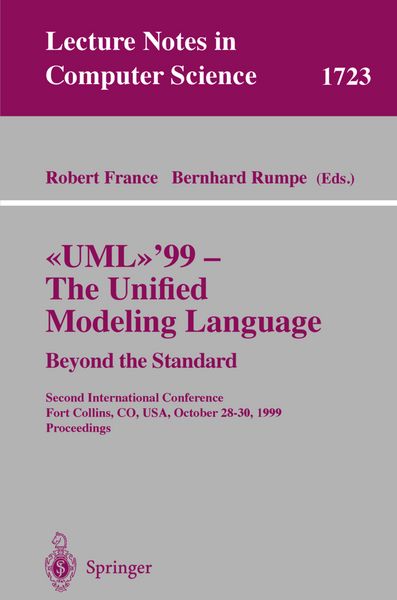

UML'99 - The Unified Modeling Language: Beyond the Standard Second International Conference, Fort Collins, CO, USA, October 28-30, 1999, Proceedings
-
- Englisch ausgewählt
99,99 €
inkl. gesetzl. MwSt.,
Beschreibung
Produktdetails
Einband
Taschenbuch
Erscheinungsdatum
15.10.1999
Abbildungen
XVII, 726 p.
Herausgeber
Robert B. France + weitereVerlag
Springer BerlinSeitenzahl
726
Maße (L/B/H)
23,5/15,5/4 cm
Gewicht
1112 g
Auflage
1999
Sprache
Englisch
ISBN
978-3-540-66712-4
Invited Talk 1 (Abstract).- Architecting Web-Based Systems with the Unified Modeling Language.- Software Architecture.- Extending Architectural Representation in UML with View Integration.- Enabling the Refinement of a Software Architecture into a Design.- Using the UML for Architectural Description.- UML and Other Notations.- Viewing the OML as a Variant of the UML.- A Comparison of the Business Object Notation and the Unified Modeling Language.- Formalizing the UML Class Diagram Using Object-Z.- Formalizing Interactions.- A Formal Approach to Collaborations in the Unified Modeling Language.- A Formal Semantics for UML Interactions.- Panel 1.- UML 2.0 Architectural Crossroads: Sculpting or Mudpacking?.- Meta-Modeling.- Core Meta-Modelling Semantics of UML: The pUML Approach.- A Metamodel for OCL.- Tools.- Tool-Supported Compression of UML Class Diagrams.- A Pragmatic Approach for Building a User-Friendly and Flexible UML Model Repository.- Components.- Modeling Dynamic Software Components in UML.- Extending UML for Modeling Reflective Software Components.- UML Extension Mechanisms.- Nine Suggestions for Improving UML Extensibility.- A Classification of Stereotypes for Object-Oriented Modeling Languages.- First-Class Extensibility for UML - Packaging of Profiles, Stereotypes, Patterns.- Process Modeling.- UML-Based Fusion Analysis.- Using UML for Modelling the Static Part of a Software Process.- Framework for Describing UML Compatible Development Processes.- Invited Talk 2.- On the Behavior of Complex Object-Oriented Systems.- Real-Time Systems.- UML-RT as a Candidate for Modeling Embedded Real-Time Systems in the Telecommunication Domain.- Modeling Hard Real Time Systems with UML The OOHARTS Approach.- UML Based Performance Modeling Framework for Object-OrientedDistributed Systems.- Constraint Languages.- Defining the Context of OCL Expressions.- Mixing Visual and Textual Constraint Languages.- Correct Realizations of Interface Constraints with OCL.- Analyzing UML Models 1.- Generating Tests from UML Specifications.- Formalising UML State Machines for Model Checking.- Panel 2.- SDL as UML: Why and What Panel.- Coding 1.- UML Behavior: Inheritance and Implementation in Current Object-Oriented Languages.- UML Collaboration Diagrams and Their Transformation to Java.- Analyzing UML Models 2.- Towards Three-Dimensional Representation and Animation of UML Diagrams.- Typechecking UML Static Models.- Precise Behavioral Modeling.- Analysing UML Use Cases as Contracts.- Closing the Gap between Object-Oriented Modeling of Structure and Behavior.- Static Modeling.- Black and White Diamonds.- Interconnecting Objects via Contracts.- How Can a Subsystem Be Both a Package and a Classifier?.- Applying the UML.- Using UML/OCL Constraints for Relational Database Design.- Towards a UML Extension for Hypermedia Design.- Why Unified Is not Universal.- Sequence Diagrams.- Timed Sequence Diagrams and Tool-Based Analysis - A Case Study.- Timing Analysis of UML Sequence Diagrams.- Coding 2.- The Normal Object Form: Bridging the Gap from Models to Code.- Modeling Exceptional Behavior.- Panel 3.- Advanced Methods and Tools for a Precise UML.
Noch keine Bewertungen vorhanden
Verfassen Sie die erste Bewertung zu diesem Artikel
Helfen Sie anderen Kundinnen und Kunden durch Ihre Meinung.
Kurze Frage zu unserer Seite
Vielen Dank für Ihr Feedback
Wir nutzen Ihr Feedback, um unsere Produktseiten zu verbessern. Bitte haben Sie Verständnis, dass wir Ihnen keine Rückmeldung geben können. Falls Sie Kontakt mit uns aufnehmen möchten, können Sie sich aber gerne an unseren Kund*innenservice wenden.
zum Kundenservice