Gutscheinbedingungen

**Gültig bis 14.09.2026 auf Spielzeug, Schreibwaren, Filme, Geschenke & Trends, Musik, tolino eReader & Zubehör, Hörbücher, nicht preisgebundene Bücher und Kalender in der Thalia App. Einzelne Artikel können ausgeschlossen sein. Aufgrund der Buchpreisbindung sind deutschsprachige Bücher und eBooks ausgenommen. Zusätzlich ausgenommen sind Abos & Flatrates, Games, Geschenkkarten/-boxen, Shelfies, Software, Zeitschriften sowie einzelne Artikel von tonies®. Pro Einkauf einmal einlösbar. Nur gültig mit im Onlineshop hinterlegter Bonuscard. Click & Collect nur bei Onlinevorabzahlung möglich. Keine Barauszahlung. Nicht kombinierbar mit anderen Aktionen und Gutscheinen. Gutschein wird auf max. 500€ Bestellwert angerechnet. Nicht gültig für Versandkosten und Services.

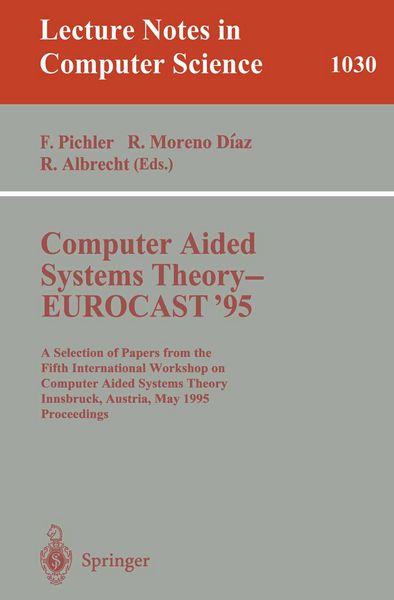
  • Produktbild: Computer Aided Systems Theory - EUROCAST '95
  • Produktbild: Computer Aided Systems Theory - EUROCAST '95
Band 1030

Computer Aided Systems Theory - EUROCAST '95 A Selection of Papers from the Fifth International Workshop on Computer Aided Systems Theory, Innsbruck, Austria, May 22 - 25, 1995. Proceedings

51,99 €

inkl. gesetzl. MwSt., Versandkostenfrei


Beschreibung

Produktdetails

Einband

Taschenbuch

Erscheinungsdatum

24.01.1996

Abbildungen

XIII, 547 p.

Herausgeber

Franz Pichler + weitere

Verlag

Springer Berlin

Seitenzahl

547

Maße (L/B/H)

23,5/15,5/3 cm

Gewicht

838 g

Auflage

1996

Sprache

Englisch

ISBN

978-3-540-60748-9

Beschreibung

Produktdetails

Einband

Taschenbuch

Erscheinungsdatum

24.01.1996

Abbildungen

XIII, 547 p.

Herausgeber

Verlag

Springer Berlin

Seitenzahl

547

Maße (L/B/H)

23,5/15,5/3 cm

Gewicht

838 g

Auflage

1996

Sprache

Englisch

ISBN

978-3-540-60748-9

Herstelleradresse

Springer-Verlag KG
Sachsenplatz 4-6
1201 Wien
AT

Email: ProductSafety@springernature.com

Noch keine Bewertungen vorhanden

Verfassen Sie die erste Bewertung zu diesem Artikel

Helfen Sie anderen Kundinnen und Kunden durch Ihre Meinung.

Kundinnen und Kunden meinen

Bewertungen (0)

  • Produktbild: Computer Aided Systems Theory - EUROCAST '95
  • Produktbild: Computer Aided Systems Theory - EUROCAST '95
  • On the structure of discrete systems.- Identification and recognition through shape in complex systems.- A logical approach to system construction.- Task management system.- Toward a unified theory of discrete event systems.- Intersensorial transformations: General systems description and implications.- Proving system properties by means of trigger-graph and Petri nets.- Refinement mapping for general (discrete event) systems theory.- A system-theoretic approach to planning and programming.- Equality of functions in CAST.- Basins of attraction estimation through symbolic graphical computing techniques.- Temporal and functional verification of a symbolic representation of complex systems.- Modelling differential equations by basic information technology means.- System theoretic aspects of software architectures.- A language for describing complex-evolutive software systems.- An architecture for process modelling and execution support.- A formal semantics for a graphical model representation in system design.- A user-interface for a microsystems high-level simulator.- CAST extensions to DASME to support Generalized Information Theory.- Symbolic computing aided design of nonlinear PID controllers.- Discrete Event simulation in an environment for Temporal Expert Systems.- TOMSPIN — a tool for modelling with stochastic petri nets.- Hybrid evolutionary programming: The tools for CAST.- Automatic induction of DEVS structures.- Systems Engineering and infrastructures for open computer based systems.- Object-oriented high level modeling of complex systems.- Multifacetted, object oriented modeling in the transportation domain.- EaSy-Sim: A tool environment for the design of complex, real-time systems.- Systems level specification and modelling of reactive systems: Concepts,methods, and tools.- DEVS-based endomorphic agents: Control through deliberative and reactive planning.- Software processes, work flow and work cell design — Separated by a common paradigm?.- High-performance parallel computing for analyzing urban air pollution.- Performance analysis of a dual robot system using a geometric concurrency model.- Computer aided rule extraction from examples.- Cast methods for generation of non-orthogonal complete transforms.- Cast system approach for visual inspection.- Finite dimensional generalized baker dynamical systems for cryptographic applications.- of the Aristotle's final causation in CAST concept and method of incursion and hyperincursion.- A semantic logic for CAST related to Zuse, Deutsch and McCulloch and Pitts computing principles.- Validation of a model of an AGVs scheduling heuristic using radio-taxi data.- Training simulator for Garoña Nuclear Power Plant.- Supervisory control and data acquisition system for the gas flow networks.