
• Produktbild: Intelligent Vision Systems for Industry
  • Produktbild: Intelligent Vision Systems for Industry

Intelligent Vision Systems for Industry

149,99 €

inkl. gesetzl. MwSt., Versandkostenfrei


Beschreibung

Produktdetails

Einband

Gebundene Ausgabe

Erscheinungsdatum

30.04.1997

Abbildungen

XXI, 457 p.

Verlag

Springer Berlin

Seitenzahl

457

Maße (L/B/H)

24,1/16/3,4 cm

Gewicht

969 g

Auflage

1997

Sprache

Englisch

ISBN

978-3-540-19969-4

Beschreibung

Produktdetails

Einband

Gebundene Ausgabe

Erscheinungsdatum

30.04.1997

Abbildungen

XXI, 457 p.

Verlag

Springer Berlin

Seitenzahl

457

Maße (L/B/H)

24,1/16/3,4 cm

Gewicht

969 g

Auflage

1997

Sprache

Englisch

ISBN

978-3-540-19969-4

Herstelleradresse

Springer-Verlag KG
Sachsenplatz 4-6
1201 Wien
AT

Email: ProductSafety@springernature.com

Noch keine Bewertungen vorhanden

Verfassen Sie die erste Bewertung zu diesem Artikel

Helfen Sie anderen Kundinnen und Kunden durch Ihre Meinung.

Kundinnen und Kunden meinen

Bewertungen (0)

  • Produktbild: Intelligent Vision Systems for Industry
  • Produktbild: Intelligent Vision Systems for Industry
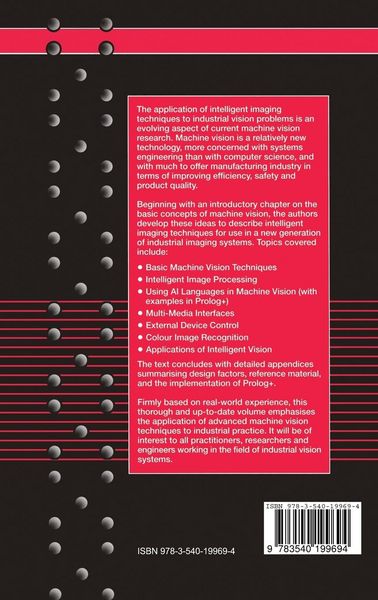
  • 1 Basic Concepts.- 1.1 Industrial Vision Systems.- 1.2 Systems Engineering.- 1.3 Intelligent Vision.- 1.4 Book Outline.- 2 Basic Machine Vision Techniques.- 2.1 Representations of Images.- 2.2 Elementary Image Processing Functions.- 2.3 Binary Images.- 2.4 Binary Mathematical Morphology.- 2.5 Grey Scale Morphology.- 2.6 Global Image Transforms.- 2.7 Texture Analysis.- 2.8 Implementation Considerations.- 2.9 Commercial Devices.- 2.10 Further Remarks.- 3 Intelligent Image Processing.- 3.1 Interactive Image Processing.- 3.2 Introducing PrologH-.- 3.3 Review of Prolog.- 3.4 The Nature of Prolog+.- 3.5 Prolog+Programs.- 3.6 Abstract Concepts in Prolog+.- 3.7 Implementation of Prolog+.- 3.8 Comments.- 4 Enhanced Intelligent Systems.- 4.1 Prolog+ Environment: A Tool-box for Machine Vision.- 4.2 Understanding Simple Spoken Instructions.- 4.3 Aids for Designing Vision Systems.- 4.4 Multi-camera Systems.- 4.5 Comments.- 5 Controlling External Devices.- 5.1 Devices and Signals.- 5.2 Protocols and Signals.- 5.3 Programmable Logic Controller.- 5.4 General Purpose Interface Unit.- 5.5 Flexible Inspection Cell, Design Issues.- 5.6 Prolog+ Predicates for Device Control.- 5.7 System Calibration.- 5.8 Picking up a Randomly Placed Object (Overhead Camera).- 5.9 Grippers.- 5.10 Summary.- 6 Colour Image Recognition.- 6.1 Introduction.- 6.2 Applications of Coarse Colour Discrimination.- 6.3 Why is a Banana Yellow?.- 6.4 Machines for Colour Discrimination.- 6.5 Ways of Thinking about Colour.- 6.6 Programmable Colour Filter (PCF).- 6.7 Colour Recognition in Prolog+ Programs.- 6.8 Discussion and Conclusions.- 7 Applications of Intelligent Vision.- 7.1 Recognition of Printed Patterns.- 7.2 Manipulation of Planar Objects.- 7.3 Packing and Depletion.- Blob Packing.- Polygon Packing.- Predicates.-7.4 Handedness of Mirror-Image Components.- Relating Chirality and Handedness.- Formal Definition.- Generating Concavity Trees.- Sample Concavity Trees.- Canonical Form of Concavity Trees.- Program to find Chirality.- Instability.- 7.5 Telling the Time.- 7.6 Food and Agricultural Products.- 8 Concluding Remarks.- References.- A Proverbs, Opinions and Folklore.- B Factors to be Considered when Designing a Vision System.- C General Reference Material.- D PIP — Software Implementation of Prolog+.- E Prolog+ and PIP Commands.- Glossary of Terms.- Index of Predicates, Operators and Grammar Rules.