KI-Beratung Beta

Gutscheinbedingungen

**Gültig bis 11.11.2026 auf Spielzeug, Schreibwaren, Filme, Geschenke & Trends, Musik, tolino eReader & Zubehör, Hörbücher und Hörbuch-Downloads, nicht preisgebundene Bücher und Kalender online auf thalia.at und in der Thalia App. Einzelne Artikel können ausgeschlossen sein. Aufgrund der Buchpreisbindung sind deutschsprachige Bücher und eBooks ausgenommen. Zusätzlich ausgenommen sind Abos & Flatrates, Games, Geschenkkarten/-boxen, Shelfies, Software, Zeitschriften sowie einzelne Artikel von tonies®. Pro Einkauf einmal einlösbar. Click & Collect nur bei Onlinevorabzahlung möglich. Keine Barauszahlung. Nicht kombinierbar mit anderen Aktionen und Gutscheinen. Gutschein wird auf max. 500€ Bestellwert angerechnet. Nicht gültig für Versandkosten und Services.

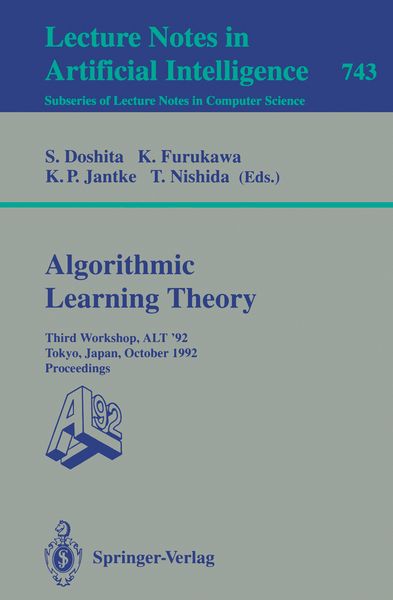
  • Produktbild: Algorithmic Learning Theory - ALT '92
  • Produktbild: Algorithmic Learning Theory - ALT '92
Band 743

Algorithmic Learning Theory - ALT '92 Third Workshop, ALT '92, Tokyo, Japan, October 20-22, 1992. Proceedings

51,99 €

inkl. gesetzl. MwSt., Versandkostenfrei


Beschreibung

This volume contains the papers that were presented at theThird Workshop onAlgorithmic Learning Theory, held in Tokyoin October 1992. In addition to 3invited papers, the volumecontains 19 papers accepted for presentation, selected from29 submitted extended abstracts. The ALT workshops have beenheld annually...

Beschreibung

This volume contains the papers that were presented at theThird Workshop onAlgorithmic Learning Theory, held in Tokyoin October 1992. In addition to 3invited papers, the volumecontains 19 papers accepted for presentation, selected from29 submitted extended abstracts. The ALT workshops have beenheld annually since 1990 and are organized and sponsored bythe Japanese Society for Artificial Intelligence. The mainobjective of these workshops is to provide an open forum fordiscussions and exchanges of ideasbetween researchers fromvarious backgrounds in this emerging, interdisciplinaryfield of learning theory. The volume is organized into partson learning via query, neural networks, inductive inference,analogical reasoning, and approximate learning.

Produktdetails

Einband

Taschenbuch

Erscheinungsdatum

20.10.1993

Abbildungen

XII, 264 p.

Herausgeber Shuji Doshita + weitere

Produktdetails

Einband

Taschenbuch

Erscheinungsdatum

20.10.1993

Abbildungen

XII, 264 p.

Herausgeber
Verlag Springer Berlin
Seitenzahl

264

Maße (L/B/H)

23,5/15,5/1,6 cm

Gewicht

423 g

Auflage

1993

Sprache

Englisch

ISBN

978-3-540-57369-2

Herstelleradresse

Springer-Verlag KG
Sachsenplatz 4-6
1201 Wien
AT

Email: ProductSafety@springernature.com

Noch keine Bewertungen vorhanden

Verfassen Sie die erste Bewertung zu diesem Artikel

Helfen Sie anderen Kundinnen und Kunden durch Ihre Meinung.

Kundinnen und Kunden meinen

Bewertungen (0)

  • Produktbild: Algorithmic Learning Theory - ALT '92
  • Produktbild: Algorithmic Learning Theory - ALT '92
  • Discovery learning in intelligent tutoring systems.- From inductive inference to algorithmic learning theory.- A stochastic approach to genetic information processing.- On learning systolic languages.- A note on the query complexity of learning DFA.- Polynomial-time MAT learning of multilinear logic programs.- Iterative weighted least squares algorithms for neural networks classifiers.- Domains of attraction in autoassociative memory networks for character pattern recognition.- Regularization learning of neural networks for generalization.- Competitive learning by entropy minimization.- Inductive inference with bounded mind changes.- Efficient inductive inference of primitive Prologs from positive data.- Monotonic language learning.- Prudence in vacillatory language identification (Extended abstract).- Implementation of heuristic problem solving process including analogical reasoning.- Planning with abstraction based on partial predicate mappings.- Learning k-term monotone Boolean formulae.- Some improved sample complexity bounds in the probabilistic PAC learning model.- An application of Bernstein polynomials in PAC model.- On PAC learnability of functional dependencies.- Protein secondary structure prediction based on stochastic-rule learning.- Notes on the PAC learning of geometric concepts with additional information.