
KI-Beratung Beta

  • Produktbild: How Landscapes Change
  • Produktbild: How Landscapes Change
Band 162 - 12%

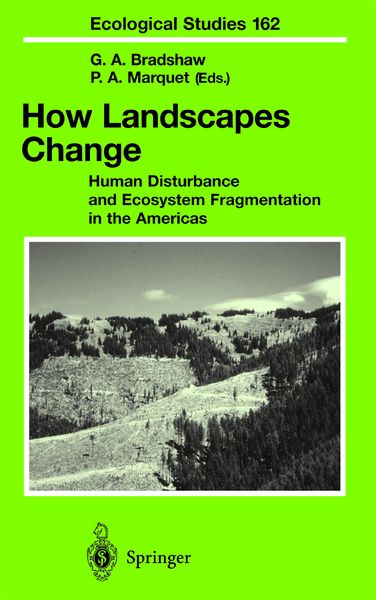
How Landscapes Change Human Disturbance and Ecosystem Fragmentation in the Americas

Aus der Reihe Ecological Studies
12% sparen

192,99 € UVP 219,99 €

inkl. gesetzl. MwSt., Versandkostenfrei


Beschreibung

Produktdetails

Einband

Gebundene Ausgabe

Erscheinungsdatum

06.12.2002

Abbildungen

XXI, 362 p.

Herausgeber

Gay A. Bradshaw + weitere

Verlag

Springer Berlin

Seitenzahl

362

Maße (L/B/H)

24,1/16/2,9 cm

Gewicht

766 g

Auflage

2003

Sprache

Englisch

ISBN

978-3-540-43697-3

Beschreibung

Rezension

"A very useful book for the library." (Bulletin of the British Ecological Society) 

Produktdetails

Einband

Gebundene Ausgabe

Erscheinungsdatum

06.12.2002

Abbildungen

XXI, 362 p.

Herausgeber

Verlag

Springer Berlin

Seitenzahl

362

Maße (L/B/H)

24,1/16/2,9 cm

Gewicht

766 g

Auflage

2003

Sprache

Englisch

ISBN

978-3-540-43697-3

Herstelleradresse

Springer-Verlag GmbH
Europaplatz 3
69115 Heidelberg
DE

Email: ProductSafety@springernature.com

Noch keine Bewertungen vorhanden

Verfassen Sie die erste Bewertung zu diesem Artikel

Helfen Sie anderen Kundinnen und Kunden durch Ihre Meinung.

Kundinnen und Kunden meinen

Bewertungen (0)

Weitere Artikel finden Sie in

  • Produktbild: How Landscapes Change
  • Produktbild: How Landscapes Change
  • I Causes and Processes of Landscape Fragmentation.- 1 Biodiversity and Human Intervention During the Last 11,000 Years in North-Central Chile.- 2 Beyond Malthus and Perverse Incentives: Economic Globalization, Forest Conversion and Habitat Fragmentation.- 3 Forest Fragmentation and Biodiversity in Central Amazonia.- 4 Climatic and Human Influences on Fire Regimes in Temperate Forest Ecosystems in North and South America.- 5 Natural Versus Anthropogenic Sources of Amazonian Biodiversity: the Continuing Quest for El Dorado.- II Ecological and Evolutionary Consequences of Fragmentation.- 6 Bees Not to Be? Responses of Insect Pollinator Faunas and Flower Pollination to Habitat Fragmentation.- 7 Implications of Evolutionary and Ecological Dynamics to the Genetic Analysis of Fragmentation.- 8 Forest Fragmentation, Plant Regeneration and Invasion Processes Across Edges in Central Chile.- 9 The Ecological Consequences of a Fragmentation-Mediated Invasion: The Argentine Ant, Linepithema humile, in Southern California.- III Ecosystem Fragmentation: Theory, Methods, and Implications for Conservation.- 10 A Review and Synthesis of Conceptual Frameworks for the Study of Forest Fragmentation.- 11 Reflections on Landscape Experiments and Ecological Theory: Tools for the Study of Habitat Fragmentation.- 12 Spatial Autocorrelation, Dispersal and the Maintenance of Source-Sink Populations.- 13 Patch Dynamics, Habitat Degradation and Space in Metapopulations.- 14 How Much Functional Redundancy Is Out There, or, Are We Willing to Do Away with Potential Backup Species?.- 15 Predicting Distributions of South American Migrant Birds in Fragmented Environments: A Possible Approach Based on Climate.- 16 Habitat Heterogeneity on a Forest-Savanna Ecotone in Noel Kempff Mercado National Park (SantaCruz, Bolivia): Implications for the Long-Term Conservation of Biodiversity in a Changing Climate.- 17 Bandages for Wounded Landscapes: Faunal Corridors and Their Role in Wildlife Conservation in the Americas.- 18 Management of the Semi-Natural Matrix.- Human Disturbance and Ecosystem Fragmentation in the Americas Synthesis and Final Reflections.