Gutscheinbedingungen

**Gültig bis 06.07.2026 auf fremdsprachige Bücher online auf thalia.at, in der Thalia App ab einem Mindestbestellwert von 30€ und in allen Thalia Buchhandlungen in Österreich. In den Buchhandlungen nur gültig auf lagernde Ware. Einzelne Artikel können ausgeschlossen sein. Ausgenommen sind preisgebundene Artikel & eBooks. Pro Einkauf einmal einlösbar. Nur gültig gegen Vorlage oder im Onlineshop hinterlegter Bonuscard. Infos zur Einlösung in der Buchhandlung sind auf der Bonuscard-Vorteilspreisseite zu finden. Click & Collect nur bei Onlinevorabzahlung möglich. Keine Einlösung bei Scan & Go-Bezahlung. Keine Barauszahlung. Nicht kombinierbar mit anderen Aktionen und Gutscheinen. Gutschein wird auf max. 500€ Bestellwert angerechnet. Nicht gültig für Versandkosten und Services.

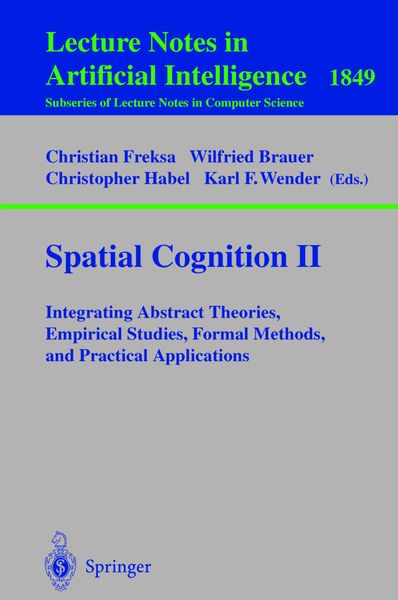
Produktbild: Spatial Cognition II

Spatial Cognition II Integrating Abstract Theories, Empirical Studies, Formal Methods, and Practical Applications

51,99 €

inkl. gesetzl. MwSt., Versandkostenfrei


Beschreibung

Produktdetails

Einband

Taschenbuch

Erscheinungsdatum

24.05.2000

Herausgeber

Christian Freksa + weitere

Verlag

Springer Berlin

Seitenzahl

424

Maße (L/B/H)

23,5/15,5/2,7 cm

Gewicht

743 g

Auflage

2000

Sprache

Englisch

ISBN

978-3-540-67584-6

Beschreibung

Produktdetails

Einband

Taschenbuch

Erscheinungsdatum

24.05.2000

Herausgeber

Verlag

Springer Berlin

Seitenzahl

424

Maße (L/B/H)

23,5/15,5/2,7 cm

Gewicht

743 g

Auflage

2000

Sprache

Englisch

ISBN

978-3-540-67584-6

Herstelleradresse

Springer-Verlag KG
Sachsenplatz 4-6
1201 Wien
AT

Email: GPSR Kontakt

Noch keine Bewertungen vorhanden

Verfassen Sie die erste Bewertung zu diesem Artikel

Helfen Sie anderen Kundinnen und Kunden durch Ihre Meinung.

Kundinnen und Kunden meinen

Bewertungen (0)

  • Produktbild: Spatial Cognition II
  • Maps and Diagrams.- Cognitive Zoom: From Object to Path and Back Again.- Monitoring Change: Characteristics of Dynamic Geo-spatial Phenomena for Visual Exploration.- The Use of Maps, Images and “Gestures” for Navigation.- Schematizing Maps: Simplification of Geographic Shape by Discrete Curve Evolution.- Schematic Maps as Wayfinding Aids.- Some Ways that Maps and Diagrams Communicate.- Spatial Communication with Maps: Defining the Correctness of Maps Using a Multi-Agent Simulation.- Schematic Maps for Robot Navigation.- Motion and Spatial Reference.- From Motion Observation to Qualitative Motion Representation.- Lexical Specifications of Paths.- Visual Processing and Representation of Spatio-temporal Patterns.- Orienting and Reorienting in Egocentric Mental Models.- Investigating Spatial Reference Systems through Distortions in Visual Memory.- Spatial Relations and Spatial Inference.- Towards Cognitive Adequacy of Topological Spatial Relations.- Interactive Layout Generation with a Diagrammatic Constraint Language.- Inference and Visualization of Spatial Relations.- A Topological Calculus for Cartographic Entities.- The Influence of Linear Shapes on Solving Interval-Based Configuration Problems.- Navigation in Real and Virtual Spaces.- Transfer of Spatial Knowledge from Virtual to Real Environments.- Coarse Qualitative Descriptions in Robot Navigation.- Oblique Angled Intersections and Barriers: Navigating through a Virtual Maze.- Modelling Navigational Knowledge by Route Graphs.- Using Realistic Virtual Environments in the Study of Spatial Encoding.- Navigating Overlapping Virtual Worlds: Arriving in One Place and Finding that You’re Somewhere Else.- Spatial Memory.- Influences of Context on Memory for Routes.- Preparing a Cup of Tea and Writing a Letter: Do Script-Based Actions Influence the Representation of a Real Environment?.- Action Related Determinants of Spatial Coding in Perception and Memory.- Investigation of Age and Sex Effects in Spatial Cognitions as Assessed in a Locomotor Maze and in a 2-D Computer Maze.