KI-Beratung Beta

Gutscheinbedingungen

**Gültig bis 11.11.2026 auf Spielzeug, Schreibwaren, Filme, Geschenke & Trends, Musik, tolino eReader & Zubehör, Hörbücher und Hörbuch-Downloads, nicht preisgebundene Bücher und Kalender online auf thalia.at und in der Thalia App. Einzelne Artikel können ausgeschlossen sein. Aufgrund der Buchpreisbindung sind deutschsprachige Bücher und eBooks ausgenommen. Zusätzlich ausgenommen sind Abos & Flatrates, Games, Geschenkkarten/-boxen, Shelfies, Software, Zeitschriften sowie einzelne Artikel von tonies®. Pro Einkauf einmal einlösbar. Click & Collect nur bei Onlinevorabzahlung möglich. Keine Barauszahlung. Nicht kombinierbar mit anderen Aktionen und Gutscheinen. Gutschein wird auf max. 500€ Bestellwert angerechnet. Nicht gültig für Versandkosten und Services.

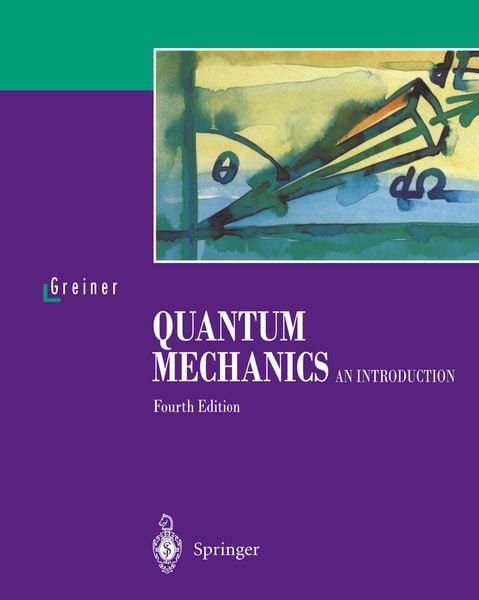
  • Produktbild: Quantum Mechanics
  • Produktbild: Quantum Mechanics
- 11%

Quantum Mechanics An Introduction

11% sparen

87,99 € UVP 98,99 €

inkl. gesetzl. MwSt., Versandkostenfrei


Beschreibung

Quantum Mechanics - An Introduction lays the foundations for the rest of the course on quantum mechanics, advanced quantum mechanics, and field theory. Starting from black-body radiation, the photoelectric effect, and wave-particle duality, Greiner goes on to discuss the uncertainty relations, spin,...

Beschreibung

Quantum Mechanics - An Introduction lays the foundations for the rest of the course on quantum mechanics, advanced quantum mechanics, and field theory. Starting from black-body radiation, the photoelectric effect, and wave-particle duality, Greiner goes on to discuss the uncertainty relations, spin, and many-body systems; he includes applications to the hydrogen atom and the Stern-Gerlach and Einstein-de Haas experiments. The mathematics of representation theory, S matrices, perturbation theory, eigenvalue problems, and hypergeometric differential equations are presented in detail, with 88 fully and carefully worked examples and exercises to consolidate the material. The text starts with the historical and phenomenological background and then carefully builds up the wave mechanical treatment of matter. This fourth edition includes improved explanatory remarks, a total of 88 fully worked examples, and more exercises


Produktdetails

Einband

Taschenbuch

Erscheinungsdatum

04.10.2000

Abbildungen

XXII, 486 p. 14 illus.

Verlag Springer Berlin

Produktdetails

Einband

Taschenbuch

Erscheinungsdatum

04.10.2000

Abbildungen

XXII, 486 p. 14 illus.

Verlag Springer Berlin
Seitenzahl

486

Maße (L/B/H)

24,2/19,3/2,8 cm

Gewicht

977 g

Auflage

Fourth Edition 2001

Sprache

Englisch

ISBN

978-3-540-67458-0

Herstelleradresse

Springer-Verlag KG
Sachsenplatz 4-6
1201 Wien
AT

Email: ProductSafety@springernature.com

Noch keine Bewertungen vorhanden

Verfassen Sie die erste Bewertung zu diesem Artikel

Helfen Sie anderen Kundinnen und Kunden durch Ihre Meinung.

Kundinnen und Kunden meinen

Bewertungen (0)

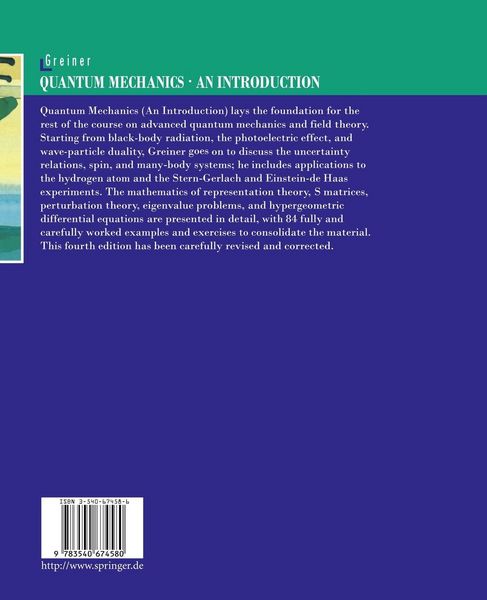
  • Produktbild: Quantum Mechanics
  • Produktbild: Quantum Mechanics
  • 1 The Quantization of Physical Quantities.- 1.1 Light Quanta.- 1.2 The Photoelectric Effect.- 1.3 The Compton Effect.- 1.4 The Ritz Combination Principle.- 1.5 The Franck-Hertz Experiment.- 1.6 The Stern-Gerlach Experiment.- 1.7 Biographical Notes.- 2 The Radiation Laws.- 2.1 A Preview of the Radiation of Bodies.- 2.2 What is Cavity Radiation?.- 2.3 The Rayleigh-Jeans Radiation Law: The Electromagnetic Eigenmodes of a Cavity.- 2.4 Planck’s Radiation Law.- 2.5 Biographical Notes.- 3 Wave Aspects of Matter.- 3.1 De Broglie Waves.- 3.2 The Diffraction of Matter Waves.- 3.3 The Statistical Interpretation of Matter Waves.- 3.4 Mean (Expectation) Values in Quantum Mechanics.- 3.5 Three Quantum Mechanical Operators.- 3.6 The Superposition Principle in Quantum Mechanics.- 3.7 The Heisenberg Uncertainty Principle.- 3.8 Biographical Notes.- 4 Mathematical Foundations of Quantum Mechanics I.- 4.1 Properties of Operators.- 4.2 Combining Two Operators.- 4.3 Bra and Ket Notation.- 4.4 Eigenvalues and Eigenfunctions.- 4.5 Measurability of Different Observables at Equal Times.- 4.6 Position and Momentum Operators.- 4.7 Heisenberg’s Uncertainty Relations for Arbitrary Observables.- 4.8 Angular-Momentum Operators.- 4.9 Kinetic Energy.- 4.10 Total Energy.- 4.11 Biographical Notes.- 5 Mathematical Supplement.- 5.1 Eigendifferentials and the Normalization of Eigenfunctions for Continuous Spectra.- 5.2 Expansion into Eigenfunctions.- 6 The Schrödinger Equation.- 6.1 The Conservation of Particle Number in Quantum Mechanics.- 6.2 Stationary States.- 6.3 Properties of Stationary States.- 6.4 Biographical Notes.- 7 The Harmonic Oscillator.- 7.1 The Solution of the Oscillator Equation.- 7.2 The Description of the Harmonic Oscillator by Creation and Annihilation Operators.- 7.3 Properties of the Operators â and â+.- 7.4 Representation of the Oscillator Hamiltonian in Terms of â and â+.- 7.5 Interpretation of â and â+.- 7.6 Biographical Notes.- 8 The Transition from Classical to Quantum Mechanics.- 8.1 Motion of the Mean Values.- 8.2 Ehrenfest’s Theorem.- 8.3 Constants of Motion, Laws of Conservation.- 8.4 Quantization in Curvilinear Coordinates.- 8.5 Biographical Notes.- 9 Charged Particles in Magnetic Fields.- Coupling to the Electromagnetic Field.- 9.1 The Hydrogen Atom.- 9.2 Three-Dimensional Electron Densities.- 9.3 The Spectrum of Hydrogen Atoms.- 9.4 Currents in the Hydrogen Atom.- 9.5 The Magnetic Moment.- 9.6 Hydrogen-like Atoms.- 9.7 Biographical Notes.- 10 The Mathematical Foundations of Quantum Mechanics II.- 10.1 Representation Theory.- 10.2 Representation of Operators.- 10.3 The Eigenvalue Problem.- 10.4 Unitary Transformations.- 10.5 The S Matrix.- 10.6 The Schrödinger Equation in Matrix Form.- 10.7 The Schrödinger Representation.- 10.8 The Heisenberg Representation.- 10.9 The Interaction Representation.- 10.10 Biographical Notes.- 11 Perturbation Theory.- 11.1 Stationary Perturbation Theory.- 11.2 Degeneracy.- 11.3 The Ritz Variational Method.- 11.4 Time-Dependent Perturbation Theory.- 11.5 Time-Independent Perturbation.- 11.6 Transitions Between Continuum States.- 11.7 Biographical Notes.- 12 Spin.- 12.1 Doublet Splitting.- 12.2 The Einstein-de Haas Experiment.- 12.3 The Mathematical Description of Spin.- 12.4 Wave Functions with Spin.- 12.5 The Pauli Equation.- 12.6 Biographical Notes.- 13 A Nonrelativistic Wave Equation with Spin.- 13.1 The Linearization of the Schrödinger Equation.- 13.2 Particles in an External Field and the Magnetic Moment.- 14 Elementary Aspects of the Quantum-Mechanical Many-Body Problem.- 14.1 The Conservation of the Total Momentum of a Particle System.- 14.2 Centre-of-Mass Motion of a System of Particles in Quantum Mechanics.- 14.3 Conservation of Total Angular Momentum in a Quantum-Mechanical Many-Particle System.- 14.4 Small Oscillations in a Many-Particle System.- 14.5 Biographical Notes.- 15 Identical Particles.- 15.1 The Pauli Principle.- 15.2 Exchange Degeneracy.- 15.3 The Slater Determinant.- 15.4 Biographical Notes.- 16 The Formal Framework of Quantum Mechanics.- 16.1 The Mathematical Foundation of Quantum Mechanics: Hilbert Space.- 16.2 Operators in Hilbert Space.- 16.3 Eigenvalues and Eigenvectors.- 16.4 Operators with Continuous or Discrete-Continuous (Mixed) Spectra.- 16.5 Operator Functions.- 16.6 Unitary Transformations.- 16.7 The Direct-Product Space.- 16.8 The Axioms of Quantum Mechanics.- 16.9 Free Particles.- 16.10 A Summary of Perturbation Theory.- 17 Conceptual and Philosophical Problems of Quantum Mechanics..- 17.1 Determinism.- 17.2 Locality.- 17.3 Hidden-Variable Theories.- 17.4 Bell’s Theorem.- 17.5 Measurement Theory.- 17.6 Schrödinger’s Cat.- 17.7 Subjective Theories.- 17.8 Classical Measurements.- 17.9 The Copenhagen Interpretation.- 17.10 Indelible Recording.- 17.11 The Splitting Universe.- 17.12 The Problem of Reality.