KI-Beratung Beta

Gutscheinbedingungen

**Gültig am 20.11.2026 ab einem Mindestbestellwert von 30€ auf Spielzeug, Schreibwaren, Filme, Geschenke & Trends, Musik, tolino eReader & Zubehör, Hörbücher und Hörbuch-Downloads, nicht preisgebundene Bücher und Kalender online auf thalia.at und in der Thalia App. Einzelne Artikel können ausgeschlossen sein. Aufgrund der Buchpreisbindung sind deutschsprachige Bücher und eBooks ausgenommen. Zusätzlich ausgenommen sind Abos & Flatrates, Games, Geschenkkarten/-boxen, Shelfies, Software, Zeitschriften sowie einzelne Artikel von tonies®. Pro Einkauf einmal einlösbar. Click & Collect nur bei Onlinevorabzahlung möglich. Keine Barauszahlung. Nicht kombinierbar mit anderen Aktionen und Gutscheinen. Gutschein wird auf max. 500€ Bestellwert angerechnet. Nicht gültig für Versandkosten und Services. Preisgebundene Artikel sind vom Mindestbestellwert ausgeschlossen.

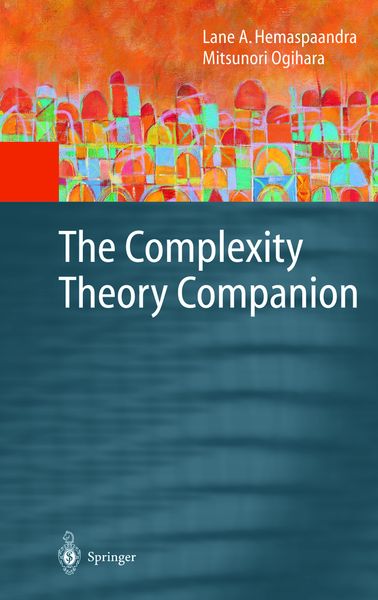
Produktbild: The Complexity Theory Companion
- 11%

The Complexity Theory Companion

11% sparen

77,99 € UVP 87,99 €

inkl. gesetzl. MwSt., Versandkostenfrei


Beschreibung

The Complexity Theory Companion is an accessible, algorithmically oriented, research-centered, up-to-date guide to some of the most interesting techniques of complexity theory.

The book's thesis is that simple algorithms are at the heart of complexity theory. From the tree-pruning and interval-pruning...

Beschreibung

The Complexity Theory Companion is an accessible, algorithmically oriented, research-centered, up-to-date guide to some of the most interesting techniques of complexity theory.

The book's thesis is that simple algorithms are at the heart of complexity theory. From the tree-pruning and interval-pruning algorithms that shape the first chapter to the query simulation procedures that dominate the last chapter, the central proof methods of the book are algorithmic. And to more clearly highlight the role of algorithmic techniques in complexity theory, the book is - unlike other texts on complexity - organized by technique rather than by topic. Each chapter of this book focuses on one technique: what it is, and what results and applications it yields.

This textbook was developed at the University of Rochester in courses given to graduate students and advanced undergraduates. Researchers also will find this book a valuable source of reference due to the comprehensive bibliography of close to five hundred entries, the thirty-five page subject index, and the appendices giving overviews of complexity classes and reductions.

Rezension

From the reviews of the first edition:


"The introduction … begins with two secrets: that algorithms are at the heart of complexity theory, and moreover that simple algorithms are at the heart of complexity theory. The main body of the book then proceeds to try and illustrate this view. … While all the chapters primarily deal with a succession of theorems, lemmas and proofs, the surrounding text makes it fairly accessible and readable. … The appendices are very well laid out and could probably replace a small library of textbooks." (A. Weaver, Journal of the Operational Research Society, Vol. 54, 2004)


"The book is intended for readers who seek an accessible, algorithmically oriented research-centered, up-to-date guide to several interesting techniques of computational complexity. In contrast to the organization of other books, each chapter of this book focuses on one particular technique in complexity theory. … The book contains two appendices, the first presenting a concise overview on complexity classes, the second one on reductions. The book presents a survey on a great variety of recent interesting techniques in complexity." (Ludwig Staiger, Zentralblatt MATH, Vol. 993, 2002)

Produktdetails

Einband

Gebundene Ausgabe

Erscheinungsdatum

01.12.2001

Abbildungen

XIII, 372 p.

Verlag Springer Berlin

Produktdetails

Einband

Gebundene Ausgabe

Erscheinungsdatum

01.12.2001

Abbildungen

XIII, 372 p.

Verlag Springer Berlin
Seitenzahl

372

Maße (L/B/H)

24,1/16/2,7 cm

Gewicht

694 g

Auflage

2002

Sprache

Englisch

ISBN

978-3-540-67419-1

Herstelleradresse

Springer-Verlag GmbH
Europaplatz 3
69115 Heidelberg
DE

Email: ProductSafety@springernature.com

Noch keine Bewertungen vorhanden

Verfassen Sie die erste Bewertung zu diesem Artikel

Helfen Sie anderen Kundinnen und Kunden durch Ihre Meinung.

Kundinnen und Kunden meinen

Bewertungen (0)

  • Produktbild: The Complexity Theory Companion
  • 1. The Self-Reducibility Technique.- 2. The One-Way Function Technique.- 3. The Tournament Divide and Conquer Technique.- 4. The Isolation Technique.- 5. The Witness Reduction Technique.- 6. The Polynomial Interpolation Technique.- 7. The Nonsolvable Group Technique.- 8. The Random Restriction Technique.- 9. The Polynomial Technique.- A. A Rogues’ Gallery of Complexity Classes.- B. A Rogues’ Gallery of Reductions.- References.