Gutscheinbedingungen

**Gültig bis 06.07.2026 auf fremdsprachige Bücher online auf thalia.at, in der Thalia App ab einem Mindestbestellwert von 30€ und in allen Thalia Buchhandlungen in Österreich. In den Buchhandlungen nur gültig auf lagernde Ware. Einzelne Artikel können ausgeschlossen sein. Ausgenommen sind preisgebundene Artikel & eBooks. Pro Einkauf einmal einlösbar. Nur gültig gegen Vorlage oder im Onlineshop hinterlegter Bonuscard. Infos zur Einlösung in der Buchhandlung sind auf der Bonuscard-Vorteilspreisseite zu finden. Click & Collect nur bei Onlinevorabzahlung möglich. Keine Einlösung bei Scan & Go-Bezahlung. Keine Barauszahlung. Nicht kombinierbar mit anderen Aktionen und Gutscheinen. Gutschein wird auf max. 500€ Bestellwert angerechnet. Nicht gültig für Versandkosten und Services.

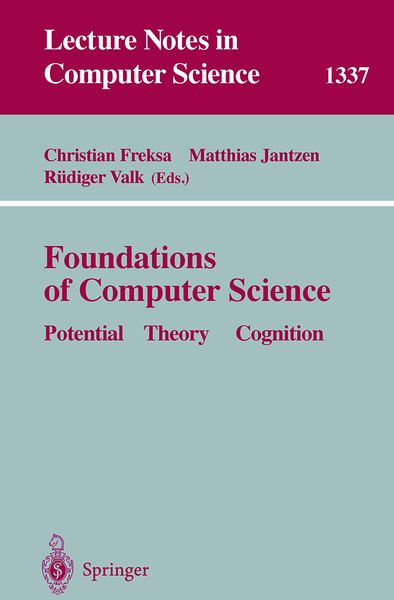
  • Produktbild: Foundations of Computer Science
  • Produktbild: Foundations of Computer Science
Band 1337

Foundations of Computer Science Potential-Theory-Cognition

99,99 €

inkl. gesetzl. MwSt., Versandkostenfrei


Beschreibung

Produktdetails

Einband

Taschenbuch

Erscheinungsdatum

24.10.1997

Herausgeber

Christian Freksa + weitere

Verlag

Springer Berlin

Seitenzahl

524

Maße (L/B/H)

23,5/15,5/2,8 cm

Gewicht

803 g

Auflage

1997

Sprache

Englisch

ISBN

978-3-540-63746-2

Beschreibung

Produktdetails

Einband

Taschenbuch

Erscheinungsdatum

24.10.1997

Herausgeber

Verlag

Springer Berlin

Seitenzahl

524

Maße (L/B/H)

23,5/15,5/2,8 cm

Gewicht

803 g

Auflage

1997

Sprache

Englisch

ISBN

978-3-540-63746-2

Herstelleradresse

Springer-Verlag KG
Sachsenplatz 4-6
1201 Wien
AT

Email: GPSR Kontakt

Noch keine Bewertungen vorhanden

Verfassen Sie die erste Bewertung zu diesem Artikel

Helfen Sie anderen Kundinnen und Kunden durch Ihre Meinung.

Kundinnen und Kunden meinen

Bewertungen (0)

  • Produktbild: Foundations of Computer Science
  • Produktbild: Foundations of Computer Science
  • The might of formulas and their limits.- Hardware — Software.- Defining discipline.- Computer science as cultural development.- Towards adjusting informatics education to information era.- Informatics and society: A curriculum for distance education.- Syntactic and semantic aspects of parallelism.- Unique fixpoints in complete lattices with applications to formal languages and semantics.- On abstract families of languages, power series, and elements.- Are there formal languages complete for SymSPACE(log n)?.- On twist-closed trios: A new morphic characterization of r.e. sets.- An automata approach to some problems on context-free grammars.- On aperiodic sets of Wang tiles.- Closure under complementation of logspace complexity classes - A survey -.- A relation between sparse and printable sets in NSPACE(log n).- A foundation for computable analysis.- A computer scientist's view of life, the universe, and everything.- Calendars and chronologies.- A uniform approach to Petri Nets.- Observing partial order runs of Petri Nets.- Representation theorems for Petri Nets.- A remark on trace equations.- Verification of distributed algorithms with algebraic Petri Nets.- A short story on action refinement.- Interactive and reactive systems: States, observations, experiments, input, output, nondeterminism, compositionality and all that.- Discrete time analysis of a state dependent tandem with different customer types.- How distributed algorithms play the token game.- The asynchronous stack revisited: Rounds set the twilight reeling.- Online scheduling of continuous media streams.- Contribution to Goodenough's and Gerhart's theory of software testing and verification: Relation between strong compiler test and compiler implementation verification.- On the arrangement complexity of uniform trees.- A relational-functional integration for declarative programming.- Inside and outside the Chinese room.- Abstract structures in spatial cognition.- Spatial and temporal structures in cognitive processes.- Qualitative vs. Fuzzy representations of spatial distance.- What's a part? On formalizing part-whole relations.- SPOCK: A feasibility study on the completeness of parts lists.- Decision support systems with adaptive reasoning strategies.- Knowledge discovery in databases — An inductive logic programming approach.- The composition heuristic.- The job assignment problem: A study in parallel and distributed machine learning.- Self-improving behavior arbitration.- Neural networks for manipulator path planning.- Path planning using a subgoal graph.- A nonlinear markovian characterization of time series using neural networks.- Feature-based perception of semantic concepts.- Automatic detection of thesaurus relations for information retrieval applications.- InfoSphere ? -V: a new approach to 3D-visualization of information.