Gutscheinbedingungen

**Gültig bis 25.06.2026 auf fremdsprachige Bücher online auf thalia.at und in der Thalia App. Einzelne Artikel können ausgeschlossen sein. Ausgenommen sind preisgebundene Artikel & eBooks. Pro Einkauf einmal einlösbar. Click & Collect nur bei Onlinevorabzahlung möglich. Keine Barauszahlung. Nicht kombinierbar mit anderen Aktionen und Gutscheinen. Gutschein wird auf max. 500€ Bestellwert angerechnet. Nicht gültig für Geschenkkarten, Versandkosten und Services.

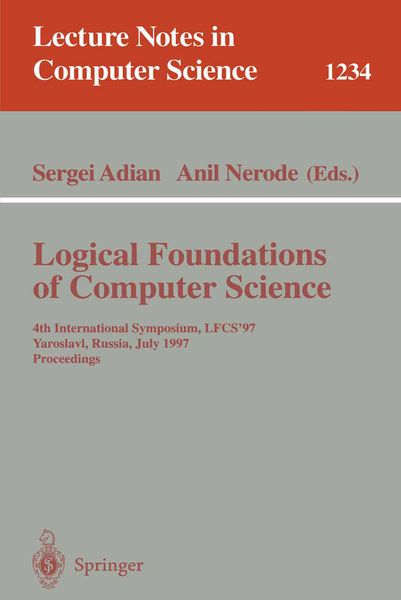
  • Produktbild: Logical Foundations of Computer Science
  • Produktbild: Logical Foundations of Computer Science
Band 1234

Logical Foundations of Computer Science 4th International Symposium, LFCS '97, Yaroslavl, Russia, July 6-12, 1997, Proceedings

51,99 €

inkl. gesetzl. MwSt., Versandkostenfrei


Beschreibung

Produktdetails

Einband

Taschenbuch

Erscheinungsdatum

28.05.1997

Herausgeber

Sergei Adian + weitere

Verlag

Springer Berlin

Seitenzahl

436

Maße (L/B/H)

23,5/15,5/2,4 cm

Gewicht

674 g

Auflage

1997

Sprache

Englisch

ISBN

978-3-540-63045-6

Beschreibung

Produktdetails

Einband

Taschenbuch

Erscheinungsdatum

28.05.1997

Herausgeber

Verlag

Springer Berlin

Seitenzahl

436

Maße (L/B/H)

23,5/15,5/2,4 cm

Gewicht

674 g

Auflage

1997

Sprache

Englisch

ISBN

978-3-540-63045-6

Herstelleradresse

Springer-Verlag GmbH
Tiergartenstr. 17
69121 Heidelberg
DE

Email: ProductSafety@springernature.com

Kundinnen und Kunden meinen

0 Bewertungen

Informationen zu Bewertungen

Zur Abgabe einer Bewertung ist eine Anmeldung im Konto notwendig. Die Authentizität der Bewertungen wird von uns nicht überprüft. Wir behalten uns vor, Bewertungstexte, die unseren Richtlinien widersprechen, entsprechend zu kürzen oder zu löschen.

Die Bewertungen sind nach Format, Anzahl Sterne und Datum sortiert.

Verfassen Sie die erste Bewertung zu diesem Artikel

Helfen Sie anderen Kund*innen durch Ihre Meinung

Kundinnen und Kunden meinen

0 Bewertungen filtern

  • Produktbild: Logical Foundations of Computer Science
  • Produktbild: Logical Foundations of Computer Science
  • Topological semantics for hybrid systems.- Domain-free pure type systems.- Generic queries over quasi-o-minimal domains.- Towards computing distances between programs via Scott domains.- A safe recursion scheme for exponential time.- Finite model theory, universal algebra and graph grammars.- Complexity of query answering in logic databases with complex values.- Recognition of deductive data base stability.- The concurrency complexity for the Horn fragment of linear logic.- Studying algorithmic problems for free semi-groups and groups.- Learning small programs with additional information.- Cut elimination for the second order propositional logic with Hilbert's ?-symbol, extensionality, and full comprehension.- Finite bases of admissible rules for the logic S52 C.- An algebraic correctness criterion for intuitionistic proof-nets.- Towards a theory of recursive structures.- On the complexity of prefix formulas in modal logic of subset spaces.- The undecidability of second order linear affine logic.- Operational logic of proofs with functionality condition on proof predicate.- On linear ordering of strongly extensional finitely-branching graphs and non-well-founded sets.- Functions for the general solution of parametric word equations.- A proof procedure for hereditary Harrop formulas with free equality.- Basic forward chaining construction for logic programs.- Decidability and undecidability of the halting problem on Turing machines, a survey.- Case study: Additive linear logic and lattices.- Some decision problems for traces.- Existential instantiation and strong normalization.- Models for the logic of proofs.- Interpretation of the full computation tree logic CTL* on sets of infinite sequences.- Type introduction for equational rewriting.- Capturing bisimulation-invariant Ptime.- Equivalence of multiplicative fragments of cyclic linear logic and noncommutative linear logic.- A decidable fragment of second order linear logic.- Some results on Propositional Dynamic Logic with fixed points.- Quasi-characteristic inference rules for modal logics.- Provability logic with operations on proofs.- Formal verification of logic programs: Foundations and implementation.- Unification of terms with term-indexed variables.- Back-forth equivalences for design of concurrent systems.- Association nets: An alternative formalization of common thinking.- Simulating ?-expansions with ?-reductions in the second-order polymorphic ?-rcalculus.- Logical schemes for first order theories.- Verification of PLTL formulae by means of monotone disjunctive normal forms.