
Gutscheinbedingungen

**Gültig bis 14.09.2026 auf Spielzeug, Schreibwaren, Filme, Geschenke & Trends, Musik, tolino eReader & Zubehör, Hörbücher, nicht preisgebundene Bücher und Kalender in der Thalia App. Einzelne Artikel können ausgeschlossen sein. Aufgrund der Buchpreisbindung sind deutschsprachige Bücher und eBooks ausgenommen. Zusätzlich ausgenommen sind Abos & Flatrates, Games, Geschenkkarten/-boxen, Shelfies, Software, Zeitschriften sowie einzelne Artikel von tonies®. Pro Einkauf einmal einlösbar. Nur gültig mit im Onlineshop hinterlegter Bonuscard. Click & Collect nur bei Onlinevorabzahlung möglich. Keine Barauszahlung. Nicht kombinierbar mit anderen Aktionen und Gutscheinen. Gutschein wird auf max. 500€ Bestellwert angerechnet. Nicht gültig für Versandkosten und Services.

  • Produktbild: Coordination Languages and Models
  • Produktbild: Coordination Languages and Models
Band 1061

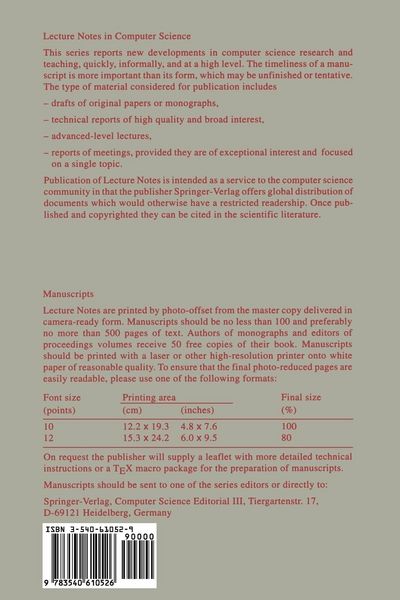
Coordination Languages and Models First International Conference, COORDINATION '96, Cesena, Italy, April 15-17, 1996. Proceedings.

51,99 €

inkl. gesetzl. MwSt., Versandkostenfrei


Beschreibung

Produktdetails

Einband

Taschenbuch

Erscheinungsdatum

03.04.1996

Abbildungen

XI, 452 p.

Herausgeber

Paolo Ciancarini + weitere

Verlag

Springer Berlin

Seitenzahl

452

Maße (L/B/H)

23,5/15,5/2,6 cm

Gewicht

703 g

Auflage

1996

Sprache

Englisch

ISBN

978-3-540-61052-6

Beschreibung

Produktdetails

Einband

Taschenbuch

Erscheinungsdatum

03.04.1996

Abbildungen

XI, 452 p.

Herausgeber

Verlag

Springer Berlin

Seitenzahl

452

Maße (L/B/H)

23,5/15,5/2,6 cm

Gewicht

703 g

Auflage

1996

Sprache

Englisch

ISBN

978-3-540-61052-6

Herstelleradresse

Springer-Verlag KG
Sachsenplatz 4-6
1201 Wien
AT

Email: ProductSafety@springernature.com

Noch keine Bewertungen vorhanden

Verfassen Sie die erste Bewertung zu diesem Artikel

Helfen Sie anderen Kundinnen und Kunden durch Ihre Meinung.

Kundinnen und Kunden meinen

Bewertungen (0)

  • Produktbild: Coordination Languages and Models
  • Produktbild: Coordination Languages and Models
  • Parallel multiset processing: From explicit coordination to chemical reaction.- Graph rewriting and constraint solving for modelling distributed systems with synchronization (extended abstract).- Coordination as constrained interaction (extended abstract).- The IWIM model for coordination of concurrent activities.- Sonia: An adaptation of Linda for coordination of activities in organizations.- The ToolBus coordination architecture.- Enhancing coordination and modularity mechanisms for a language with objects-as-multisets.- Towards a compositional method for coordinating Gamma programs.- Introducing a calculus for higher-order multiset programming.- ?2Log: Towards remote coordination.- A process algebra based on Linda.- Intra- and inter-object coordination with MESSENGERS.- Ariadne and HOPLa: Flexible coordination of collaborative processes.- Coordination in the ImpUnity framework.- Compiler correctness for concurrent languages.- A software environment for concurrent coordinated programming.- Designing a coordination model for open systems.- CCE: A process-calculus based formalism for specifying multi-object coordination.- An extensible framework for the development of coordinated applications.- Broadcasting in time.- Semantics of a higher-order coordination language.- Solving the Linda multiple rd problem.- Coordinating distributed objects with declarative interfaces.- Coordinating services in open distributed systems with Laura.- Visifold: A visual environment for a coordination language.- ALWAN: A skeleton programming language.- Weaving the Web using coordination.- Investigating strategies for cooperative planning of independent agents through prototype evaluation.- A case study of integration of a software process management system with software engineeringenvironments for process monitoring and management.- Nepi: A network programming language based on the ?-calculus.- Modelling interoperability by CHAM: A case study.- Integrating coordination features in PVM.- A simulator framework for embedded systems.- Understanding behavior of business process models.