KI-Beratung Beta

Gutscheinbedingungen

**Gültig bis 18.11.2026 auf englischsprachige Klassiker (klassiker-32728) online auf thalia.at und in der Thalia App. Einzelne Artikel können ausgeschlossen sein. Ausgenommen sind preisgebundene Artikel & eBooks. Pro Einkauf einmal einlösbar. Click & Collect nur bei Onlinevorabzahlung möglich. Keine Barauszahlung. Nicht kombinierbar mit anderen Aktionen und Gutscheinen. Gutschein wird auf max. 500€ Bestellwert angerechnet. Nicht gültig für Geschenkkarten, Versandkosten und Services.

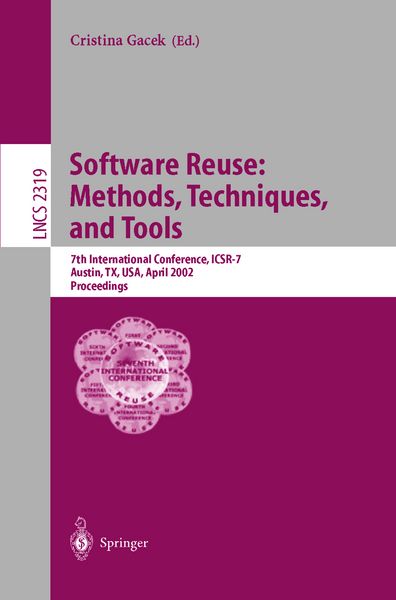
  • Produktbild: Software Reuse: Methods, Techniques, and Tools
  • Produktbild: Software Reuse: Methods, Techniques, and Tools
Band 2319

Software Reuse: Methods, Techniques, and Tools 7th International Conference, ICSR-7, Austin, TX, USA, April 15-19, 2002. Proceedings

51,99 €

inkl. gesetzl. MwSt., Versandkostenfrei


Beschreibung

As a result of the open-source movement there is now a great deal of reusable software available in the public domain. This offers significant functionality that commercial software vendors can use in their software projects. Open-source approaches to software development have illustrated that complex,...

Beschreibung

As a result of the open-source movement there is now a great deal of reusable software available in the public domain. This offers significant functionality that commercial software vendors can use in their software projects. Open-source approaches to software development have illustrated that complex, mission critical software can be developed by distributed teams of developers sharing a common goal. Commercial software vendors have an opportunity to both learn from the op- source community as well as leverage that knowledge for the benefit of its commercial clients. Nonetheless, the open-source movement is a diverse collection of ideas, knowledge, techniques, and solutions. As a result, it is far from clear how these approaches should be applied to commercial software engineering. This paper has looked at many of the dimensions of the open-source movement, and provided an analysis of the different opportunities available to commercial software vendors. References and Notes 1. It can be argued that the open-source community has produced really only two essential 9 products -- Apache (undeniably the most popular web server) and Linux although both are essentially reincarnations of prior systems. Both are also somewhat products of their times: Apache filled a hole in the then emerging Web, at a time no platform vendor really knew how to step in, and Linux filled a hole in the fragmented Unix market, colored by the community s general anger against Microsoft. 2.Evans Marketing Services, Linux Developers Survey, Volume 1, March 2000.

Produktdetails

Einband

Taschenbuch

Erscheinungsdatum

03.04.2002

Abbildungen

XII, 356 p.

Herausgeber Cristina Gacek

Produktdetails

Einband

Taschenbuch

Erscheinungsdatum

03.04.2002

Abbildungen

XII, 356 p.

Herausgeber Cristina Gacek
Verlag Springer Berlin
Seitenzahl

356

Maße (L/B/H)

23,5/15,5/2 cm

Gewicht

557 g

Auflage

2002

Sprache

Englisch

ISBN

978-3-540-43483-2

Herstelleradresse

Springer-Verlag KG
Sachsenplatz 4-6
1201 Wien
AT

Email: ProductSafety@springernature.com

Noch keine Bewertungen vorhanden

Verfassen Sie die erste Bewertung zu diesem Artikel

Helfen Sie anderen Kundinnen und Kunden durch Ihre Meinung.

Kundinnen und Kunden meinen

Bewertungen (0)

  • Produktbild: Software Reuse: Methods, Techniques, and Tools
  • Produktbild: Software Reuse: Methods, Techniques, and Tools
  • Integrating and Reusing GUI-Driven Applications.- Source Tree Composition.- Layered Development with (Unix) Dynamic Libraries.- Early-Reply Components: Concurrent Execution with Sequential Reasoning.- Concepts and Guidelines of Feature Modeling for Product Line Software Engineering.- Domain Modeling for World Wide Web Based Software Product Lines with UML.- Enhancing Component Reusability through Product Line Technology.- Modeling Variability with the Variation Point Model.- Reusing Open-Source Software and Practices: The Impact of Open-Source on Commercial Vendors.- Integrating Reference Architecture Definition and Reuse Investment Planning.- Control Localization in Domain Specific Translation.- Model Reuse with Metamodel-Based Transformations.- Generation of Text Search Applications for Databases. An Exercise on Domain Engineering.- Domain Networks in the Software Development Process.- Supporting Reusable Use Cases.- Project Management Knowledge Reuse through Scenario Models.- Adaptation of Coloured Petri Nets Models of Software Artifacts for Reuse.- Improving Hazard Classification through the Reuse of Descriptive Arguments.- Service Oriented Programming: A New Paradigm of Software Reuse.- An Empirical User Study of an Active Reuse Repository System.- Towards the Formalization of a Reusability Framework for Refactoring.- Service Facilities: Extending Abstract Factories to Decouple Advanced Dependencies.- Software Fortresses.- The Case against a Grand Unification Theory.- ICSR7 Young Researchers Workshop.- International Workshop on Reuse Economics.- Workshop on Generative Programming 2002 (GP2002).- ICSR7 Workshop on Component-Based Software Development Processes.- Industrial Experience with Product Line Approaches.- Workshop on Software Reuse and Agile Approaches.- Software Architecture Quality Analysis Methods.- Tutorial on Practical Product Line Scoping and Modeling.- Transformation Systems: Generative Reuse for Software Generation, Maintenance and Reengineering.- Component-Based Product-Line Engineering with the UML.- Building Reusable Test Assets for a Product Line.- Architecture-Centric Software Engineering.- Practical Strategies and Techniques for Adopting Software Product Lines.- Generative Programming: Methods, Techniques, and Applications Tutorial Abstract.