KI-Beratung Beta

Produktbild: Modeling and Using Context
Band 1688

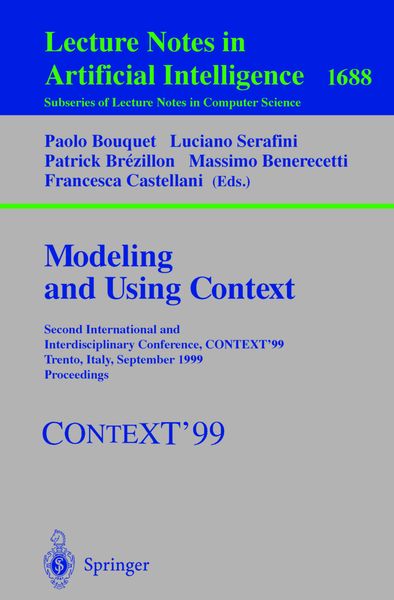
Modeling and Using Context Second International and Interdisciplinary Conference, CONTEXT'99, Trento, Italy, September 9-11, 1999, Proceedings

51,99 €

inkl. gesetzl. MwSt., Versandkostenfrei


Beschreibung

Produktdetails

Einband

Taschenbuch

Erscheinungsdatum

25.08.1999

Abbildungen

XII, 536 p.

Herausgeber

Paolo Bouquet + weitere

Verlag

Springer Berlin

Seitenzahl

536

Maße (L/B/H)

23,5/15,5/3 cm

Gewicht

820 g

Auflage

1999

Sprache

Englisch

ISBN

978-3-540-66432-1

Beschreibung

Portrait

The research of Professor P. Brézillon focuses since 1992 on the study of Intelligent Assistant Systems, and particularly the aspects as explanation, context, and incremental knowledge acquisition. Since several years, the emphasis of his studies is on the notion of context. Professor P. Brézillon is the instigator of the series of international and interdisciplinary conferences (biannual) on modeling and using context from 1997 (in Rio de Janeiro, Brasil) to 2019 (in Trento, Italy). He has published about 450 papers in international conferences and international journals (e.g., IEEE Expert, AI Magazine, The Knowledge Engineering Review, and the International Journal on Human-Computer Studies). He has been the chair of several workshops (at ECAI, IJCAI, etc.), co-organizer of two international conferences in the AI area, member of 191 program committees, and has given several invited talks and tutorials. Professor P. Brézillon is the Coordinator of about twenty real-world projects and participates in 40 contract managements. For example, the SART project with the subway company in Paris (France) is a real-world application dealing explicitly with context  from 1995 to 2002. The SART project met around 50 persons in France (Paris) and Brazil (Rio de Janeiro) for developing an intelligent assistant system to support the responsible of subway lines in incident situation. The French Foreign Ministry retained SART as a leader project in the France-Brazil cooperation. Professor P. Brézillon also intervenes in several projects in medicine, mainly around breast cancer diagnosis.

Produktdetails

Einband

Taschenbuch

Erscheinungsdatum

25.08.1999

Abbildungen

XII, 536 p.

Herausgeber

Verlag

Springer Berlin

Seitenzahl

536

Maße (L/B/H)

23,5/15,5/3 cm

Gewicht

820 g

Auflage

1999

Sprache

Englisch

ISBN

978-3-540-66432-1

Herstelleradresse

Springer-Verlag KG
Sachsenplatz 4-6
1201 Wien
AT

Email: ProductSafety@springernature.com

Noch keine Bewertungen vorhanden

Verfassen Sie die erste Bewertung zu diesem Artikel

Helfen Sie anderen Kundinnen und Kunden durch Ihre Meinung.

Kundinnen und Kunden meinen

Bewertungen (0)

  • Produktbild: Modeling and Using Context
  • Full Papers.- Strawson on Intended Meaning and Context.- Epistemic Context, Defeasible Inference and Conversational Implicature.- An Implemented Context System that Combines Belief Reasoning, Metaphor-Based Reasoning and Uncertainty Handling.- Pragmatic Reasoning: Inferring Contexts.- A Model of Context Adapted to Domain-Independent Machine Translation.- Three Forms of Contextual Dependence.- Context Representation for Dialogue Management.- Ecological Interfaces: Extending the Pointing Paradigm by Visual Context.- Formal Context and Morphological Analysis.- The Pragmatic Roots of Context.- Non-acceptances: Re- or Un-creating Context?.- Modelling (Un)Bounded Beliefs.- A Context-Based Logic for Distributed Knowledge Representation and Reasoning.- Independence from Context Information Provided by Spatial Signature Learning in a Natural Object Localization Task.- Contextual Dependence and the Epistemic Foundations of Dynamic Semantics.- Dynamics and Automaticity of Context: A Cognitive Modeling Approach.- A Mental Space Account for Speaker’s Empathy: Japanese Profiling Identity vs. English Shading Identity.- On the Role of Context in Relevance-Based Accessibility Ranking of Candidate Referents.- Contextual Inference in Computational Semantics.- Contexts and Views in Object-Oriented Languages.- Objective and Cognitive Context.- Dynamics Between Contextual Knowledge and Proceduralized Context.- A Context-Based Audiovisual Representation Model for Audiovisual Information Systems.- Putting Similarity Assessments into Context: Matching Functions with the User’s Intended Operations.- Presupposition, Implicature and Context in Text Understanding.- The Formal Structure of Ecological Contexts.- Type Theoretic Foundations for Context, Part 1: Contexts as Complex Type-TheoreticObjects.- Violation Contexts and Deontic Independence.- A Model of Explicit Context Representation and Use for Intelligent Agents.- Context-Scanning Strategy in Temporal Reasoning.- The Role of Context in the Analysis and Design of Agent Programs.- Context and Supercontext.- The Role of Context in Interpreting Perceived Events as Actions.- Short Papers.- Contexts, Domains, and Software.- Contextual Data and Domain Knowledge for Incorporation in Knowledge Discovery Systems.- The Differential (?) Processing of Literal and Nonliteral Speech Acts : A Psycholinguistic Approach.- Open Theories and Abduction for Context and Accommodation.- Context as Fuzzy Degrees of Acceptability for Knowledge Base Integrity.- Building Context with Intonation.- Parrot-Talk Requires Multiple Context Dimensions.- Contextual Divorces: Towards a Framework for Identifying Critical Context Issues in Collaborative-Argumentation System Design.- The Role of Context in Pronominal Reference to Higher Order Entities in English and Norwegian.- Connectionist Analysis and Creation of Context for Natural Language Understanding and Knowledge Management.- The Notion of Context in Organisational Memories.- The Effect of Context Complexity on the Memorisation of Objects.- Effects of Discourse Context on Inference Computation During Comprehension.- Counterfactual Reasoning by Means of a Calculus of Narrative Context.- Context and Decision Graphs for Incident Management on a Subway Line.- Using Context to Guide Information Search for Preventive Quality Management.- The Context-Dependency of Temporal Reference in Event Semantics.- How Context Contributes to Metaphor Understanding.- Exploiting Context in Gesture Recognition.- The Use of Context in the Analysis of Negative Concord and N-words.- Aspects of Context for Understanding Multi-modal Communication.