Gutscheinbedingungen

**Gültig bis 06.07.2026 auf fremdsprachige Bücher online auf thalia.at, in der Thalia App ab einem Mindestbestellwert von 30€ und in allen Thalia Buchhandlungen in Österreich. In den Buchhandlungen nur gültig auf lagernde Ware. Einzelne Artikel können ausgeschlossen sein. Ausgenommen sind preisgebundene Artikel & eBooks. Pro Einkauf einmal einlösbar. Nur gültig gegen Vorlage oder im Onlineshop hinterlegter Bonuscard. Infos zur Einlösung in der Buchhandlung sind auf der Bonuscard-Vorteilspreisseite zu finden. Click & Collect nur bei Onlinevorabzahlung möglich. Keine Einlösung bei Scan & Go-Bezahlung. Keine Barauszahlung. Nicht kombinierbar mit anderen Aktionen und Gutscheinen. Gutschein wird auf max. 500€ Bestellwert angerechnet. Nicht gültig für Versandkosten und Services.

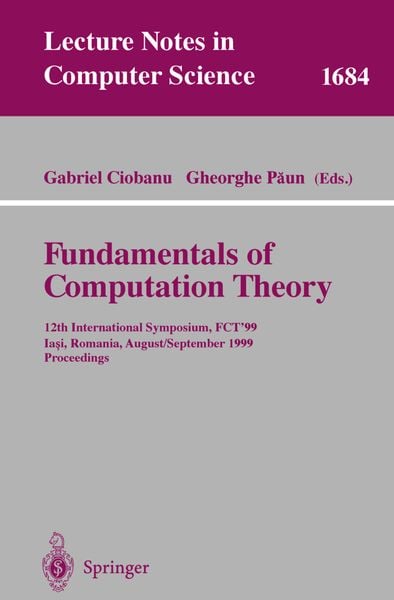
  • Produktbild: Fundamentals of Computation Theory
  • Produktbild: Fundamentals of Computation Theory
Band 1684

Fundamentals of Computation Theory 12th International Symposium, FCT'99 Iasi, Romania, August 30 - September 3, 1999 Proceedings

99,99 €

inkl. gesetzl. MwSt., Versandkostenfrei


Beschreibung

Produktdetails

Einband

Taschenbuch

Erscheinungsdatum

18.08.1999

Herausgeber

Gabriel Ciobanu + weitere

Verlag

Springer Berlin

Seitenzahl

576

Maße (L/B/H)

23,5/15,5/3,2 cm

Gewicht

879 g

Auflage

1999

Sprache

Englisch

ISBN

978-3-540-66412-3

Beschreibung

Produktdetails

Einband

Taschenbuch

Erscheinungsdatum

18.08.1999

Herausgeber

Verlag

Springer Berlin

Seitenzahl

576

Maße (L/B/H)

23,5/15,5/3,2 cm

Gewicht

879 g

Auflage

1999

Sprache

Englisch

ISBN

978-3-540-66412-3

Herstelleradresse

Springer-Verlag KG
Sachsenplatz 4-6
1201 Wien
AT

Email: GPSR Kontakt

Noch keine Bewertungen vorhanden

Verfassen Sie die erste Bewertung zu diesem Artikel

Helfen Sie anderen Kundinnen und Kunden durch Ihre Meinung.

Kundinnen und Kunden meinen

Bewertungen (0)

  • Produktbild: Fundamentals of Computation Theory
  • Produktbild: Fundamentals of Computation Theory
  • Randomized complexity of linear arrangements and polyhedra?.- Tile transition systems as structured coalgebras?.- Caesar and DNA — views on cryptology.- Automata and their interaction: Definitional suggestions.- Axiomatising asynchronous process calculi.- A polynomial time approximation scheme for dense MupIN 2S{upAT}.- Decidable classes of the verification problem in a timed predicate logic.- Interpretations of extensible objects and types.- Restrictive acceptance suffices for equivalence problems.- Grammar systems as language analyzers and recursively enumerable languages.- An interpretation of extensible objects.- Modeling operating systems schedulers with multi-stack-queue grammars.- Iterative arrays with a wee bit alternation.- Secret sharing schemes with detection of cheaters for a general access structure.- Constructive notes on uniform and locally convex spaces.- Graph automorphisms with maximal projection distances.- Kleene theorems for event-clock automata.- Strong iteration lemmata for regular, linear, context-free, and linear indexed languages.- Exponential output size of top-down tree transducers.- On recognizable languages in divisibility monoids.- Expressiveness of point-to-point versus broadcast communications.- On relative loss bounds in generalized linear regression.- Generalized P-systems.- Optimal, distributed decision-making: The case of no communication.- Generalized PCP is decidable for marked morphisms.- On time-constructible functions in one-dimensional cellular automata.- Dichotomy theorem for the generalized unique satisfiability problem.- A general categorical connection between local event structures and local traces.- Correct translation of mutually recursive function systems into TOL collage grammars.- Synchronized product of linear bounded machines.- On maximal repetitions in words.- Axiomatization of the coherence property for categories of symmetries.- Sewing grammars.- State and transition complexity of Watson-Crick finite automata.- A confluence result for a typed ?-calculus of exception handling with fixed-point.- ?-Uniformly decidable sets and turing machines.- A parallel context-free derivation hierarchy.- Generalized synchronization languages.- A generalization of Dijkstra’s calculus to typed program specifications.- Homomorphisms and concurrent term rewriting.- On two-sided infinite fixed points of morphisms.- Tiling multi-dimensional arrays.- Modeling interaction by sheaves and geometric logic.- The operators minCh and maxCh on the polynomial hierarchy.- The Kolmogorov complexity of real numbers.- A partial order method for the verification of time Petri nets.- Deriving formulas for domination numbers of fasciagraphs and rotagraphs.