KI-Beratung Beta

Gutscheinbedingungen

**Gültig am 20.11.2026 ab einem Mindestbestellwert von 30€ auf Spielzeug, Schreibwaren, Filme, Geschenke & Trends, Musik, tolino eReader & Zubehör, Hörbücher und Hörbuch-Downloads, nicht preisgebundene Bücher und Kalender online auf thalia.at und in der Thalia App. Einzelne Artikel können ausgeschlossen sein. Aufgrund der Buchpreisbindung sind deutschsprachige Bücher und eBooks ausgenommen. Zusätzlich ausgenommen sind Abos & Flatrates, Games, Geschenkkarten/-boxen, Shelfies, Software, Zeitschriften sowie einzelne Artikel von tonies®. Pro Einkauf einmal einlösbar. Click & Collect nur bei Onlinevorabzahlung möglich. Keine Barauszahlung. Nicht kombinierbar mit anderen Aktionen und Gutscheinen. Gutschein wird auf max. 500€ Bestellwert angerechnet. Nicht gültig für Versandkosten und Services. Preisgebundene Artikel sind vom Mindestbestellwert ausgeschlossen.

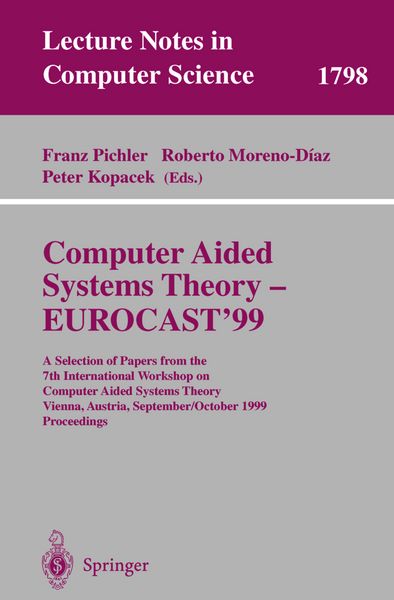
  • Produktbild: Computer Aided Systems Theory - EUROCAST'99
  • Produktbild: Computer Aided Systems Theory - EUROCAST'99
Band 1798

Computer Aided Systems Theory - EUROCAST'99 A Selection of Papers from the 7th International Workshop on Computer Aided Systems Theory Vienna, Austria, September 29 - October 2, 1999 Proceedings

99,99 €

inkl. gesetzl. MwSt., Versandkostenfrei


Beschreibung

Computer Aided Systems Theory (CAST) deals with the task of contributing to the creation and implementation of tools for the support of usual CAD tools for design and simulation by formal mathematical or logical means in modeling. Naturally,thebasisfortheconstructionandimplementationofCASTsoftwareis...

Beschreibung

Computer Aided Systems Theory (CAST) deals with the task of contributing to the creation and implementation of tools for the support of usual CAD tools for design and simulation by formal mathematical or logical means in modeling. Naturally,thebasisfortheconstructionandimplementationofCASTsoftwareis provided by the existing current knowledge in modeling and by the experience of practitioners in engineering design. Systems Theory, as seen from the viewpoint of CAST research and CAST tool development, has the role of providing formal frameworks and related theoretical knowledge for model-construction and model analysis. We purposely do not distinguish sharply between systems theory and CAST and other similar ?elds of research and tool development such as for example in applied numerical analysis or other computational sciences. TheheredocumentedEUROCASTconferencewhichtookplaceattheVienna University of Technology re?ects current mainstreams in CAST. As in the p- vious conferences new topics, both theoretical and application oriented, have been addressed. The presented papers show that the ?eld is widespread and that new - velopments in computer science and in information technology are the driving forces. Theeditorswouldliketothanktheauthorsforprovidingtheirmanuscriptsin hardcopyandinelectronicformontime.Thesta?ofSpringer-VerlagHeidelberg gave, as in previous CAST publications, valuable support in editing this volume.

Produktdetails

Einband

Taschenbuch

Erscheinungsdatum

26.07.2000

Abbildungen

X, 606 p.

Herausgeber Franz Pichler + weitere

Produktdetails

Einband

Taschenbuch

Erscheinungsdatum

26.07.2000

Abbildungen

X, 606 p.

Herausgeber
Verlag Springer Berlin
Seitenzahl

606

Maße (L/B/H)

23,5/15,5/3,4 cm

Gewicht

925 g

Auflage

2000

Sprache

Englisch

ISBN

978-3-540-67822-9

Herstelleradresse

Springer-Verlag KG
Sachsenplatz 4-6
1201 Wien
AT

Email: ProductSafety@springernature.com

Noch keine Bewertungen vorhanden

Verfassen Sie die erste Bewertung zu diesem Artikel

Helfen Sie anderen Kundinnen und Kunden durch Ihre Meinung.

Kundinnen und Kunden meinen

Bewertungen (0)

  • Produktbild: Computer Aided Systems Theory - EUROCAST'99
  • Produktbild: Computer Aided Systems Theory - EUROCAST'99
  • Survey Papers.- The Cast Project: Experiences and Future Perspectives.- Cast Methods in Biocybernetics.- On the Way to the Next Generation of Robots.- Conceptual Frameworks, Methods and Tools.- Representation of the RCS Reference Model Architecture Using an Architectural Description Language.- Conceptual Design, Functional Decomposition, Mathematical Modelling, and Perturbation Analysis.- AV-Petri Systems: How to Get Together Abstraction and Views for Petri Systems?.- Computer-Aided Analysis and Validation of Heterogeneous System Specifications.- Patterns for Embedded Systems Design.- Towards Verifying Distributed Systems Using Object-Oriented Petri Nets.- Representing Petri Nets in an Action Based Formalism.- Simplification of Proof Procedures Based on the Path Condition Concepts.- Parallel Processor Array for Tomographic Reconstruction Algorithms.- A Formalized Description Approach to Continuos Time Systems.- Modeling Complex Systems by Multi-agent Holarchies.- Partition of Systems by General System Logical Theory (GSLT).- Intelligent Robots.- Multiagent Approach to Intelligent Control of Robot.- Design of Competence Promoting Multi-Agent-Systems to Support the User in Fault Diagnosis of CNC-Machine Tools.- System Integration Techniques in Robotics.- Multi-processor Design of Non-linear Robust Motion Control for Rigid Robots.- Mobile Robot Path Planning Among Weighted Regions Using Quadtree Representations.- Matrix Model of Robot in Matlab – Simulink.- Modeling and Simulation.- Integrating Two Dynamic Models of Business-Logistics Plant.- Assembly Reengineering Model.- Design for Disassembly and Recycling for Small and Medium Sized Companies for the Next Generation.- Modeling the Emergence of Social Entities.- Simulating Social Grouping: An Interactive Team-BuildingTool (ITBT).- Sociological Aspects of Data Acquisition and Processing.- Efficient Concurrent Simulation of DEVS Systems Based on Concurrent Inference.- Simulation of Gaussian Processes and First Passage Time Densities Evaluation.- Distributed Simulation with Multimedia Interface.- Microscopic Randomness and “Fundamental Diagram” in the Traffic Flow Problem.- Floating Car Data Analysis of Urban Road Networks.- Information Lost in the Hologram Subdividing Process.- Systems Engineering and Software Development.- Electronic Performance Support Systems Challenges and Problems.- A Framework for the Elicitation, Evolution, and Traceability of System Requirements.- Development of a Precision Assembly System Using Selective Assembly and Micro Machining.- Computer Aided Planning System of a Flexible Microrobot-Based Microassembly Station.- A Formalisation of the Evolution of Software Systems.- HEDES: A System Theory Based Tool to Support Evolutionary Software Systems.- Vertical Partitioning Algorithms in Distributed Databases.- Decision Based Adaptive Model for Managing Software Development Projects.- A Fractal Software Complexity Metric Analyser.- Artificial Intelligent Systems and Control.- Systems Approach to Attention Mechanisms in the Visual Pathway.- On Completness in Early Vision from Systems Theory.- McCulloch Program II in Artificial Systems and Lastres Theorem.- A Medical Ontology for Integrating Case-Based Reasoning, Rule-Based Reasoning, and Patient Databases.- Uncertain Variables in the Computer Aided Analysis of Uncertain Systems.- Variable-Structure Learning Controllers.- An Identification Algorithmic Toolkit for Intelligent Control Systems.- Non Selective Gas Sensors and Artificial Neural Networks – Determination of Gas Mixtures.- The Supervision of HybridControl Systems – A Layered Architecture.- Automatic Players for Computer Games.