Gutscheinbedingungen

**Gültig bis 15.06.2026 auf Spiele & Spielzeug online auf thalia.at, in der Thalia App ab einem Mindestbestellwert von 30€ und in allen Thalia Buchhandlungen in Österreich. In den Buchhandlungen nur gültig auf lagernde Ware. Einzelne Artikel können ausgeschlossen sein. Ausgenommen sind preisgebundene Artikel sowie online auf thalia.at und in der Thalia App einzelne Artikel von tonies®. Pro Einkauf einmal einlösbar. Nur gültig gegen Vorlage oder im Onlineshop hinterlegter Bonuscard. Infos zur Einlösung in der Buchhandlung sind auf der Bonuscard-Vorteilspreisseite zu finden. Click & Collect nur bei Onlinevorabzahlung möglich. Keine Einlösung bei Scan & Go-Bezahlung. Keine Barauszahlung. Nicht kombinierbar mit anderen Aktionen und Gutscheinen. Gutschein wird auf max. 500€ Bestellwert angerechnet. Nicht gültig für Geschenkkarten, Versandkosten und Services.

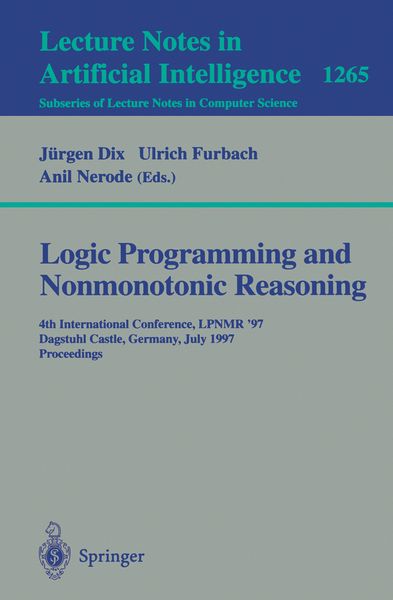
  • Produktbild: Logic Programming and Nonmonotonic Reasoning
  • Produktbild: Logic Programming and Nonmonotonic Reasoning

Logic Programming and Nonmonotonic Reasoning 4th International Conference, LPNMR '97, Dagstuhl Castle, Germany, July 28-31, 1997. Proceedings

51,99 €

inkl. gesetzl. MwSt., Versandkostenfrei


Beschreibung

Produktdetails

Einband

Taschenbuch

Erscheinungsdatum

02.07.1997

Herausgeber

Ulrich Furbach + weitere

Verlag

Springer Berlin

Seitenzahl

461

Maße (L/B/H)

23,5/15,5/2,5 cm

Gewicht

709 g

Auflage

1997

Sprache

Englisch

ISBN

978-3-540-63255-9

Beschreibung

Produktdetails

Einband

Taschenbuch

Erscheinungsdatum

02.07.1997

Herausgeber

Verlag

Springer Berlin

Seitenzahl

461

Maße (L/B/H)

23,5/15,5/2,5 cm

Gewicht

709 g

Auflage

1997

Sprache

Englisch

ISBN

978-3-540-63255-9

Herstelleradresse

Springer-Verlag KG
Sachsenplatz 4-6
1201 Wien
AT

Email: ProductSafety@springernature.com

Kundinnen und Kunden meinen

0 Bewertungen

Informationen zu Bewertungen

Zur Abgabe einer Bewertung ist eine Anmeldung im Konto notwendig. Die Authentizität der Bewertungen wird von uns nicht überprüft. Wir behalten uns vor, Bewertungstexte, die unseren Richtlinien widersprechen, entsprechend zu kürzen oder zu löschen.

Die Bewertungen sind nach Format, Anzahl Sterne und Datum sortiert.

Verfassen Sie die erste Bewertung zu diesem Artikel

Helfen Sie anderen Kund*innen durch Ihre Meinung

Kundinnen und Kunden meinen

0 Bewertungen filtern

  • Produktbild: Logic Programming and Nonmonotonic Reasoning
  • Produktbild: Logic Programming and Nonmonotonic Reasoning
  • Forward and backward chaining in constraint programming.- Strong and weak constraints in disjunctive datalog.- Nonmonotonic reasoning with quantified boolean constraints.- Improving the alternating fixpoint: The transformation approach.- Is non-monotonic reasoning always harder.- Complexity of only knowing: The prepositional case.- Affordable classes of normal logic programs.- Automated reasoning with nonmonotonic logics.- Simulations between programs as cellular automata.- Separating disbeliefs from beliefs in autoepistemic reasoning.- Power defaults (preliminary report).- A study of Przymusinski's static semantics.- Resolution for skeptical stable semantics.- Computing non-ground representations of stable models.- Industry needs for integrated information services.- Computing, solving, proving: A report on the Theorema project.- Towards a systematic approach to representing knowledge in declarative logic programming.- A paraconsistent semantics with contradiction support detection.- On conservative enforced updates.- A general framework for revising nonmonotonic theories.- Composing general logic programs.- Modular logic programming and generalized quantifiers.- Programs with universally quantified embedded implications.- Generalized query answering in disjunctive deductive databases: Procedural and nonmonotonic aspects.- DisLoP: Towards a disjunctive logic programming system.- REVISE: Logic programming and diagnosis.- A deductive system for non-monotonic reasoning.- The deductive database system LOLA.- ACLP: Flexible solutions to complex problems.- Nonmonotonic reasoning in FLORID.- GLUE: Opening the world to theorem provers.- Smodels — an implementation of the stable model and well-founded semantics for normal logic programs.- XSB: A system for efficiently computing well-founded semantics.- An implementation platform for query-answering in default logics: The XRay system, its implementation and evaluation.