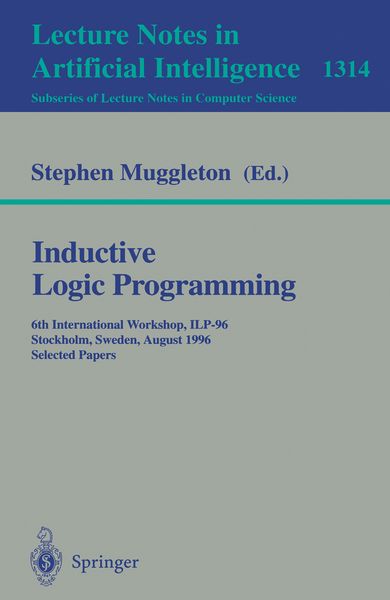
Inductive Logic Programming 6th International Workshop, ILP-96, Stockholm, Sweden, August 26-28, 1996, Selected Papers
-
- Taschenbuch ausgewählt
- eBook
-
Sprache:Englisch
-
Verlag:Springer Berlin
- Springer 54,99 €
- Springer Berlin 51,99 € ausgewählt
-
Auflage:1997
- 1997 51,99 € ausgewählt
- 2007 51,99 €
- 2012 51,99 €
51,99 €
inkl. gesetzl. MwSt.,
Beschreibung
Produktdetails
Einband
Taschenbuch
Erscheinungsdatum
03.09.1997
Abbildungen
X, 402 p.
Herausgeber
Stephen MuggletonVerlag
Springer BerlinSeitenzahl
402
Maße (L/B/H)
23,5/15,5/2,3 cm
Gewicht
622 g
Auflage
1997
Sprache
Englisch
ISBN
978-3-540-63494-2
This book constitutes the strictly refereed post-workshop proceedings of the 6th International Workshop on Inductive Logic Programming, ILP-96, held in Stockholm, Sweden, in August 1996.
The 21 full papers were carefully reviewed and selected for inclusion in the book in revised version. Also included is the invited contribution "Inductive logic programming for natural language processing" by Raymond J. Mooney. Among the topics covered are natural language learning, drug design, NMR and ECG analysis, glaucoma diagnosis, efficiency measures for implementations and database interaction, program synthesis, proof encoding and learning in the absence of negative data, and least generalizations under implication ordering.
Noch keine Bewertungen vorhanden
Verfassen Sie die erste Bewertung zu diesem Artikel
Helfen Sie anderen Kundinnen und Kunden durch Ihre Meinung.
Kurze Frage zu unserer Seite
Vielen Dank für Ihr Feedback
Wir nutzen Ihr Feedback, um unsere Produktseiten zu verbessern. Bitte haben Sie Verständnis, dass wir Ihnen keine Rückmeldung geben können. Falls Sie Kontakt mit uns aufnehmen möchten, können Sie sich aber gerne an unseren Kund*innenservice wenden.
zum Kundenservice