KI-Beratung Beta

  • Produktbild: Object Representation in Computer Vision
  • Produktbild: Object Representation in Computer Vision
Band 994

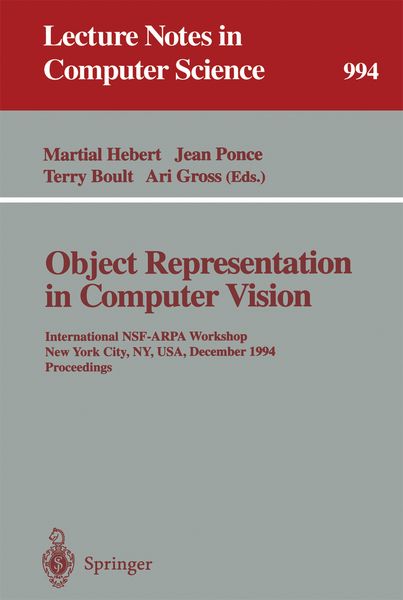
Object Representation in Computer Vision International NSF-ARPA Workshop, New York City, NY, USA, December 5 - 7, 1994. Proceedings

51,99 €

inkl. gesetzl. MwSt., Versandkostenfrei


Beschreibung

Produktdetails

Einband

Taschenbuch

Erscheinungsdatum

18.10.1995

Abbildungen

X, 366 p.

Herausgeber

Martial Hebert + weitere

Verlag

Springer Berlin

Seitenzahl

366

Maße (L/B/H)

23,5/15,5/2,1 cm

Gewicht

569 g

Auflage

1995

Sprache

Englisch

ISBN

978-3-540-60477-8

Beschreibung

Produktdetails

Einband

Taschenbuch

Erscheinungsdatum

18.10.1995

Abbildungen

X, 366 p.

Herausgeber

Verlag

Springer Berlin

Seitenzahl

366

Maße (L/B/H)

23,5/15,5/2,1 cm

Gewicht

569 g

Auflage

1995

Sprache

Englisch

ISBN

978-3-540-60477-8

Herstelleradresse

Springer-Verlag KG
Sachsenplatz 4-6
1201 Wien
AT

Email: ProductSafety@springernature.com

Noch keine Bewertungen vorhanden

Verfassen Sie die erste Bewertung zu diesem Artikel

Helfen Sie anderen Kundinnen und Kunden durch Ihre Meinung.

Kundinnen und Kunden meinen

Bewertungen (0)

  • Produktbild: Object Representation in Computer Vision
  • Produktbild: Object Representation in Computer Vision
  • Report on the 1995 workshop on 3-D object representations in computer vision.- Object recognition: The search for representation.- Appearance-based 3D object recognition.- Using quasi-invariants for automatic model building and object recognition: An overview.- Object representation for recognition-by-alignment.- Distinctive representations for the recognition of curved surfaces using outlines and markings.- The epipolar parametrization.- Using two-dimensional models to interact with the three-dimensional world.- Representations for recognizing complex curved 3D objects.- On representation and invariant recognition of complex objects based on patches and parts.- Algebraic geometry and object representation in computer vision.- Discrete surface signal processing: The polygon as the surface element.- Spline representations in 3-D vision.- Triangles as a primary representation.- Body-centered representation and perception.- The challenge of generic object recognition.- A physics-based framework for segmentation, shape and motion estimation.- Modal represenations.- Time representation of deformations: Combining vibration modes and Fourier analysis.- Physics in a fantasy world vs robust statistical estimation.- Towards a robust physics-based object recognition system.- Toward non-parametric digital shape representation and recovery.- Spherical representations: From EGI to SAI.- From physics-based representation to functional modeling of highly complex objects.