• Produktbild: Machine Learning: ECML-95
  • Produktbild: Machine Learning: ECML-95

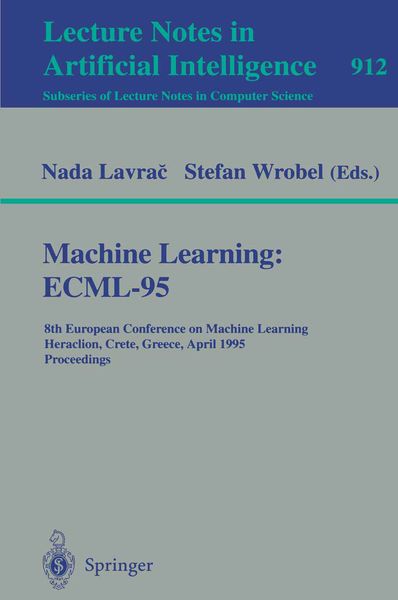
Machine Learning: ECML-95 8th European Conference on Machine Learning, Heraclion, Crete, Greece, April 25 - 27, 1995. Proceedings

51,99 €

inkl. gesetzl. MwSt., Versandkostenfrei


Beschreibung

Produktdetails

Einband

Taschenbuch

Erscheinungsdatum

05.04.1995

Abbildungen

XII, 376 p.

Herausgeber

Nada Lavrač + weitere

Verlag

Springer Berlin

Seitenzahl

376

Maße (L/B/H)

23,5/15,5/2,1 cm

Gewicht

587 g

Auflage

1995

Sprache

Englisch

ISBN

978-3-540-59286-0

Beschreibung

Produktdetails

Einband

Taschenbuch

Erscheinungsdatum

05.04.1995

Abbildungen

XII, 376 p.

Herausgeber

Verlag

Springer Berlin

Seitenzahl

376

Maße (L/B/H)

23,5/15,5/2,1 cm

Gewicht

587 g

Auflage

1995

Sprache

Englisch

ISBN

978-3-540-59286-0

Herstelleradresse

Springer-Verlag KG
Sachsenplatz 4-6
1201 Wien
AT

Email: ProductSafety@springernature.com

Noch keine Bewertungen vorhanden

Verfassen Sie die erste Bewertung zu diesem Artikel

Helfen Sie anderen Kundinnen und Kunden durch Ihre Meinung.

Kundinnen und Kunden meinen

Bewertungen (0)

  • Produktbild: Machine Learning: ECML-95
  • Produktbild: Machine Learning: ECML-95
  • Reasoning and learning in probabilistic and possibilistic networks: An overview.- Problem decomposition and the learning of skills.- Machine learning in the world wide web.- Abstract computer models: Towards a new method for theorizing about adaptive agents.- Learning abstract planning cases.- The role of prototypicality in exemplar-based learning.- Specialization of recursive predicates.- A distributed genetic algorithm improving the generalization behavior of neural networks.- Learning non-monotonic logic programs: Learning exceptions.- A comparative utility analysis of case-based reasoning and control-rule learning systems.- A minimization approach to propositional inductive learning.- On concept space and hypothesis space in case-based learning algorithms.- The power of decision tables.- Pruning multivariate decision trees by hyperplane merging.- Multiple-Knowledge Representations in concept learning.- The effect of numeric features on the scalability of inductive learning programs.- Analogical logic program synthesis from examples.- A guided tour through hypothesis spaces in ILP.- JIGSAW: Puzzling together RUTH and SPECTRE (Extended abstract).- Discovery of constraints and data dependencies in relational databases (Extended abstract).- Learning disjunctive normal forms in a dual classifier system (Extended abstract).- The effects of noise on efficient incremental induction (Extended abstract).- Analysis of Rachmaninoff's piano performances using inductive logic programming (Extended abstract).- Handling real numbers in ILP: A step towards better behavioural clones (Extended abstract).- Simplifying decision trees by pruning and grafting: New results (Extended abstract).- A tight integration of pruning and learning (Extended abstract).- Decision-tree based neural network (Extended abstract).- Learning recursion with iterative bootstrap induction (Extended abstract).- Patching proofs for reuse (Extended abstract).- Adapting to drift in continuous domains (Extendedabstract).- Parallel recombinative reinforcement learning (Extended abstract).- Learning to solve complex tasks for reactive systems (Extended abstract).- Co-operative Reinforcement Learning by payoff filters (Extended abstract).- Automatic synthesis of control programs by combination of learning and problem solving methods (Extended abstract).- Analytical learning guided by empirical technology: An approach to integration (Extended abstract).- A new MDL measure for robust rule induction (Extended abstract).- Class-driven statistical discretization of continuous attributes (Extended abstract).- Generating neural networks through the induction of threshold logic unit trees (Extended abstract).- Learning classification rules using lattices (Extended abstract).- Hybrid classification: Using axis-parallel and oblique subdivisions of the attribute space (Extended abstract).- An induction-based control for genetic algorithms (Extended abstract).- Fender: An approach to theory restructuring(extended abstract).- Language series revisited: The complexity of hypothesis spaces in ILP (Extended abstract).- Prototype, nearest neighbor and hybrid algorithms for time series classification (Extended abstract).