KI-Beratung Beta

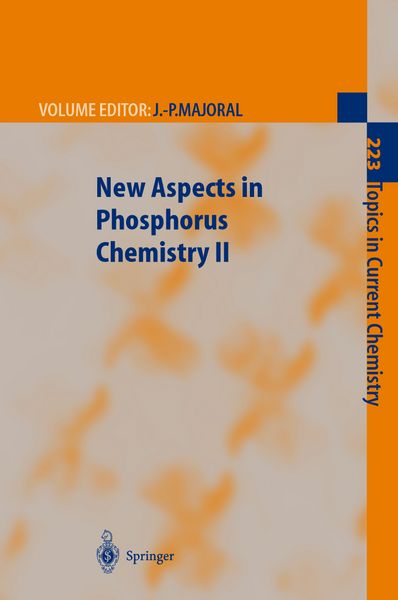
  • Produktbild: New Aspects in Phosphorus Chemistry II
  • Produktbild: New Aspects in Phosphorus Chemistry II
Band 223 - 12%

New Aspects in Phosphorus Chemistry II

12% sparen

289,99 € UVP 329,99 €

inkl. gesetzl. MwSt., Versandkostenfrei


Beschreibung

Strong non-ionic bases are highly advantageous as stoichiometric reagents and as catalysts in synthetic organic chemistry owing to side reactions that f- quently occur when ionic bases such as LDA or alkali metal alkoxides are employed. A second reason that non-ionic bases are frequently more useful...

Beschreibung

Strong non-ionic bases are highly advantageous as stoichiometric reagents and as catalysts in synthetic organic chemistry owing to side reactions that f- quently occur when ionic bases such as LDA or alkali metal alkoxides are employed. A second reason that non-ionic bases are frequently more useful in these applications is that such bases are often more soluble in less polar organic solvents,particularly at low temperatures. Thirdly,non-ionic bases can provide reactive naked or tightly associated deprotonated substrate anions that are s- bilized by the relatively large,poorly solvated cations formed by the protonated base. In such cations,extensive positive charge delocalization can occur. Prior to our work on pro-azaphosphatranes of type 1 (Scheme 1),the very strong n- ionic bases utilized for organic transformations were largely confined to the nitrogenous bases shown below (Scheme 2). Scheme 1 Scheme 2 4 J. G. Verkade 2 Uses of Strong Nonionic Nitrogen Bases 2. 1 Amines One of the earliest strong non-ionic bases to make its appearance was Proton Sponge and its derivatives [1] and these systems have been reviewed [2]. More recently Proton Sponge has been used in the palladium-catalyzed arylation of 2,3-dihydrofuran [3], and it also catalyzes Knoevenagel condensations of s- strates possessing activated methylene groups [4]. Recently the synthesis of the macrocyclic tetramine below (Scheme 3) was reported [5]. The encrypted nitrogens are very basic (pK ,24.

Produktdetails

Einband

Gebundene Ausgabe

Erscheinungsdatum

27.11.2002

Abbildungen

X, 263 p.

Herausgeber Jean-Pierre Majoral

Produktdetails

Einband

Gebundene Ausgabe

Erscheinungsdatum

27.11.2002

Abbildungen

X, 263 p.

Herausgeber Jean-Pierre Majoral
Verlag Springer Berlin
Seitenzahl

263

Maße (L/B/H)

24,1/16/2,1 cm

Gewicht

530 g

Auflage

2003

Sprache

Englisch

ISBN

978-3-540-44086-4

Herstelleradresse

Spektrum-Akademischer Vlg
Slevogtstraße 3-5
69126 Heidelberg
DE

Email: ProductSafety@springernature.com

Noch keine Bewertungen vorhanden

Verfassen Sie die erste Bewertung zu diesem Artikel

Helfen Sie anderen Kundinnen und Kunden durch Ihre Meinung.

Kundinnen und Kunden meinen

Bewertungen (0)

  • Produktbild: New Aspects in Phosphorus Chemistry II
  • Produktbild: New Aspects in Phosphorus Chemistry II
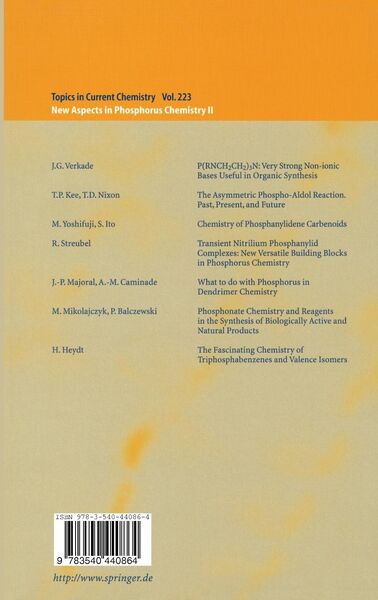
  • P(RNCH2CH2)3N: Very Strong Non-Ionic Bases Useful in Organic Synthesis.- The Asymmetric Phospho-Aldol Reaction. Past, Present and Future.- Chemistry of Phosphanylidene Carbenoids.- Transient Nitrilium Phosphanylid Complexes — New Versatile Building Blocks in Phosphorus Chemistry.- What to do with Phosphorus in Dendrimer Chemistry.- Phosphonate Chemistry and Reagents in the Synthesis of Biologically Active and Natural Products.- The Fascinating Chemistry of 1,3,5-Triphosphinines and Valence Isomers [1].