Gutscheinbedingungen

**Gültig bis 06.07.2026 auf fremdsprachige Bücher online auf thalia.at, in der Thalia App ab einem Mindestbestellwert von 30€ und in allen Thalia Buchhandlungen in Österreich. In den Buchhandlungen nur gültig auf lagernde Ware. Einzelne Artikel können ausgeschlossen sein. Ausgenommen sind preisgebundene Artikel & eBooks. Pro Einkauf einmal einlösbar. Nur gültig gegen Vorlage oder im Onlineshop hinterlegter Bonuscard. Infos zur Einlösung in der Buchhandlung sind auf der Bonuscard-Vorteilspreisseite zu finden. Click & Collect nur bei Onlinevorabzahlung möglich. Keine Einlösung bei Scan & Go-Bezahlung. Keine Barauszahlung. Nicht kombinierbar mit anderen Aktionen und Gutscheinen. Gutschein wird auf max. 500€ Bestellwert angerechnet. Nicht gültig für Versandkosten und Services.

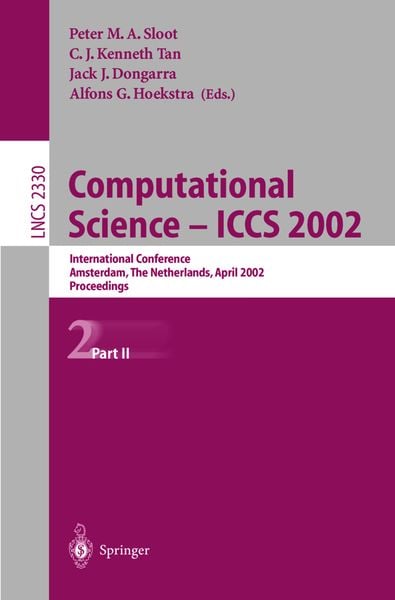
Produktbild: Computational Science — ICCS 2002
Band 2330

Computational Science — ICCS 2002 International Conference Amsterdam, The Netherlands, April 21–24, 2002 Proceedings, Part II

51,99 €

inkl. gesetzl. MwSt., Versandkostenfrei


Beschreibung

Produktdetails

Einband

Taschenbuch

Erscheinungsdatum

12.04.2002

Herausgeber

Peter Sloot + weitere

Verlag

Springer Berlin

Seitenzahl

1115

Maße (L/B/H)

23,5/15,5/6,5 cm

Gewicht

1827 g

Auflage

2002

Sprache

Englisch

ISBN

978-3-540-43593-8

Beschreibung

Produktdetails

Einband

Taschenbuch

Erscheinungsdatum

12.04.2002

Herausgeber

Verlag

Springer Berlin

Seitenzahl

1115

Maße (L/B/H)

23,5/15,5/6,5 cm

Gewicht

1827 g

Auflage

2002

Sprache

Englisch

ISBN

978-3-540-43593-8

Herstelleradresse

Springer-Verlag KG
Sachsenplatz 4-6
1201 Wien
AT

Email: GPSR Kontakt

Noch keine Bewertungen vorhanden

Verfassen Sie die erste Bewertung zu diesem Artikel

Helfen Sie anderen Kundinnen und Kunden durch Ihre Meinung.

Kundinnen und Kunden meinen

Bewertungen (0)

  • Produktbild: Computational Science — ICCS 2002
  • Workshop Papers I.- Inverse Direct Lighting with a Monte Carlo Method and Declarative Modelling.- Light Meshes—Original Approach to Produce Soft Shadows in Ray Tracing.- Adding Synthetic Detail to Natural Terrain Using a Wavelet Approach.- The New Area Subdivision Methods for Producing Shapes of Colored Paper Mosaic.- Fast Algorithm for Triangular Mesh Simplification Based on Vertex Decimation.- Geometric Determination of the Spheres which Are Tangent to Four Given Ones.- Metamorphosis of Non-homeomorphic Objects.- Bézier surfaces of minimal area.- Transformation of a Dynamic B-spline Curve Into Piecewise Power Basis Representation.- Rapid Generation of C 2 Continuous Blending Surfaces.- Interactive Multi-volume Visualization.- Efficient Implementation of Multiresolution Triangle Strips.- The Hybrid Octree: Towards the Definition of a Multiresolution Hybrid Framework.- Interactive Hairstyle Modeling Using a Sketching Interface.- Orthogonal Cross Cylinder Using Segmentation Based Environment Modeling.- Helping the Designer in Solution Selection: Applications in CAD.- Polar Isodistance Curves on Parametric Surfaces.- Total Variation Regularization for Edge Preserving 3D SPECT Imaging in High Performance Computing Environments.- Computer Graphics Techniques for Realistic Modeling, Rendering and Animation of Water. Part I: 1980–88.- Computer Graphics Techniques for Realistic Modeling, Rendering and Animation of Water. Part II: 1989–1997.- A Case Study in Geometric Constructions.- Interactive versus Symbolic Approaches to Plane Loci Generation in Dynamic Geometry Environments.- Deformations Expressed as Displacement Maps An Easy Way to Combine Deformations.- A Property on Singularities of NURBS Curves.- Interactive Deformation of Irregular Surface Models.- Bandwidth Reduction Techniques for Remote Navigation Systems.- OSCONVR: An Interactive Virtual Reality Interface to an Object-Oriented Database System for Construction Architectural Design.- Internet Client Graphics Generation Using XML Formats.- The Compression of the Normal Vectors of 3D Mesh Models Using Clustering.- Semi-metric Formal 3D Reconstruction from Perspective Sketches.- Reconstruction of Surfaces from Scan Paths.- Extending Neural Networks for B-Spline Surface Reconstruction.- Computational Geometry and Spatial Meshes.- Workshop Papers I.- A Combinatorial Scheme for Developing Efficient Composite Solvers.- Parallel and Fully Recursive Multifrontal Supernodal Sparse Cholesky.- Parallel Iterative Methods in Modern Physical Applications.- Solving Unsymmetric Sparse Systems of Linear Equations with PARDISO.- A Multipole Approach for Preconditioners.- Orthogonal Method for Linear Systems. Preconditioning.- Antithetic Monte Carlo Linear Solver.- Restarted Simpler GMRES Augmented with Harmonic Ritz Vectors.- A Projection Method for a Rational Eigenvalue Problem in Fluid-Structure Interaction.- On Implementation of Vector Gauss Method for Solving Large-Scale Systems of Index 1 Differential-Algebraic Equations.- One Class of Splitting Iterative Schemes.- Filtration-Convection Problem: Spectral-Difference Method and Preservation of Cosymmetry.- A Comparative Study of Dirichlet and Neumann Conditions for Path Planning through Harmonic Functions.- Adaptation and Assessment of a High Resolution Semi-Discrete Numerical Scheme for Hyperbolic Systems with Source Terms and Stiffness.- The Computational Modeling of Crystalline Materials Using a Stochastic Variational Principle.- Realization of the Finite Mass Method.- Domain Decomposition Using a 2- Level Correction Scheme.- Computational Models for Materials with Shape Memory: Towards a Systematic Description of Coupled Phenomena.- Calculation of Thermal State of Bodies with Multilayer Coatings.- An Irregular Grid Method for Solving High- Dimensional Problems in Finance.- On Polynomial and Polynomial Matrix Interpolation.- Comparing the Performance of Solvers for a Bioelectric Field Problem.- Iteration Revisited Examples From a General Theory.- A New Prime Edge Length Crystallographic FFT.- Workshop Papers I.- TopoMon: A Monitoring Tool for Grid Network Topology.- Logistical Storage Resources for the Grid.- Towards the Design of an Active Grid.- An Active Reliable Multicast Framework for the Grids.- Workshop Papers I.- A Parallel Quasi-Monte Carlo Method for Solving Systems of Linear Equations.- Mixed Monte Carlo Parallel Algorithms for Matrix Computation.- Numerical Experiments with Monte Carlo Methods and SPAI Preconditioner for Solving System of Linear Equations.- Measuring the Performance of a Power PC Cluster.- Monte Carlo Techniques for Estimating the Fiedler Vector in Graph Applications.- Workshop Papers I.- Peer-to-Peer Computing Enabled Collaboration.- Working Towards Strong Wireless Group Communications: The Janus Architecture.- Towards Mobile Computational Application Steering: Visualizing The Spatial Characteristics of Metropolitan Area Wireless Networks.- Hungarian Supercomputing Grid.- The Construction of a Reliable Multipeer Communication Protocol for Distributed Virtual Environments..- Process Oriented Design for Java: Concurrency for All.- Collaborative Computing and E-learning.- CSP Networking for Java (JCSP.net).- The MICROBE Benchmarking Toolkit for Java: a Component-Based Approach.- Distributed Peer-to-Peer Control in Harness.- A Comparison of Conventional Distributed Computing Environments and Computational Grids.- Workshop Papers I.- Developing Grid Based Infrastructure for Climate Modeling.- A Real Application of the Model Coupling Toolkit.- Simplifying the Task of Generating Climate Simulations and Visualizations.- On the Computation of Mass Fluxes for Eulerian Transport Models from Spectral Meteorological Fields.- Designing a Flexible Grid Enabled Scientific Modeling Interface.- Workshop Papers I.- Parallel Contact Detection Strategies for Cable and Membrane Structures.- A Parallel Domain Decomposition Algorithm for the Adaptive Finite Element Solution of 3-D Convection-Diffusion Problems.- Parallel Performance in Multi-physics Simulation.- A Parallel Finite Volume Method for Aerodynamic Flows.- Workshop Papers I.- An Extensible Compiler for Creating Scriptable Scientific Software.- Guard: A Tool for Migrating Scientific Applications to the .NET Framework.- Lithium: A Structured Parallel Programming Environment inJa va.- Using the TrustME Tool Suite for Automatic Component Protocol Adaptation.- Integrating CUMULVS into AVS/Express.- Monitoring System for Distributed Java Applications.- A Concept of Portable Monitoring of Multithreaded Programs.- dproc - Extensible Run-Time Resource Monitoring for Cluster Applications.- A Comparison of Counting and Sampling Modes of Using Performance Monitoring Hardware.- Debugging Large-Scale, Long-Running Parallel Programs.- Performance Prediction for Parallel Iterative Solvers.- Improving Data Locality Using Dynamic Page Migration Based on Memory Access Histograms.- Multiphase Mesh Partitioning for Parallel Computational Mechanics Codes.- The Shared Memory Parallelisation of an Ocean Modelling Code Using an Interactive Parallelisation Toolkit.- Dynamic Load Equilibration for Cyclic Applications in Distributed Systems.- 3G Medicine - The Integration of Technologies.- Architecture of Secure Portable and Interoperable Electronic Health Records.- Designing for change and reusability - Using XML, XSL, and MPEG-7 for developing professional health Information systems.- Personal LocationMessaging.- The E-CARE Project - Removing the Wires.- Workshop Papers I.- Automatic Generation of Efficient Adjoint Code for a Parallel Navier-Stokes Solver.- Switchback: Profile-Driven Recomputation for Reverse Mode.- Reducing the Memory Requirement in Reverse Mode Automatic Differentiation by Solving TBR Flow Equations.- The Implementation and Testing of Time-minimal and Resource-optimal Parallel Reversal Schedules.- Automatic Differentiation for Nonlinear Controller Design.- Computation of Sensitivity Information for Aircraft Design by Automatic Differentiation.- Performance Issues for Vertex Elimination Methods in Computing Jacobians using Automatic Differentiation.- Making Automatic Differentiation Truly Automatic: Coupling PETSc with ADIC.- Improved Interval Constraint Propagation for Constraints on Partial Derivatives.