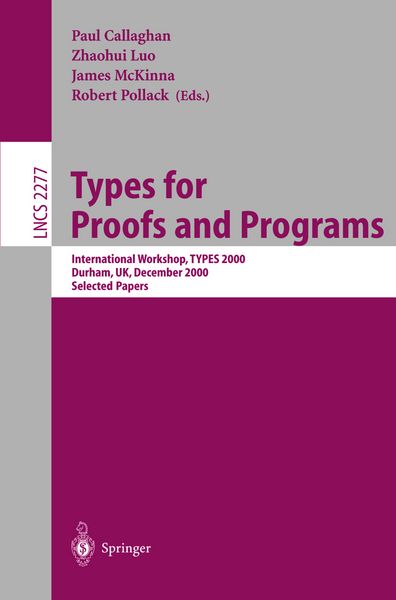
• Produktbild: Types for Proofs and Programs
  • Produktbild: Types for Proofs and Programs
Band 2277

Types for Proofs and Programs International Workshop, TYPES 2000, Durham, UK, December 8-12, 2000. Selected Papers

51,99 €

inkl. gesetzl. MwSt., Versandkostenfrei


Beschreibung

Produktdetails

Einband

Taschenbuch

Erscheinungsdatum

20.02.2002

Abbildungen

VIII, 248 p.

Herausgeber

Paul Callaghan + weitere

Verlag

Springer Berlin

Seitenzahl

248

Maße (L/B/H)

23,5/15,5/1,5 cm

Gewicht

394 g

Auflage

2002

Sprache

Englisch

ISBN

978-3-540-43287-6

Beschreibung

Produktdetails

Einband

Taschenbuch

Erscheinungsdatum

20.02.2002

Abbildungen

VIII, 248 p.

Herausgeber

Verlag

Springer Berlin

Seitenzahl

248

Maße (L/B/H)

23,5/15,5/1,5 cm

Gewicht

394 g

Auflage

2002

Sprache

Englisch

ISBN

978-3-540-43287-6

Herstelleradresse

Springer-Verlag KG
Sachsenplatz 4-6
1201 Wien
AT

Email: ProductSafety@springernature.com

Noch keine Bewertungen vorhanden

Verfassen Sie die erste Bewertung zu diesem Artikel

Helfen Sie anderen Kundinnen und Kunden durch Ihre Meinung.

Kundinnen und Kunden meinen

Bewertungen (0)

  • Produktbild: Types for Proofs and Programs
  • Produktbild: Types for Proofs and Programs
  • Collection Principles in Dependent Type Theory.- Executing Higher Order Logic.- A Tour with Constructive Real Numbers.- An Implementation of Type:Type.- On the Logical Content of Computational Type Theory: A Solution to Curry’s Problem.- Constructive Reals in Coq: Axioms and Categoricity.- A Constructive Proof of the Fundamental Theorem of Algebra without Using the Rationals.- A Kripke-Style Model for the Admissibility of Structural Rules.- Towards Limit Computable Mathematics.- Formalizing the Halting Problem in a Constructive Type Theory.- On the Proofs of Some Formally Unprovable Propositions and Prototype Proofs in Type Theory.- Changing Data Structures in Type Theory: A Study of Natural Numbers.- Elimination with a Motive.- Generalization in Type Theory Based Proof Assistants.- An Inductive Version of Nash-Williams’ Minimal-Bad-Sequence Argument for Higman’s Lemma.