Gutscheinbedingungen

**Gültig von 22.06.2026 ab 19 Uhr bis 23.06.2026 24 Uhr auf Spielzeug, Schreibwaren, Filme, Geschenke & Trends, Musik, tolino eReader & Zubehör, Hörbücher und Hörbuch-Downloads (außer Abo), nicht preisgebundene Bücher und Kalender online auf thalia.at und in der Thalia App. Einzelne Artikel können ausgeschlossen sein. Aufgrund der Buchpreisbindung sind deutschsprachige Bücher und eBooks ausgenommen. Zusätzlich ausgenommen sind preisgebundene Artikel, Abos & Flatrates, eBooks, Games, Geschenkkarten/-boxen, Shelfies, Software, Zeitschriften sowie einzelne Artikel von tonies®. Pro Einkauf einmal einlösbar. Click & Collect nur bei Onlinevorabzahlung möglich. Keine Barauszahlung. Nicht kombinierbar mit anderen Aktionen und Gutscheinen. Gutschein wird auf max. 500€ Bestellwert angerechnet. Nicht gültig für Versandkosten und Services.

  • Produktbild: Continuous and Discontinuous Modelling of Cohesive-Frictional Materials
  • Produktbild: Continuous and Discontinuous Modelling of Cohesive-Frictional Materials
Band 568

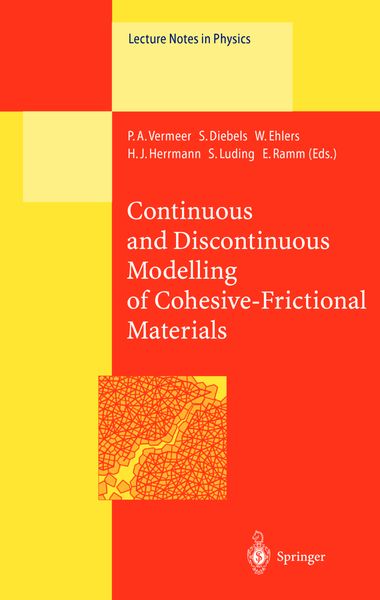
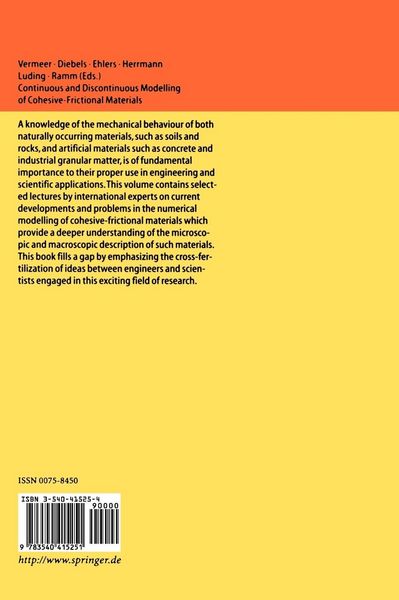
Continuous and Discontinuous Modelling of Cohesive-Frictional Materials

Aus der Reihe Lecture Notes in Physics

51,99 €

inkl. gesetzl. MwSt., Versandkostenfrei


Beschreibung

Produktdetails

Einband

Gebundene Ausgabe

Erscheinungsdatum

01.01.2001

Herausgeber

P.A. Vermeer + weitere

Verlag

Springer Berlin

Seitenzahl

310

Maße (L/B/H)

26/18,3/2,3 cm

Gewicht

809 g

Auflage

2001

Sprache

Englisch

ISBN

978-3-540-41525-1

Beschreibung

Produktdetails

Einband

Gebundene Ausgabe

Erscheinungsdatum

01.01.2001

Herausgeber

Verlag

Springer Berlin

Seitenzahl

310

Maße (L/B/H)

26/18,3/2,3 cm

Gewicht

809 g

Auflage

2001

Sprache

Englisch

ISBN

978-3-540-41525-1

Herstelleradresse

Springer-Verlag KG
Sachsenplatz 4-6
1201 Wien
AT

Email: ProductSafety@springernature.com

Kundinnen und Kunden meinen

0 Bewertungen

Informationen zu Bewertungen

Zur Abgabe einer Bewertung ist eine Anmeldung im Konto notwendig. Die Authentizität der Bewertungen wird von uns nicht überprüft. Wir behalten uns vor, Bewertungstexte, die unseren Richtlinien widersprechen, entsprechend zu kürzen oder zu löschen.

Die Bewertungen sind nach Format, Anzahl Sterne und Datum sortiert.

Verfassen Sie die erste Bewertung zu diesem Artikel

Helfen Sie anderen Kund*innen durch Ihre Meinung

Kundinnen und Kunden meinen

0 Bewertungen filtern

  • Produktbild: Continuous and Discontinuous Modelling of Cohesive-Frictional Materials
  • Produktbild: Continuous and Discontinuous Modelling of Cohesive-Frictional Materials
  • Computational models for failure in cohesive-frictional materials with stochastically distributed imperfections.- Modeling of localized damage and fracture in quasibrittle materials.- Microplane modelling and particle modelling of cohesive-frictional materials.- Short-term creep of shotcrete - thermochemoplastic material modelling and nonlinear analysis of a laboratory test and of a NATM excavation by the Finite Element Method.- Thermo-poro-mechanics of rapid fault shearing.- A view on the variational setting of micropolar continua.- Macromodelling of softening in non-cohesive soils.- An experimental investigation of the relationships between grain size distribution and shear banding in sand.- Micromechanics of the elastic behaviour of granular materials.- On sticky-sphere assemblies.- Cohesive granular texture.- Micro-mechanisms of deformation in granular materials: experiments and numerical results.- Scaling properties of granular materials.- Discrete and continuum modelling of granular materials.- Difficulties and limitation of statistical homogenization in granular materials.- From discontinuous models towards a continuum description.- From solids to granulates - Discrete element simulations of fracture and fragmentation processes in geomaterials.- Microscopic modelling of granular materials taking into account particle rotations.- Microstructured materials: local constitutive equation with internal lenght, theoretical and numerical studies.- Damage in a composite material under combined mechanical and hygral load.