
KI-Beratung Beta

  • Produktbild: Structure in Complexity Theory
  • Produktbild: Structure in Complexity Theory
Band 223

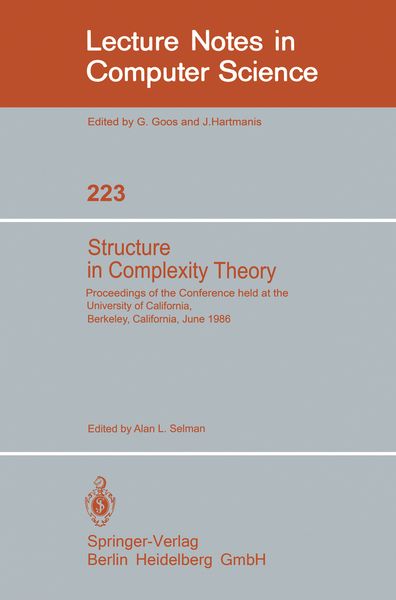
Structure in Complexity Theory Proceedings of the Conference held at the University of California, Berkeley, June 2-5, 1986

51,99 €

inkl. gesetzl. MwSt., Versandkostenfrei


Beschreibung

The complexity of sparse sets in P.- Isomorphisms and 1-L reductions.- Randomness, relativizations, and polynomial reducibilities.- On non-uniform polynomial space.- One-way functions and circuit complexity.- Relativized alternation.- The polynomial hierarchy and intuitionistic Bounded Arithmetic.- With...

Beschreibung

The complexity of sparse sets in P.- Isomorphisms and 1-L reductions.- Randomness, relativizations, and polynomial reducibilities.- On non-uniform polynomial space.- One-way functions and circuit complexity.- Relativized alternation.- The polynomial hierarchy and intuitionistic Bounded Arithmetic.- With probability one, a random oracle separates PSPACE from the polynomial-time hierarchy.- The boolean hierarchy: Hardware over NP.- Exponential time and bounded arithmetic.- Probabilistic game automata.- Two lower bound arguments with "inaccessible" numbers.- Resource-bounded Kolmogorov complexity of hard languages.- A note on one-way functions and polynomial time isomorphisms.- What is a hard instance of a computational problem?.- The complexity of optimization problems.- The power of the queue.- A depth-size tradeoff for boolean circuits with unbounded fan-in.- An optimal lower bound for turing machines with one work tape and a two-way input tape.- Separation results for bounded alternation.- Parallel computation with threshold functions.- The topology of provability in complexity theory.- Optimal approximations of complete sets.- Expanders, randomness, or time versus space.- Diagonalisation methods in a polynomial setting.- Bounded oracles and complexity classes inside linear space.- Parallel computation and the NC hierarchy relativized.- Probabilistic quantifiers, adversaries, and complexity classes : An overview.

Produktdetails

Einband

Taschenbuch

Erscheinungsdatum

01.05.1986

Abbildungen

VIII, 404 p.

Herausgeber Alan L. Selman

Produktdetails

Einband

Taschenbuch

Erscheinungsdatum

01.05.1986

Abbildungen

VIII, 404 p.

Herausgeber Alan L. Selman
Verlag Springer Berlin
Seitenzahl

404

Maße (L/B/H)

23,5/15,5/2,3 cm

Gewicht

622 g

Auflage

1986

Sprache

Englisch

ISBN

978-3-540-16486-9

Herstelleradresse

Springer-Verlag KG
Sachsenplatz 4-6
1201 Wien
AT

Email: ProductSafety@springernature.com

Noch keine Bewertungen vorhanden

Verfassen Sie die erste Bewertung zu diesem Artikel

Helfen Sie anderen Kundinnen und Kunden durch Ihre Meinung.

Kundinnen und Kunden meinen

Bewertungen (0)

  • Produktbild: Structure in Complexity Theory
  • Produktbild: Structure in Complexity Theory
  • The complexity of sparse sets in P.- Isomorphisms and 1-L reductions.- Randomness, relativizations, and polynomial reducibilities.- On non-uniform polynomial space.- One-way functions and circuit complexity.- Relativized alternation.- The polynomial hierarchy and intuitionistic Bounded Arithmetic.- With probability one, a random oracle separates PSPACE from the polynomial-time hierarchy.- The boolean hierarchy: Hardware over NP.- Exponential time and bounded arithmetic.- Probabilistic game automata.- Two lower bound arguments with "inaccessible" numbers.- Resource-bounded Kolmogorov complexity of hard languages.- A note on one-way functions and polynomial time isomorphisms.- What is a hard instance of a computational problem?.- The complexity of optimization problems.- The power of the queue.- A depth-size tradeoff for boolean circuits with unbounded fan-in.- An optimal lower bound for turing machines with one work tape and a two-way input tape.- Separation results for bounded alternation.- Parallel computation with threshold functions.- The topology of provability in complexity theory.- Optimal approximations of complete sets.- Expanders, randomness, or time versus space.- Diagonalisation methods in a polynomial setting.- Bounded oracles and complexity classes inside linear space.- Parallel computation and the NC hierarchy relativized.- Probabilistic quantifiers, adversaries, and complexity classes : An overview.