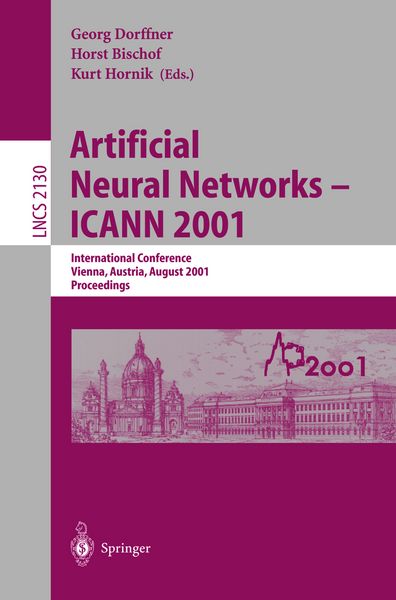
Produktbild: Artificial Neural Networks - ICANN 2001
Band 2130 - 22%

Artificial Neural Networks - ICANN 2001 International Conference Vienna, Austria, August 21-25, 2001 Proceedings

22% sparen

119,99 € UVP 153,99 €

inkl. gesetzl. MwSt., Versandkostenfrei


Beschreibung

Produktdetails

Einband

Taschenbuch

Erscheinungsdatum

13.08.2001

Herausgeber

Georg Dorffner + weitere

Verlag

Springer Berlin

Seitenzahl

1262

Maße (L/B/H)

23,6/15,7/4,7 cm

Gewicht

1590 g

Auflage

1. Auflage

Sprache

Englisch

ISBN

978-3-540-42486-4

Beschreibung

Produktdetails

Einband

Taschenbuch

Erscheinungsdatum

13.08.2001

Herausgeber

Verlag

Springer Berlin

Seitenzahl

1262

Maße (L/B/H)

23,6/15,7/4,7 cm

Gewicht

1590 g

Auflage

1. Auflage

Sprache

Englisch

ISBN

978-3-540-42486-4

Herstelleradresse

Springer-Verlag GmbH
Heidelberger Platz 3
14197 Berlin
Deutschland
Email: sdc-bookservice@springer.com
Url: www.springer.com
Telephone: +49 30 827870
Fax: +49 30 8214091

Noch keine Bewertungen vorhanden

Verfassen Sie die erste Bewertung zu diesem Artikel

Helfen Sie anderen Kundinnen und Kunden durch Ihre Meinung.

Kundinnen und Kunden meinen

Bewertungen (0)

  • Produktbild: Artificial Neural Networks - ICANN 2001
  • Invited Papers.- The Complementary Brain (Abstract).- Neural Networks for Adaptive Processing of Structured Data.- Bad Design and Good Performance: Strategies of the Visual System for Enhanced Scene Analysis.- Data Analysis and Pattern Recognition.- Fast Curvature Matrix-Vector Products.- Architecture Selection in NLDA Networks.- Neural Learning Invariant to Network Size Changes.- Boosting Mixture Models for Semi-supervised Learning.- Bagging Can Stabilize without Reducing Variance.- Symbolic Prosody Modeling by Causal Retro-causal NNs with Variable Context Length.- Discriminative Dimensionality Reduction Based on Generalized LVQ.- A Computational Intelligence Approach to Optimization with Unknown Objective Functions.- Clustering Gene Expression Data by Mutual Information with Gene Function.- Learning to Learn Using Gradient Descent.- A Variational Approach to Robust Regression.- Minimum-Entropy Data Clustering Using Reversible Jump Markov Chain Monte Carlo.- Behavioral Market Segmentation of Binary Guest Survey Data with Bagged Clustering.- Direct Estimation of Polynomial Densities in Generalized RBF Networks Using Moments.- Generalisation Improvement of Radial Basis Function Networks Based on Qualitative Input Conditioning for Financial Credit Risk Prediction.- Approximation of Bayesian Discriminant Function by Neural Networks in Terms of Kullback-Leibler Information.- The Bias-Variance Dilemma of the Monte Carlo Method.- A Markov Chain Monte Carlo Algorithm for the Quadratic Assignment Problem Based on Replicator Equations.- Mapping Correlation Matrix Memory Applications onto a Beowulf Cluster.- Accelerating RBF Network Simulation by Using Multimedia Extensions of Modern Microprocessors.- A Game-Theoretic Adaptive Categorization Mechanism for ART-Type Networks.- Gaussian Radial Basis Functions and Inner-Product Spaces.- Mixture of Probabilistic Factor Analysis Model and Its Applications.- Deferring the Learning for Better Generalization in Radial Basis Neural Networks.- Improvement of Cluster Detection and Labeling Neural Network by Introducing Elliptical Basis Function.- Independent Variable Group Analysis.- Weight Quantization for Multi-layer Perceptrons Using Soft Weight Sharing.- Voting-Merging: An Ensemble Method for Clustering.- The Application of Fuzzy ARTMAP in the Detection of Computer Network Attacks.- Transductive Learning: Learning Iris Data with Two Labeled Data.- Approximation of Time-Varying Functions with Local Regression Models.- Theory.- Complexity of Learning for Networks of Spiking Neurons with Nonlinear Synaptic Interactions.- Product Unit Neural Networks with Constant Depth and Superlinear VC Dimension.- Generalization Performances of Perceptrons.- Bounds on the Generalization Ability of Bayesian Inference and Gibbs Algorithms.- Learning Curves for Gaussian Processes Models: Fluctuations and Universality.- Tight Bounds on Rates of Neural-Network Approximation.- Kernel Methods.- Scalable Kernel Systems.- On-Line Learning Methods for Gaussian Processes.- Online Approximations for Wind-Field Models.- Fast Training of Support Vector Machines by Extracting Boundary Data.- Multiclass Classification with Pairwise Coupled Neural Networks or Support Vector Machines.- Incremental Support Vector Machine Learning: A Local Approach.- Learning to Predict the Leave-One-Out Error of Kernel Based Classifiers.- Sparse Kernel Regressors.- Learning on Graphs in the Game of Go.- Nonlinear Feature Extraction Using Generalized Canonical Correlation Analysis.- Gaussian Process Approach to Stochastic Spiking Neurons with Reset.- Kernel Based Image Classification.- Gaussian Processes for Model Fusion.- Kernel Canonical Correlation Analysis and Least Squares Support Vector Machines.- Learning and Prediction of the Nonlinear Dynamics of Biological Neurons with Support Vector Machines.- Close-Class-Set Discrimination Method for Recognition of Stop_Consonant-Vowel Utterances Using Support Vector Machines.- Linear Dependency between ? and the Input Noise in ?-Support Vector Regression.- The Bayesian Committee Support Vector Machine.- Topographic Mapping.- Using Directional Curvatures to Visualize Folding Patterns of the GTM Projection Manifolds.- Self Organizing Map and Sammon Mapping for Asymmetric Proximities.- Active Learning with Adaptive Grids.- Complex Process Visualization through Continuous Feature Maps Using Radial Basis Functions.- A Soft k-Segments Algorithm for Principal Curves.- Product Positioning Using Principles from the Self-Organizing Map.- Combining the Self-Organizing Map and K-Means Clustering for On-Line Classification of Sensor Data.- Histogram Based Color Reduction through Self-Organized Neural Networks.- Sequential Learning for SOM Associative Memory with Map Reconstruction.- Neighborhood Preservation in Nonlinear Projection Methods: An Experimental Study.- A Topological Hierarchical Clustering: Application to Ocean Color Classification.- Hierarchical Clustering of Document Archives with the Growing Hierarchical Self-Organizing Map.- Independent Component Analysis.- Blind Source Separation of Single Components from Linear Mixtures.- Blind Source Separation Using Principal Component Neural Networks.- Blind Separation of Sources by Differentiating the Output Cumulants and Using Newton’s Method.- Mixtures of Independent Component Analysers.- Conditionally Independent Component Extraction for Naive Bayes Inference.- Fast Score Function Estimation with Application in ICA.- Health Monitoring with Learning Methods.- Breast Tissue Classification in Mammograms Using ICA Mixture Models.- Neural Network Based Blind Source Separation of Non-linear Mixtures.- Feature Extraction Using ICA.- Signal Processing.- Continuous Speech Recognition with a Robust Connectionist/Markovian Hybrid Model.- Faster Convergence and Improved Performance in Least-Squares Training of Neural Networks for Active Sound Cancellation.- Bayesian Independent Component Analysis as Applied to One-Channel Speech Enhancement.- Massively Parallel Classification of EEG Signals Using Min-Max Modular Neural Networks.- Single Trial Estimation of Evoked Potentials Using Gaussian Mixture Models with Integrated Noise Component.- A Probabilistic Approach to High-Resolution Sleep Analysis.- Comparison of Wavelet Thresholding Methods for Denoising ECG Signals.- Evoked Potential Signal Estimation Using Gaussian Radial Basis Function Network.- ‘Virtual Keyboard’ Controlled by Spontaneous EEG Activity.- Clustering of EEG-Segments Using Hierarchical Agglomerative Methods and Self-Organizing Maps.- Nonlinear Signal Processing for Noise Reduction of Unaveraged Single Channel MEG Data.- Time Series Processing.- A Discrete Probabilistic Memory Model for Discovering Dependencies in Time.- Applying LSTM to Time Series Predictable through Time-Window Approaches.- Generalized Relevance LVQ for Time Series.- Unsupervised Learning in LSTM Recurrent Neural Networks.- Applying Kernel Based Subspace Classification to a Non-intrusive Monitoring for Household Electric Appliances.- Neural Networks in Circuit Simulators.- Neural Networks Ensemble for Cyclosporine Concentration Monitoring.- Efficient Hybrid Neural Network for Chaotic Time Series Prediction.- Online Symbolic-Sequence Prediction with Discrete-Time Recurrent Neural Networks.- Prediction Systems Based on FIR BP Neural Networks.- On the Generalization Ability of Recurrent Networks.- Finite-State Reber Automaton and the Recurrent Neural Networks Trained in Supervised and Unsupervised Manner.- Estimation of Computational Complexity of Sensor Accuracy Improvement Algorithm Based on Neural Networks.- Fusion Architectures for the Classification of Time Series.- Special Session: Agent-Based Economic Modeling.- The Importance of Representing Cognitive Processes in Multi-agent Models.- Multi-agent FX-Market Modeling Based on Cognitive Systems.- Speculative Dynamics in a Heterogeneous-Agent Model.- Nonlinear Adaptive Beliefs and the Dynamics of Financial Markets: The Role of the Evolutionary Fitness Measure.- Analyzing Purchase Data by a Neural Net Extension of the Multinomial Logit Model.- Selforganization and Dynamical Systems.- Using Maximal Recurrence in Linear Threshold Competitive Layer Networks.- Exponential Transients in Continuous-Time Symmetric Hopfield Nets.- Initial Evolution Results on CAM-Brain Machines (CBMs).- Self-Organizing Topology Evolution of Turing Neural Networks.- Efficient Pattern Discrimination with Inhibitory WTA Nets.- Cooperative Information Control to Coordinate Competition and Cooperation.- Qualitative Analysis of Continuous Complex-Valued Associative Memories.- Self Organized Partitioning of Chaotic Attractors for Control.- A Generalisable Measure of Self-Organisation and Emergence.- Market-Based Reinforcement Learning in Partially Observable Worlds.- Sequential Strategy for Learning Multi-stage Multi-agent Collaborative Games.- Robotics and Control.- Neural Architecture for Mental Imaging of Sequences Based on Optical Flow Predictions.- Visual Checking of Grasping Positions of a Three-Fingered Robot Hand.- Anticipation-Based Control Architecture for a Mobile Robot.- Neural Adaptive Force Control for Compliant Robots.- A Design of Neural-Net Based Self-Tuning PID Controllers.- Kinematic Control and Obstacle Avoidance for Redundant Manipulators Using a Recurrent Neural Network.- Adaptive Neural Control of Nonlinear Systems.- A Hierarchical Method for Training Embedded Sigmoidal Neural Networks.- Towards Learning Path Planning for Solving Complex Robot Tasks.- Hammerstein Model Identification Using Radial Basis Functions Neural Networks.- Evolving Neural Behaviour Control for Autonomous Robots.- Construction by Autonomous Agents in a Simulated Environment.- A Neural Control Model Using Predictive Adjustment Mechanism of Viscoelastic Property of the Human Arm.- Multi-joint Arm Trajectory Formation Based on the Minimization Principle Using the Euler-Poisson Equation.- Vision and Image Processing.- Neocognitron of a New Version: Handwritten Digit Recognition.- A Comparison of Classifiers for Real-Time Eye Detection.- Neural Network Analysis of Dynamic Contrast-Enhanced MRI Mammography.- A New Adaptive Color Quantization Technique.- Tunable Oscillatory Network for Visual Image Segmentation.- Detecting Shot Transitions for Video Indexing with FAM.- Finding Faces in Cluttered Still Images with Few Examples.- Description of Dynamic Structured Scenes by a SOM/ARSOM Hierarchy.- Evaluation of Distance Measures for Partial Image Retrieval Using Self-Organizing Map.- Video Sequence Boundary Detection Using Neural Gas Networks.- A Neural-Network-Based Approach to Adaptive Human Computer Interaction.- Adaptable Neural Networks for Unsupervised Video Object Segmentation of Stereoscopic Sequences.- Computational Neuroscience.- A Model of Border-Ownership Coding in Early Vision.- Extracting Slow Subspaces from Natural Videos Leads to Complex Cells.- Neural Coding of Dynamic Stimuli.- Resonance of a Stochastic Spiking Neuron Mimicking the Hodgkin-Huxley Model.- Spike and Burst Synchronization in a Detailed Cortical Network Model with I-F Neurons.- Using Depressing Synapses for Phase Locked Auditory Onset Detection.- Controlling Oscillatory Behaviour of a Two Neuron Recurrent Neural Network Using Inputs.- Temporal Hebbian Learning in Rate-Coded Neural Networks: A Theoretical Approach towards Classical Conditioning.- A Mathematical Analysis of a Correlation Based Model for the Orientation Map Formation.- Learning from Chaos: A Model of Dynamical Perception.- Episodic Memory and Cognitive Map in a Rate Model Network of the Rat Hippocampus.- A Model of Horizontal 360° Object Localization Based on Binaural Hearing and Monocular Vision.- Self-Organization of Orientation Maps, Lateral Connections, and Dynamic Receptive Fields in the Primary Visual Cortex.- Markov Chain Model Approximating the Hodgkin-Huxley Neuron.- Connectionist Cognitive Science.- A Neural Oscillator Model of Auditory Attention.- Coupled Neural Maps for the Origins of Vowel Systems.- Learning for Text Summarization Using Labeled and Unlabeled Sentences.- On-Line Error Detection of Annotated Corpus Using Modular Neural Networks.- Instance-Based Method to Extract Rules from Neural Networks.- A Novel Binary Spell Checker.- Neural Nets for Short Movements in Natural Language Processing.- Using Document Features to Optimize Web Cache.- Generation of Diversiform Characters Using a Computational Handwriting Model and a Genetic Algorithm.- Information Maximization and Language Acquisition.- A Mirror Neuron System for Syntax Acquisition.- A Network of Relaxation Oscillators that Finds Downbeats in Rhythms.- Knowledge Incorporation and Rule Extraction in Neural Networks.