KI-Beratung Beta

Gutscheinbedingungen

**Gültig bis 18.11.2026 auf englischsprachige Klassiker (klassiker-32728) online auf thalia.at und in der Thalia App. Einzelne Artikel können ausgeschlossen sein. Ausgenommen sind preisgebundene Artikel & eBooks. Pro Einkauf einmal einlösbar. Click & Collect nur bei Onlinevorabzahlung möglich. Keine Barauszahlung. Nicht kombinierbar mit anderen Aktionen und Gutscheinen. Gutschein wird auf max. 500€ Bestellwert angerechnet. Nicht gültig für Geschenkkarten, Versandkosten und Services.

  • Produktbild: Advances in Robot Learning
  • Produktbild: Advances in Robot Learning
Band 1812

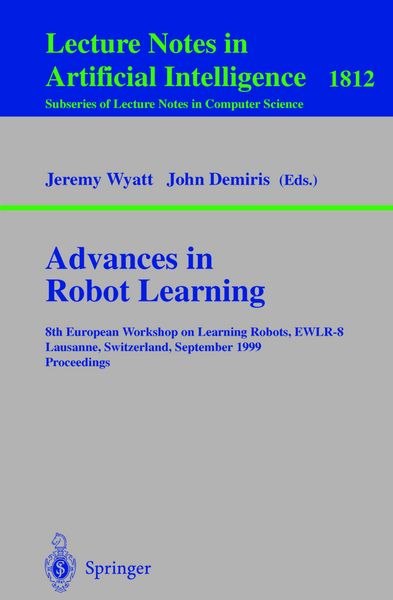
Advances in Robot Learning 8th European Workhop on Learning Robots, EWLR-8 Lausanne, Switzerland, September 18, 1999 Proceedings

51,99 €

inkl. gesetzl. MwSt., Versandkostenfrei


Beschreibung

Robot learning is an exciting and interdisciplinary ?eld. This state is re?ected in the range and form of the papers presented here. Techniques that have - come well established in robot learning are present: evolutionary methods, neural networkapproaches, reinforcement learning; as are techniques from...

Beschreibung

Robot learning is an exciting and interdisciplinary ?eld. This state is re?ected in the range and form of the papers presented here. Techniques that have - come well established in robot learning are present: evolutionary methods, neural networkapproaches, reinforcement learning; as are techniques from control t- ory, logic programming, and Bayesian statistics. It is notalbe that in many of the papers presented in this volume several of these techniques are employed in conjunction. In papers by Nehmzow, Grossmann and Quoy neural networks are utilised to provide landmark-based representations of the environment, but di?erent techniques are used in each paper to make inferences based on these representations. Biology continues to provide inspiration for the robot learning researcher. In their paper Peter Eggenberger et al. borrow ideas about the role of n- romodulators in switching neural circuits, These are combined with standard techniques from arti?cial neural networks and evolutionary computing to p- vide a powerful new algorithm for evolving robot controllers. In the ?nal paper in this volume Bianco and Cassinis combine observations about the navigation behaviour of insects with techniques from control theory to produce their visual landmarklearning system. Hopefully this convergence of engineering and biol- ical approaches will continue. A rigourous understanding of the ways techniques from these very di?erent disciplines can be fused is an important challenge if progress is to continue. Al these papers are also testament to the utility of using robots to study intelligence and adaptive behaviour.

Produktdetails

Einband

Taschenbuch

Erscheinungsdatum

11.10.2000

Abbildungen

VIII, 172 p.

Herausgeber Jeremy Wyatt + weitere

Produktdetails

Einband

Taschenbuch

Erscheinungsdatum

11.10.2000

Abbildungen

VIII, 172 p.

Herausgeber
Verlag Springer Berlin
Seitenzahl

172

Maße (L/B/H)

23,5/15,5/1,1 cm

Gewicht

283 g

Auflage

2000

Sprache

Englisch

ISBN

978-3-540-41162-8

Herstelleradresse

Springer-Verlag KG
Sachsenplatz 4-6
1201 Wien
AT

Email: ProductSafety@springernature.com

Noch keine Bewertungen vorhanden

Verfassen Sie die erste Bewertung zu diesem Artikel

Helfen Sie anderen Kundinnen und Kunden durch Ihre Meinung.

Kundinnen und Kunden meinen

Bewertungen (0)

  • Produktbild: Advances in Robot Learning
  • Produktbild: Advances in Robot Learning
  • Map Building through Self-Organisation for Robot Navigation.- Learning a Navigation Task in Changing Environments by Multi-task Reinforcement Learning.- Toward Seamless Transfer from Simulated to Real Worlds: A Dynamically—Rearranging Neural Network Approach.- How Does a Robot Find Redundancy by Itself?.- Learning Robot Control by Relational Concept Induction with Iteratively Collected Examples.- Reinforcement Learning in Situated Agents: Theoretical Problems and Practical Solutions.- A Planning Map for Mobile Robots: Speed Control and Paths Finding in a Changing Environment.- Probabilistic and Count Methods in Map Building for Autonomous Mobile Robots.- Biologically-Inspired Visual Landmark Learning for Mobile Robots.