KI-Beratung Beta

Gutscheinbedingungen

**Gültig am 01.10.2026 ab einem Mindestbestellwert von 30€ auf Spielzeug, Schreibwaren, Filme, Geschenke & Trends, Musik, tolino eReader & Zubehör, Hörbücher und Hörbuch-Downloads, nicht preisgebundene Bücher und Kalender online auf thalia.at und in der Thalia App. Einzelne Artikel können ausgeschlossen sein. Aufgrund der Buchpreisbindung sind deutschsprachige Bücher und eBooks ausgenommen. Zusätzlich ausgenommen sind Abos & Flatrates, Games, Geschenkkarten/-boxen, Shelfies, Software, Zeitschriften sowie einzelne Artikel von tonies®. Pro Einkauf einmal einlösbar. Click & Collect nur bei Onlinevorabzahlung möglich. Keine Barauszahlung. Nicht kombinierbar mit anderen Aktionen und Gutscheinen. Gutschein wird auf max. 500€ Bestellwert angerechnet. Nicht gültig für Versandkosten und Services. Preisgebundene Artikel sind vom Mindestbestellwert ausgeschlossen.

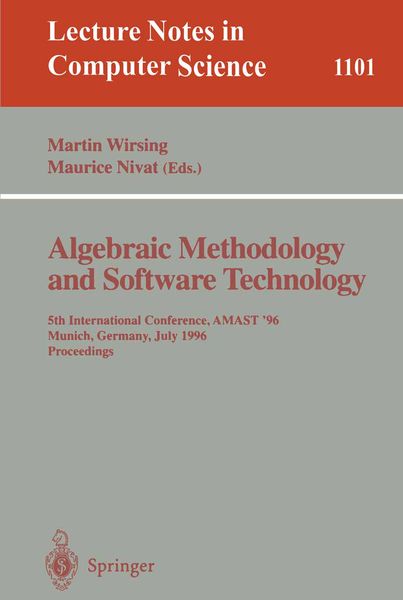
  • Produktbild: Algebraic Methodology and Software Technology
  • Produktbild: Algebraic Methodology and Software Technology
Band 1101

Algebraic Methodology and Software Technology 5th International Conference, AMAST '96 Munich, Germany, July 1996. Proceedings

99,99 €

inkl. gesetzl. MwSt., Versandkostenfrei


Beschreibung

Produktdetails

Einband

Taschenbuch

Erscheinungsdatum

19.06.1996

Abbildungen

XIII, 647 p.

Herausgeber

Martin Wirsing + weitere

Verlag

Springer Berlin

Seitenzahl

647

Maße (L/B/H)

23,5/15,5/3,6 cm

Gewicht

984 g

Auflage

1996

Sprache

Englisch

ISBN

978-3-540-61463-0

Beschreibung

Produktdetails

Einband

Taschenbuch

Erscheinungsdatum

19.06.1996

Abbildungen

XIII, 647 p.

Herausgeber

Verlag

Springer Berlin

Seitenzahl

647

Maße (L/B/H)

23,5/15,5/3,6 cm

Gewicht

984 g

Auflage

1996

Sprache

Englisch

ISBN

978-3-540-61463-0

Herstelleradresse

Springer-Verlag KG
Sachsenplatz 4-6
1201 Wien
AT

Email: ProductSafety@springernature.com

Noch keine Bewertungen vorhanden

Verfassen Sie die erste Bewertung zu diesem Artikel

Helfen Sie anderen Kundinnen und Kunden durch Ihre Meinung.

Kundinnen und Kunden meinen

Bewertungen (0)

  • Produktbild: Algebraic Methodology and Software Technology
  • Produktbild: Algebraic Methodology and Software Technology
  • Two industrial trials of formal specification.- Industrial applications of ASF+SDF.- The embedded software of an electricity meter: An experience in using formal methods in an industrial project.- Applying research results in the industrial environment: The case of the TRIO specification language.- Using heterogeneous formal methods in distributed software engineering education.- Introducing formal methods to software engineers through OMG's CORBA environment and interface definition language.- Toward a classification approach to design.- Semantic foundations for embedding HOL in Nuprl.- Free variable tableaux for a many sorted logic with preorders.- Automating induction over mutually recursive functions.- Pushouts of order-sorted algebraic specifications.- A formal framework for modules with state.- Object-oriented implementation of abstract data type specifications.- On the completeness of the equations for the Kleene star in bisimulation.- An equational axiomatization of observation congruence for prefix iteration.- Finite axiom systems for testing preorder and De Simone process languages.- Constructive semantics of Esterel: From theory to practice (abstract).- Using ghost variables to prove refinement.- Tracing the origins of verification conditions.- Preprocessing for invariant validation.- Formal verification of Signal programs: Application to a power transformer station controller.- The discrete time toolbus.- A study on the specification and verification of performance properties.- Symbolic bisimulation for timed processes.- Approximative analysis by process algebra with graded spatial actions.- Boolean formalism and explanations.- Proving existential termination of normal logic programs.- Programming in Lygon: An overview.- Some characteristics of strong innermost normalization.- On the emergence of properties in component-based systems.- Algebraic view specification.- Towards heterogeneous formal specifications.- A categorical characterization of consistency results.- Algebraic specification of reactive systems.- A model for mobile point-to-point data-flow networks without channel sharing.- Coalgebraic specifications and models of deterministic hybrid systems.- A bounded retransmission protocol for large data packets.- SPECWARE: An advanced environment for the formal development of complex software systems.- Asspegique+ an integrated specification environment providing inter-operability of tools.- Towards integrating algebraic specification and functional programming: the Opal system.- InterACT: An interactive theorem prover for algebraic specifications.- A new proof-manager and graphic interface for the Larch Prover.- TERSE: A visual environment for supporting analysis, verification and transformation of term rewriting systems.- The ToolBus coordination architecture.- ASD: The action semantic description tools.- Using occurrrence and evolving algebras for the specification of language-based programming tools.- ECHIDNA: A system for manipulating explicit choice higher dimensional automata.- Verification using PEP.- The Fc2tools set.- Programming in Lygon: A system demonstration.- CtCoq: A system presentation.- The Typelab specification and verification environment.- Incremental formalization.- Proplane: A specification development environment.- A logic-based technology to mechanize software components reuse.- TkGofer: A functional GUI library.- ALPHA — A class library for a metamodel based on algebraic graph theory.- Resolution of goals with the functional and logic programming language LPG: Impact of abstractinterpretation.- Combining reductions and computations in ReDuX.- Conditional directed narrowing.