KI-Beratung Beta

Gutscheinbedingungen

**Gültig bis 31.10.2026 ab einem Mindestbestellwert von 30€ auf Spielzeug, Schreibwaren, Filme, Geschenke & Trends, Musik, tolino eReader & Zubehör, Hörbücher und Hörbuch-Downloads, nicht preisgebundene Bücher und Kalender online auf thalia.at und in der Thalia App. Einzelne Artikel können ausgeschlossen sein. Aufgrund der Buchpreisbindung sind deutschsprachige Bücher und eBooks ausgenommen. Zusätzlich ausgenommen sind Abos & Flatrates, Games, Geschenkkarten/-boxen, Shelfies, Software, Zeitschriften sowie einzelne Artikel von tonies®. Pro Einkauf einmal einlösbar. Click & Collect nur bei Onlinevorabzahlung möglich. Keine Barauszahlung. Nicht kombinierbar mit anderen Aktionen und Gutscheinen. Gutschein wird auf max. 500€ Bestellwert angerechnet. Nicht gültig für Versandkosten und Services. Preisgebundene Artikel sind vom Mindestbestellwert ausgeschlossen.

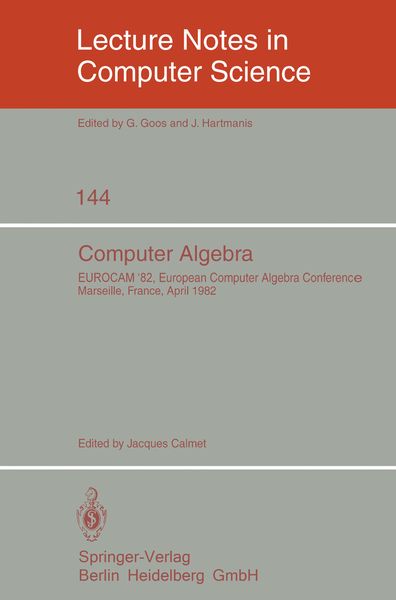
  • Produktbild: Computer Algebra
  • Produktbild: Computer Algebra
Band 144

Computer Algebra EUROCAM '82, European Computer Algebra Conference, Marseilles, France, April 5-7, 1982

51,99 €

inkl. gesetzl. MwSt., Versandkostenfrei


Beschreibung

Produktdetails

Einband

Taschenbuch

Erscheinungsdatum

08.10.1982

Abbildungen

XVI, 304 p.

Herausgeber

J. Calmet

Verlag

Springer Berlin

Seitenzahl

304

Maße (L/B/H)

23,5/15,5/1,8 cm

Gewicht

487 g

Auflage

1982

Sprache

Englisch

ISBN

978-3-540-11607-3

Beschreibung

Produktdetails

Einband

Taschenbuch

Erscheinungsdatum

08.10.1982

Abbildungen

XVI, 304 p.

Herausgeber

J. Calmet

Verlag

Springer Berlin

Seitenzahl

304

Maße (L/B/H)

23,5/15,5/1,8 cm

Gewicht

487 g

Auflage

1982

Sprache

Englisch

ISBN

978-3-540-11607-3

Herstelleradresse

Springer-Verlag KG
Sachsenplatz 4-6
1201 Wien
AT

Email: ProductSafety@springernature.com

Noch keine Bewertungen vorhanden

Verfassen Sie die erste Bewertung zu diesem Artikel

Helfen Sie anderen Kundinnen und Kunden durch Ihre Meinung.

Kundinnen und Kunden meinen

Bewertungen (0)

  • Produktbild: Computer Algebra
  • Produktbild: Computer Algebra
  • Asymptotically fast algorithms for the numerical muitiplication and division of polynomials with complex coefficients.- An adaptive hybrid algorithm for multiplying dense polynomials.- The construction of multivariate polynomials with preassigned zeros.- Lattices and factorization of polynomials over algebraic number fields.- Commutative algebra and computer algebra.- The nielsen reduction as key problem to polynomial algorithms in free groups.- The structure of near-rings of small order.- Computing double coset representatives for the generation of solvable groups.- On the determination of algebraic number fields of given discriminant.- Rewrite rule theory and abstract data type analysis.- Algebraic specifications: A constructive methodology in logic programming.- A theorem-proving approach to the Knuth-Bendix completion algorithm.- Solving symbolic equations with press.- Deterministic versus probabilistic factorization of integral polynomials.- On polynomial factorization.- Hacijan's algorithm in VAXIMA: improvements and difficulties.- The parallel Risch algorithm (I).- An algorithm to compute the equations of tangent cones.- Computer algebra systems viewed by a notorious user.- Implementation of differential geometric objects and functions with an application to extended Maxwell equations.- A sum-substitutor used as trigonometric simplifier.- Transformation of an intractable problem into a tractable problem: Evaluation of a determinant in several variables.- Algebraic computation of the solution of some nonlinear differential equations.- Factorization in cylindrical algebraic decomposition — Abstract.- Cylindrical algebraic decomposition by quantifier elimination.- Algorithms for the computation of free lattices.- Linear algebraic approach for computing polynomialresultant.- The development of a vector-based algebra system.- Nlargeing a z80 microprocessor.- Escaping from intermediate expression swell: a continuing saga.- REDUCE — A case study in algebra system development.- An algorithm to obtain formal solutions of a linear homogeneous differential equation at an irregular singular point.- Symbolic numeric methods in microwave technology.- A program in REDUCE for finding explicit solutions to certain ordinary differential equations.- An application of MACSYMA to nonlinear systems decoupling.