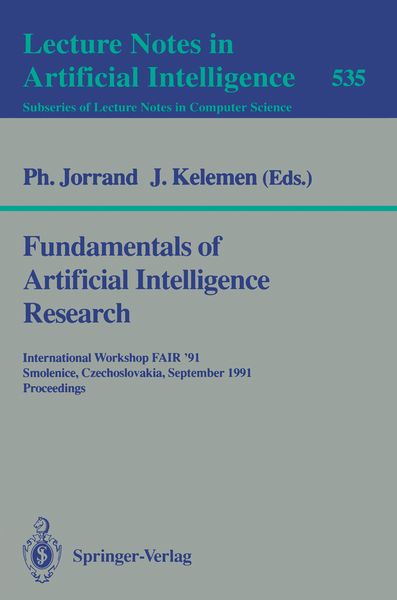
Fundamentals of Artificial Intelligence Research International Workshop FAIR '91, Smolenice, Czechoslovakia, September 8-13, 1991. Proceedings
-
- Englisch ausgewählt
51,99 €
inkl. gesetzl. MwSt.,
Beschreibung
Produktdetails
Einband
Taschenbuch
Erscheinungsdatum
28.08.1991
Abbildungen
VIII, 260 p.
Herausgeber
Philippe Jorrand + weitereVerlag
Springer BerlinSeitenzahl
260
Maße (L/B/H)
23,5/15,5/1,5 cm
Gewicht
417 g
Auflage
1991
Sprache
Englisch
ISBN
978-3-540-54507-1
contributions to the scientific programme of the
international workshop Fundamentals of Artificial
Intelligence Research, FAIR '91, held at Smolenice Castle,
Czechoslovakia, September 8-12, 1991, under the sponsorship
of the European Coordinating Committee for Artificial
Intelligence, ECCAI. FAIR'91, the first of an intended
series of international workshops, addresses issues which
belong to the theoretical foundations of artificial
intelligence considered as a discipline focused on concise
theoretical description of some aspects of intelligence by
toolsand methods adopted from mathematics, logic, and
theoretical computer science. The intended goal of the FAIR
workshops is to provide a forum for the exchange of ideas
and results in a domain where theoretical models play an
essential role. It is felt that such theoretical studies,
their development and their relations to AI experiments and
applications have to be promoted in the AI research
community.
Noch keine Bewertungen vorhanden
Verfassen Sie die erste Bewertung zu diesem Artikel
Helfen Sie anderen Kundinnen und Kunden durch Ihre Meinung.
Kurze Frage zu unserer Seite
Vielen Dank für Ihr Feedback
Wir nutzen Ihr Feedback, um unsere Produktseiten zu verbessern. Bitte haben Sie Verständnis, dass wir Ihnen keine Rückmeldung geben können. Falls Sie Kontakt mit uns aufnehmen möchten, können Sie sich aber gerne an unseren Kund*innenservice wenden.
zum Kundenservice