Gutscheinbedingungen

**Gültig bis 22.07.2026 ab einem Mindestbestellwert von 40€ auf Spielzeug, Schreibwaren, Filme, Geschenke & Trends, Musik, tolino eReader & Zubehör, Hörbücher und Hörbuch-Downloads (außer Abo), nicht preisgebundene Bücher und Kalender online auf thalia.at und in der Thalia App. Einzelne Artikel können ausgeschlossen sein. Aufgrund der Buchpreisbindung sind deutschsprachige Bücher und eBooks ausgenommen. Zusätzlich ausgenommen sind preisgebundene Artikel, Abos & Flatrates, eBooks, Games, Geschenkkarten/-boxen, Shelfies, Software, Zeitschriften sowie einzelne Artikel von tonies®. Pro Einkauf einmal einlösbar. Click & Collect nur bei Onlinevorabzahlung möglich. Keine Barauszahlung. Nicht kombinierbar mit anderen Aktionen und Gutscheinen. Gutschein wird auf max. 500€ Bestellwert angerechnet. Nicht gültig für Versandkosten und Services. Preisgebundene Artikel sind vom Mindestbestellwert ausgeschlossen.

  • Produktbild: Agent-Based Computational Demography
  • Produktbild: Agent-Based Computational Demography
- 11%

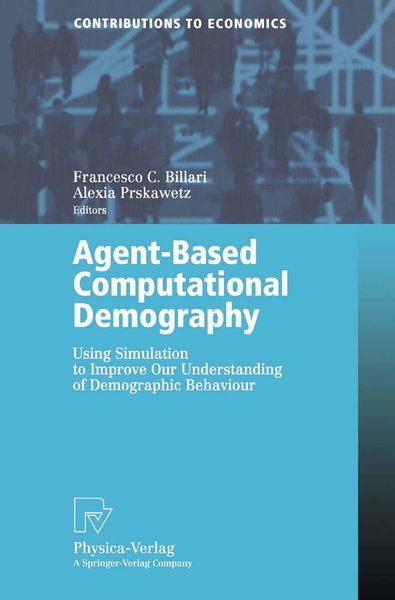
Agent-Based Computational Demography Using Simulation to Improve Our Understanding of Demographic Behaviour

11% sparen

96,99 € UVP 109,99 €

inkl. gesetzl. MwSt., Versandkostenfrei


Beschreibung

Produktdetails

Einband

Taschenbuch

Erscheinungsdatum

17.04.2003

Abbildungen

X, w. mit 77 Illustrationen

Herausgeber

Francesco C. Billari + weitere

Verlag

Physica

Seitenzahl

210

Maße (L/B/H)

23,5/15,5/1,3 cm

Gewicht

347 g

Auflage

1. Auflage

Sprache

Englisch

ISBN

978-3-7908-1550-4

Beschreibung

Produktdetails

Einband

Taschenbuch

Erscheinungsdatum

17.04.2003

Abbildungen

X, w. mit 77 Illustrationen

Herausgeber

Verlag

Physica

Seitenzahl

210

Maße (L/B/H)

23,5/15,5/1,3 cm

Gewicht

347 g

Auflage

1. Auflage

Sprache

Englisch

ISBN

978-3-7908-1550-4

Herstelleradresse

Physica Verlag
Tiergartenstr. 17
69121 Heidelberg
DE

Email: ProductSafety@springernature.com

Noch keine Bewertungen vorhanden

Verfassen Sie die erste Bewertung zu diesem Artikel

Helfen Sie anderen Kundinnen und Kunden durch Ihre Meinung.

Kundinnen und Kunden meinen

Bewertungen (0)

  • Produktbild: Agent-Based Computational Demography
  • Produktbild: Agent-Based Computational Demography
  • Introduction: Agent-Based Computational Demography.- 1 Introduction: Demographers Are Almost Absent in a Flourishing Field of Research.- 2 The Gap Between Theory and Techniques in Demography.- 3 The Added Gains of Agent-Based Computational Demography.- 4 Difficulties and Challenges for Agent-Based Computational Demography.- 5 Agent-Based Models in Demography: Examples in this Book.- 6 Discussion: The Potential Roles of Agent-Based Computational Demography.- References.- Data, Models, Theory and Reality: The Structure of Demographic Knowledge.- 1 Introduction.- 2 The Methodology of Ansley J. Coale.- 3 Nathan Keyfitz on the Fruitfulness of Abstract Modelling.- 4 A Model-Based View of Science.- 5 Elements of Science.- 6 Assessing Scientific Knowledge.- 7 Coda: On the Dangers of Dichotomies.- References.- The Role of Agent-Based Modelling in Demographic Explanation.- 1 Introduction.- 2 The Problem of Thin Social Processes.- 3 The Problem of Relating Existing Theories to ABM.- 4 Representing Social Context.- 5 Representing Cognitive Complexity.- 6 Collecting Appropriate Data.- 7 Conclusion.- References.- Diffusion Processes in Demographic Transitions: A Prospect on Using Multi Agent Simulation to Explore the Role of Cognitive Strategies and Social Interactions.- 1 Introduction.- 2 Behavioural Rules in MAS.- 3 Decision Making.- 4 The Consumat Approach.- 5 A Possible Application of the Consumat Approach: The Diffusion of Contraceptives.- 6 Prospects for Applications of the Consumat Approach in Demographic Research Questions.- 7 Conclusions.- References.- The Collapse of the Berlin Wall: Simulating State -Level East to West German Migration Patterns.- 1 Introduction.- 2 Historical Background.- 3 Evidence on East to West German Migration.- 4 Theoretical Framework.- 5 Data and Stylized Facts.- 6 An Agent-Based Simulation Model.- 7 Conclusions.- References.- Agent-Based Modeling of Householders’ Migration Behavior and Its Consequences.- 1 Introduction.- 2 Agent-Based Modelling as a Tool for Analysis of Complex Multi-Agent Systems.- 3 Abstract Models of Residential Migration.- 4 A Real-World Agent-Based Model of Residential Choice and Migration.- 5 Discussion.- 6 Conclusions.- References.- Population-Wide Marriage Patterns Produced by Individual Mate-Search Heuristics.- 1 Introduction.- 2 The Demographic Patterns of Age at Marriage.- 3 Modeling Sequential Search Processes.- 4 Implications and Conclusions.- References.- On the Cultural Evolution of Age-at-Marriage Norms.- 1 Introduction.- 2 Background.- 3 An Agent-Based Model.- 4 Results and Discussion.- 5 Summary and Prospects for Future Research.- References.- Bringing Behavior Back into Micro-Simulation: Feedback Mechanisms in Demographic Models.- 1 Introduction.- 2 Data and Methods.- 3 Results.- 4 Summary of Findings.- References.- Consequences of Mortality Crises in Pre-Modern European Towns: A Multiagent-Based Simulation Approach.- 1 Introduction.- 2 James.- 3 Implementation in James.- 4 First Experiments and Some Preliminary Results.- 5 Conclusions and Future Prospects of the Model.- References.- Agents, Hierarchies and Sustainability.- 1 Setting: A Sugarscape-Like Grid.- 2 Agents: Overview.- 3 Experiments.- 4 Conclusion.- References.