Gutscheinbedingungen

**Gültig bis 06.07.2026 auf fremdsprachige Bücher online auf thalia.at, in der Thalia App ab einem Mindestbestellwert von 30€ und in allen Thalia Buchhandlungen in Österreich. In den Buchhandlungen nur gültig auf lagernde Ware. Einzelne Artikel können ausgeschlossen sein. Ausgenommen sind preisgebundene Artikel & eBooks. Pro Einkauf einmal einlösbar. Nur gültig gegen Vorlage oder im Onlineshop hinterlegter Bonuscard. Infos zur Einlösung in der Buchhandlung sind auf der Bonuscard-Vorteilspreisseite zu finden. Click & Collect nur bei Onlinevorabzahlung möglich. Keine Einlösung bei Scan & Go-Bezahlung. Keine Barauszahlung. Nicht kombinierbar mit anderen Aktionen und Gutscheinen. Gutschein wird auf max. 500€ Bestellwert angerechnet. Nicht gültig für Versandkosten und Services.

  • Produktbild: Business Cycles in the Contemporary World
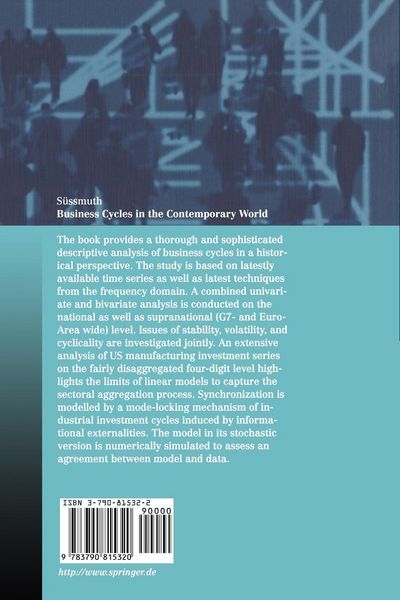
  • Produktbild: Business Cycles in the Contemporary World
  • Produktbild: Business Cycles in the Contemporary World

Business Cycles in the Contemporary World Description, Causes, Aggregation, and Synchronization

49,99 €

inkl. gesetzl. MwSt., Versandkostenfrei


Beschreibung

Produktdetails

Einband

Taschenbuch

Erscheinungsdatum

27.11.2002

Verlag

Physica

Seitenzahl

165

Maße (L/B/H)

23,5/15,5/1,1 cm

Gewicht

283 g

Auflage

1. Auflage

Sprache

Englisch

ISBN

978-3-7908-1532-0

Beschreibung

Produktdetails

Einband

Taschenbuch

Erscheinungsdatum

27.11.2002

Verlag

Physica

Seitenzahl

165

Maße (L/B/H)

23,5/15,5/1,1 cm

Gewicht

283 g

Auflage

1. Auflage

Sprache

Englisch

ISBN

978-3-7908-1532-0

Herstelleradresse

Physica Verlag
Tiergartenstr. 17
69121 Heidelberg
DE

Email: ProductSafety@springernature.com

Noch keine Bewertungen vorhanden

Verfassen Sie die erste Bewertung zu diesem Artikel

Helfen Sie anderen Kundinnen und Kunden durch Ihre Meinung.

Kundinnen und Kunden meinen

Bewertungen (0)

  • Produktbild: Business Cycles in the Contemporary World
  • Produktbild: Business Cycles in the Contemporary World
  • Produktbild: Business Cycles in the Contemporary World
  • 1. Introduction.- 1.1 Business Cycle Research: 21st Century Perspective.- 1.1.1 The Classic View.- 1.1.2 From CBC to RBC School.- 1.2 Recent Empirical Findings in Favor of CBC.- 1.1.1 Aggregate Investment Fluctuations and Business Cycles.- 1.1.2 The Cyclicality of the Aggregate Investment Series.- 1.1.3 Investment, the RBC View and Disaggregated Dynamics.- I.Methodology.- 2. General Considerations and Historiography.- 2.1 Methodologies: Econometrics vs. Natural Sciences.- 2.2 The Econometric Approach to Time Series Analysis.- 3. The Analysis of Cyclical Dynamics.- 3.1 The Detrending Problem.- 3.2 Volatility and Spectral Analysis.- 3.2.1 Contribution-to-Variance Analysis.- 3.2.2 Spectral Analysis: The Univariate Case.- 3.2.3 The Analysis of Complex Roots.- 3.2.4 Spectral Analysis: The Multivariate Case.- II. National, Supra- and International Cycles.- 4. The G7 and Eurol5 Economies: 1960 - 2000.- 4.1 Data and Strategy.- 4.2 National Uni- and Bivariate Stylized Facts.- 4.2.1 General Salient Facts.- 4.2.2 Robust Univariate Stylized Facts: National Cycles.- 4.2.3 Robust Bivariate Stylized Facts: National Cycles.- 4.3 Supranational Bivariate Stylized Facts.- 5. Mode-Locking and the Global Cycle.- 5.1 Introduction and Motivation of the Discussion.- 5.2 Generalizing Economic Cycles’ Mode-Lock Modelling.- 5.3 A Model Incorporating Information Externalities.- 5.1.1 The Model without Information Externalities.- 5.1.2 Introducing Information Externalities.- 5.1.3 Calibration of the Model and Some Simulations.- 5.4 Outlook and Concluding Remark.- III. The Sectoral Constitution of Macro-Cycles.- 6. An Aggregation Problem for Linear Models?.- 6.1 Description of US Business Cycles.- 6.1.1 Business Cycles in Central US NIPA Time Series.- 6.1.2 Cycles in Disaggregated US Manufacturing Investment.- 6.2 Testing Autoregressivity and Aggregate Feedback.- 6.3 Linear Models of the Aggregation Process.- 6.4 Evaluation of Linear Models.- 7. The Synchronization of Sectoral Cycles.- 7.1 Definitions of Synchronization.- 7.2 A Recent Approach: Method and Findings.- 7.3 The “Shift-Win“-Approach: Method and Findings.- 8. A Non-Linear Synchronization Model.- 8.1 Theoretical Underpinning of the Model.- 8.1.1 The Medium-Term Investment Objective: Smoothing.- 8.1.2 The Short-Term Investment Objective: Herding.- 8.1.3 The Integrated Model: Smoothing and Herding.- 8.1.4 The Synchronization Mechanism.- 8.2 A Thorough Simulation Study.- 8.2.1 Calibration as an Alternative to Estimation.- 8.2.2 Setting Up the Simulation Strategy and Determining Priors.- 8.2.3. Monte Carlo Simulations of the Model Incorporating Shocks.- 8.2.4 Evaluation of the Model and Outlook.- 9. Conclusion.- Abbreviations.- References.