

• Produktbild: Applying Soft Computing in Defining Spatial Relations
  • Produktbild: Applying Soft Computing in Defining Spatial Relations
  • Produktbild: Applying Soft Computing in Defining Spatial Relations
Band 106

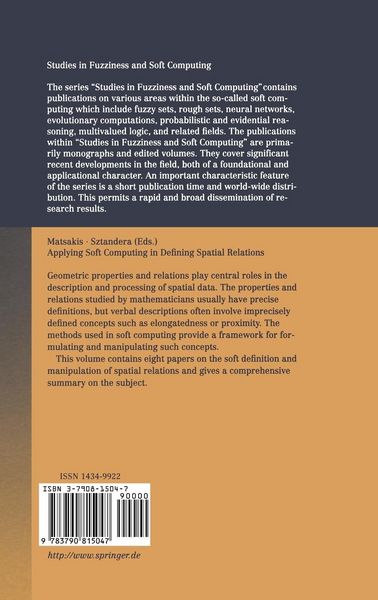
Applying Soft Computing in Defining Spatial Relations

49,99 €

inkl. gesetzl. MwSt., Versandkostenfrei


Beschreibung

Produktdetails

Einband

Gebundene Ausgabe

Erscheinungsdatum

04.09.2002

Abbildungen

XIII, 205 p.

Herausgeber

Pascal Matsakis + weitere

Verlag

Physica

Seitenzahl

205

Maße (L/B/H)

24,1/16/1,7 cm

Gewicht

506 g

Auflage

2002

Sprache

Englisch

ISBN

978-3-7908-1504-7

Beschreibung

Produktdetails

Einband

Gebundene Ausgabe

Erscheinungsdatum

04.09.2002

Abbildungen

XIII, 205 p.

Herausgeber

Verlag

Physica

Seitenzahl

205

Maße (L/B/H)

24,1/16/1,7 cm

Gewicht

506 g

Auflage

2002

Sprache

Englisch

ISBN

978-3-7908-1504-7

Herstelleradresse

Physica
Tiergartenstr. 17
69121 Heidelberg, Neckar
Deutschland
Email: sdc-bookservice@springer.com
Url: www.springer.com
Telephone: +49 6221 3454301
Fax: +49 6221 4878177

Noch keine Bewertungen vorhanden

Verfassen Sie die erste Bewertung zu diesem Artikel

Helfen Sie anderen Kundinnen und Kunden durch Ihre Meinung.

Kundinnen und Kunden meinen

Bewertungen (0)

  • Produktbild: Applying Soft Computing in Defining Spatial Relations
  • Produktbild: Applying Soft Computing in Defining Spatial Relations
  • Produktbild: Applying Soft Computing in Defining Spatial Relations
  • Fuzzifying Spatial Relations.- 1 Motivation.- 2 Imprecision in Spatial Relations.- 3 Applying Allen’s Algorithm to Fuzzy Relations.- 4 Other Fuzzy Relations.- 5 Fuzzy Constraint Satisfaction.- 6 Conclusion.- Acknowledgement.- References.- Path Composition of Positional Relations Integrating Qualitative and Fuzzy Knowledge.- 1 Introduction.- 2 Composition of Positional Relations.- 3 Path Composition.- 4 Integrating Qualitative and Fuzzy Knowledge.- 5 Fuzzy Knowledge Coming from Particular Distance Systems.- 6 Conclusions.- Acknowledgments.- References.- Spatial Relations Based on Dominance of Fuzzy Sets.- 1 Spatial Relations.- 2 Spatial Relations Among Fuzzy Subsets.- References.- Mathematical Morphology and Spatial Relationships: Quantitative, Semi-Quantitative and Symbolic Settings.- 1 Introduction.- 2 Basic Morphological Operations, Fuzzy and Logical Extensions.- 3 Computing Spatial Relationships from Mathematical Morphology: Quantitative and Semi-Quantitative Setting.- 4 Spatial Representations of Spatial Relationships.- 5 Symbolic Representations of Spatial Relationships.- 6 Conclusion.- References.- Understanding the Spatial Organization of Image Regions by Means of Force Histograms: A Guided Tour.- 1 Introduction.- 2 The Notion of the Histogram of Forces.- 3 Comparing Force Histograms.- 4 Defining Fuzzy Spatial Relations.- 5 Generating Linguistic Spatial Descriptions.- 6 Conclusion.- Acknowledgments.- References.- Fuzzy Spatial Relationships and Mobile Agent Technology in Geospatial Information Systems.- 1 Introduction.- 2 Background.- 3 Fuzzy Directional Relationships and Querying.- 4 Extensions to the Model.- 5 Intelligent Agent Technology.- 6 Summary and Future Work.- Acknowledgments.- References.- Using Fuzzy Spatial Relations to Control Movement Behavior ofMobile Objects in Spatially Explicit Ecological Models.- 1 Introduction.- 2 Modeling Habitat Landscape.- 3 Fuzzy Control of Spatial Movement.- 4 Discussion.- References.- A Fuzzy Set Model of Approximate Linguistic Terms in Descriptions of Binary Topological Relations Between Simple Regions.- 1 Introduction.- 2 Related Literature.- 3 Fuzziness of Approximate Linguistic Terms — Preliminary Cognitive Evidences.- 4 A Fuzzy Set Model of Approximate Linguistic Terms.- 5 Discussion.- 6 Concluding Remarks.- Acknowledgements.- References.- About the Editors.