Gutscheinbedingungen

**Gültig bis 06.07.2026 auf fremdsprachige Bücher online auf thalia.at, in der Thalia App ab einem Mindestbestellwert von 30€ und in allen Thalia Buchhandlungen in Österreich. In den Buchhandlungen nur gültig auf lagernde Ware. Einzelne Artikel können ausgeschlossen sein. Ausgenommen sind preisgebundene Artikel & eBooks. Pro Einkauf einmal einlösbar. Nur gültig gegen Vorlage oder im Onlineshop hinterlegter Bonuscard. Infos zur Einlösung in der Buchhandlung sind auf der Bonuscard-Vorteilspreisseite zu finden. Click & Collect nur bei Onlinevorabzahlung möglich. Keine Einlösung bei Scan & Go-Bezahlung. Keine Barauszahlung. Nicht kombinierbar mit anderen Aktionen und Gutscheinen. Gutschein wird auf max. 500€ Bestellwert angerechnet. Nicht gültig für Versandkosten und Services.

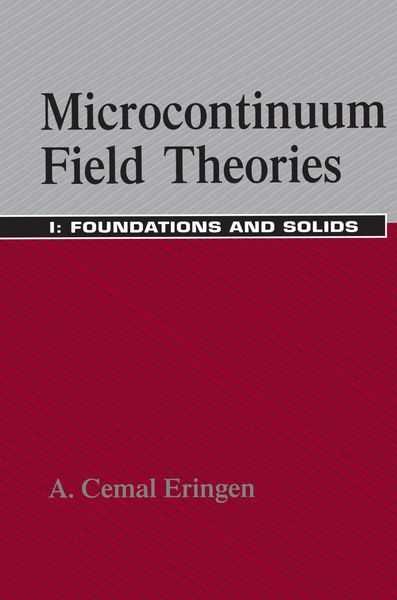
  • Produktbild: Microcontinuum Field Theories
  • Produktbild: Microcontinuum Field Theories
- 12%

Microcontinuum Field Theories I. Foundations and Solids

12% sparen

239,99 € UVP 274,99 €

inkl. gesetzl. MwSt., Versandkostenfrei


Beschreibung

Produktdetails

Einband

Gebundene Ausgabe

Erscheinungsdatum

04.06.1999

Verlag

Springer Us

Seitenzahl

325

Maße (L/B/H)

24,1/16/2,4 cm

Gewicht

685 g

Auflage

1999

Sprache

Englisch

ISBN

978-0-387-98620-3

Beschreibung

Produktdetails

Einband

Gebundene Ausgabe

Erscheinungsdatum

04.06.1999

Verlag

Springer Us

Seitenzahl

325

Maße (L/B/H)

24,1/16/2,4 cm

Gewicht

685 g

Auflage

1999

Sprache

Englisch

ISBN

978-0-387-98620-3

Herstelleradresse

Springer-Verlag KG
Sachsenplatz 4-6
1201 Wien
AT

Email: GPSR Kontakt

Noch keine Bewertungen vorhanden

Verfassen Sie die erste Bewertung zu diesem Artikel

Helfen Sie anderen Kundinnen und Kunden durch Ihre Meinung.

Kundinnen und Kunden meinen

Bewertungen (0)

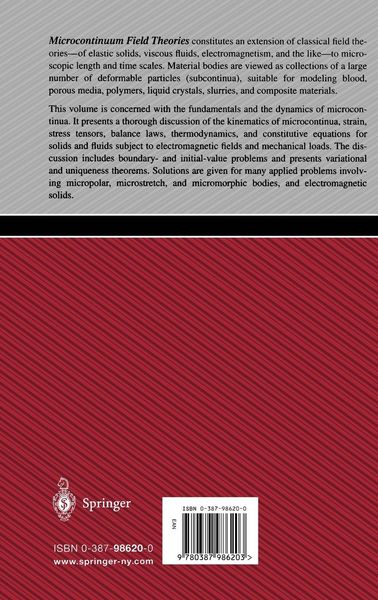
  • Produktbild: Microcontinuum Field Theories
  • Produktbild: Microcontinuum Field Theories
  • 1 Kinematics.- 1.0 Scope.- 1.1 Physical Picture.- 1.2 Motions and Deformations.- 1.3 Rotation.- 1.4 Microstretch and Micropolar Continua.- 1.5 Strain Measures.- 1.6 Relative Motion, Relative Strain Measures.- 1.7 Compatibility Conditions.- 1.8 Material Time-Rate of Tensors.- 1.9 Objective Tensors.- 1.10 Mass, Inertia, Momenta, Kinetic Energy.- 1 Problems.- 2 Stress.- 2.0 Scope.- 2.1 Balance of Energy.- 2.2 Balance Laws.- 2.3 Second Law of Thermodynamics.- 2.4 Dissipation Potential.- 2 Problems.- 3 Constitutive Equations.- 3.0 Scope.- 3.1 Constitutive Equations of Elastic Solids.- 3.2 Constitutive Equations of Fluids.- 3.3 Thermodynamic Restrictions on Solids.- 3.4 Thermodynamic Restrictions on Fluids.- 3.5 Thermodynamic Restrictions on.- Memory-Dependent Solids.- 3.6 Thermodynamic Restrictions on.- Memory-Dependent Fluids.- 3 Problems.- 4 Electromagnetic Interactions.- 4.0 Scope.- 4.1 Balance Laws.- 4.2 Constitutive Equations of E-M Solids.- 4.3 Constitutive Equations of E-M Fluids.- 4.4 Memory-Dependent E-M Solids.- 4.5 Memory-Dependent E-M Fluids.- 4 Problems.- 5 Theory of Micropolar Elasticity.- 5.0 Scope.- 5.1 Linear Constitutive Equations.- 5.2 Material Symmetry and Stability.- 5.3 Isotropic Solids.- 5.4 Formulation of Problems in Micropolar Elasticity.- 5.5 Mixed Boundary-Initial Value Problems in Linear Theory.- 5.6 Curvilinear Coordinates.- 5.7 Uniqueness Theorem.- 5.8 Reciprocal Theorem.- 5.9 Variational Principles.- 5.10 Conservation Laws.- 5.11 Plane Harmonic Waves.- 5.12 Material Moduli.- 5.13 Experimental Attempts.- 5.14 Displacement Potentials.- 5.15 Micropolar Waves in Half-Space.- 5.16 Micropolar Surface Waves.- 5.17 Micropolar Waves in Plates.- 5.18 Fundamental Solutions.- 5.19 Problems of Sphere and Spherical Cavity.- 5.20 Axisymmetric Problems.- 5.21 Penny-Shaped Crack.- 5.22 Stress Distribution Around an Elliptic Hole.- 5.23 Stress Concentration Around a Circular Hole.- 5.24 Nonlinear Waves.- 5.25 Fundamental Solutions in Micropolar Elastostatics.- 5.26 Dislocations and Disclinations.- 5.27 Theory of Micropolar Plates.- 5.28 Flexural Waves.- 5.29 Other Contributions.- 5 Problems.- 6 Microstretch Elasticity.- 6.0 Scope.- 6.1 Linear Constitutive Equations.- 6.2 Uniqueness Theorem.- 6.3 Plane Harmonic Microstretch Waves.- 6.4 A Lattice Model for Microstretch Continuum.- 6.5 Fundamental Solutions.- 6.6 Microstretch Surface Waves.- 6.7 Other Solutions.- 6 Problems.- 7 Micromorphic Elasticity.- 7.0 Scope.- 7.1 Linear Constitutive Equations.- 7.2 Passage to Microstretch and Micropolar Theories.- 7.3 Restrictions on Material Moduli.- 7.4 Plane Harmonic Waves.- 7.5 Other Contributions.- 7 Problems.- 8 Electromagnetic Interactions.- 8.0 Scope.- 8.1 Linear Constitutive Equations.- 8.2 Material Stability.- 8.3 Balance Laws.- 8.4 Field Equations.- 8.5 Piezoelectric Waves.- 8 Problems.- References.