KI-Beratung Beta

Gutscheinbedingungen

**Gültig bis 30.11.2026 auf Spielzeug, Schreibwaren, Filme, Geschenke & Trends, Musik, tolino eReader & Zubehör, Hörbücher und Hörbuch-Downloads, nicht preisgebundene Bücher und Kalender online auf thalia.at und in der Thalia App. Einzelne Artikel können ausgeschlossen sein. Aufgrund der Buchpreisbindung sind deutschsprachige Bücher und eBooks ausgenommen. Zusätzlich ausgenommen sind Abos & Flatrates, Games, Geschenkkarten/-boxen, Shelfies, Software, Zeitschriften sowie einzelne Artikel von tonies®. Pro Einkauf einmal einlösbar. Nur gültig mit im Onlineshop hinterlegter Bonuscard. Click & Collect nur bei Onlinevorabzahlung möglich. Keine Barauszahlung. Nicht kombinierbar mit anderen Aktionen und Gutscheinen. Gutschein wird auf max. 500€ Bestellwert angerechnet. Nicht gültig für Versandkosten und Services.

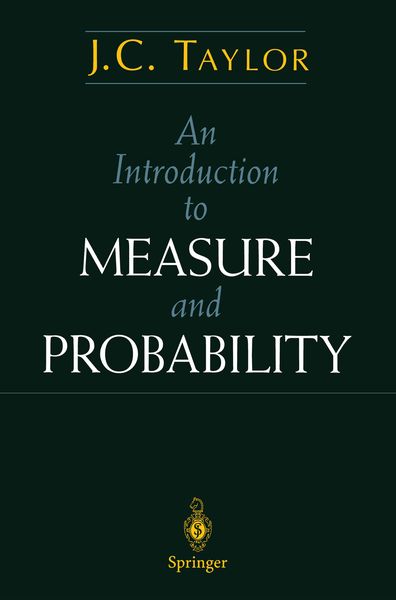
  • Produktbild: An Introduction to Measure and Probability
  • Produktbild: An Introduction to Measure and Probability
- 11%

An Introduction to Measure and Probability

11% sparen

72,99 € UVP 82,49 €

inkl. gesetzl. MwSt., Versandkostenfrei


Beschreibung

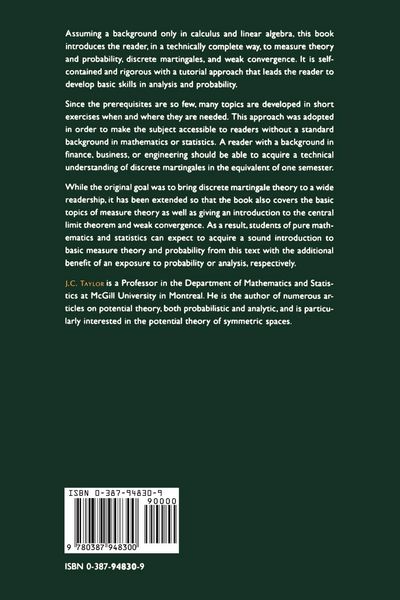
Assuming only calculus and linear algebra, this book introduces the reader in a technically complete way to measure theory and probability, discrete martingales, and weak convergence. It is self- contained and rigorous with a tutorial approach that leads the reader to develop basic skills in analysis...

Beschreibung

Assuming only calculus and linear algebra, this book introduces the reader in a technically complete way to measure theory and probability, discrete martingales, and weak convergence. It is self- contained and rigorous with a tutorial approach that leads the reader to develop basic skills in analysis and probability. While the original goal was to bring discrete martingale theory to a wide readership, it has been extended so that the book also covers the basic topics of measure theory as well as giving an introduction to the Central Limit Theory and weak convergence. Students of pure mathematics and statistics can expect to acquire a sound introduction to basic measure theory and probability. A reader with a background in finance, business, or engineering should be able to acquire a technical understanding of discrete martingales in the equivalent of one semester. J. C. Taylor is a Professor in the Department of Mathematics and Statistics at McGill University in Montreal. He is the author of numerous articles on potential theory, both probabilistic and analytic, and is particularly interested in the potential theory of symmetric spaces.

Produktdetails

Einband

Taschenbuch

Erscheinungsdatum

15.11.1996

Abbildungen

XVII, 324 p. 4 illus.

Verlag Springer Us

Produktdetails

Einband

Taschenbuch

Erscheinungsdatum

15.11.1996

Abbildungen

XVII, 324 p. 4 illus.

Verlag Springer Us
Seitenzahl

324

Maße (L/B/H)

23,5/15,5/1,8 cm

Gewicht

487 g

Auflage

1997

Sprache

Englisch

ISBN

978-0-387-94830-0

Herstelleradresse

Springer-Verlag GmbH
Tiergartenstr. 17
69121 Heidelberg
DE

Email: ProductSafety@springernature.com

Noch keine Bewertungen vorhanden

Verfassen Sie die erste Bewertung zu diesem Artikel

Helfen Sie anderen Kundinnen und Kunden durch Ihre Meinung.

Kundinnen und Kunden meinen

Bewertungen (0)

  • Produktbild: An Introduction to Measure and Probability
  • Produktbild: An Introduction to Measure and Probability
  • I. Probability Spaces.- 1. Introduction to ?.- 2. What is a probability space? Motivation.- 3. Definition of a probability space.- 4. Construction of a probability from a distribution function.- 5. Additional exercises*.- II. Integration.- 1. Integration on a probability space.- 2. Lebesgue measure on ? and Lebesgue integration.- 3. The Riemann integral and the Lebesgue integral.- 4. Probability density functions.- 5. Infinite series again.- 6. Differentiation under the integral sign.- 7. Signed measures and the Radon-Nikodym theorem*.- 8. Signed measures on ? and functions of bounded variation*.- 9. Additional exercises*.- III. Independence and Product Measures.- 1. Random vectors and Borel sets in ?n.- 2. Independence.- 3. Product measures.- 4. Infinite products.- 5. Some remarks on Markov chains*.- 6. Additional exercises*.- IV. Convergence of Random Variables and Measurable Functions.- 1. Norms for random variables and measurable functions.- 2. Continuous functions and Lp*.- 3. Pointwise convergence and convergence in measure or probability.- 4. Kolmogorov’s inequality and the strong law of large numbers.- 5. Uniform integrability and truncation*.- 6. Differentiation: the Hardy—Littlewood maximal function*.- 7. Additional exercises*.- V. Conditional Expectation and an Introduction to Martingales.- 1. Conditional expectation and Hilbert space.- 2. Conditional expectation.- 3. Sufficient statistics*.- 4. Martingales.- 5. An introduction to martingale convergence.- 6. The three-series theorem and the Doob decomposition.- 7. The martingale convergence theorem.- VI. An Introduction to Weak Convergence.- 1. Motivation: empirical distributions.- 2. Weak convergence of probabilities: equivalent formulations.- 3. Weak convergence of random variables.- 4.Empirical distributions again: the Glivenko—Cantelli theorem.- 5. The characteristic function.- 6. Uniqueness and inversion of the characteristic function.- 7. The central limit theorem.- 8. Additional exercises*.- 9. Appendix*.