KI-Beratung Beta

  • Produktbild: A Theory of Objects
  • Produktbild: A Theory of Objects

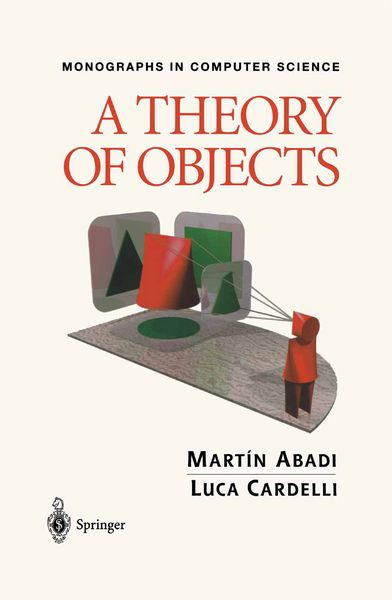
A Theory of Objects

252,99 €

inkl. gesetzl. MwSt., Versandkostenfrei


Beschreibung

Procedural languages are generally well understood and their formal foundations cast in the forms of various lambda-calculi. For object- oriented languages however the situation is not as clear-cut. In this book the authors propose and develop a different approach by developing object calculi in which...

Beschreibung

Procedural languages are generally well understood and their formal foundations cast in the forms of various lambda-calculi. For object- oriented languages however the situation is not as clear-cut. In this book the authors propose and develop a different approach by developing object calculi in which objects are treated as primitives. Using object calculi,the authors are able to explain both the semantics of objects and their typing rules and demonstrate how to develop all of the most important concepts of object-oriented programming languages: self, dynamic dispatch, classes, inheritance, protected and private methods, prototyping, subtyping, covariance and contravariance, and method specialization. Many researchers and graduate students will find this an important development of the underpinnings of object-oriented programming.

Produktdetails

Einband

Gebundene Ausgabe

Erscheinungsdatum

09.08.1996

Abbildungen

XIII, 396 p.

Verlag Springer Us

Produktdetails

Einband

Gebundene Ausgabe

Erscheinungsdatum

09.08.1996

Abbildungen

XIII, 396 p.

Verlag Springer Us
Seitenzahl

396

Maße (L/B/H)

24,1/16/2,8 cm

Gewicht

741 g

Auflage

1996

Sprache

Englisch

ISBN

978-0-387-94775-4

Herstelleradresse

Springer-Verlag GmbH
Europaplatz 3
69115 Heidelberg
DE

Email: ProductSafety@springernature.com

Noch keine Bewertungen vorhanden

Verfassen Sie die erste Bewertung zu diesem Artikel

Helfen Sie anderen Kundinnen und Kunden durch Ihre Meinung.

Kundinnen und Kunden meinen

Bewertungen (0)

  • Produktbild: A Theory of Objects
  • Produktbild: A Theory of Objects
  • Prologue.- Review: Object-Oriented Features.- 1 Object Orientation.- 2 Class-Based Languages.- 3 Advanced Class-Based Features.- 4 Object-Based Languages.- 5 Modeling Object-Oriented Languages.- I: Untyped and First-Order Calculi.- 6 Untyped Calculi.- 7 First-Order Calculi.- 8 Subtyping.- 9 Recursion.- 10 Untyped Imperative Calculi.- 11 First-Order Imperative Calculi.- 12 A First-Order Language.- II: Second-Order Calculi.- 13 Second-Order Calculi.- 14 A Semantics.- 15 Definable Covariant Self Types.- 16 Primitive Covariant Self Types.- 17 Imperative Calculi with Self Types.- 18 Interpretations of Object Calculi.- 19 A Second-Order Language.- III: Higher-Order Calculi.- 20 A Higher-Order Calculus.- 21 A Language with Matching.- Epilogue.- APPENDIX: Rules and Proofs.- A Fragments.- A.1 Simple-Objects Fragments.- A.2 Other Typing Fragments.- A.3 Other Equational Fragments.- B Systems.- C Proofs.- C.1 Proof of the Variance Lemma from Section 13.3.- C.2 Proof of the Variance Lemma from Section 16.4.- C.3 Deriving the Rules for ?-Objects from Section 15.1.2.- C.4 Denotational Soundness of Equational Rules.- List of Figures.- List of Tables.- List of Notations.- List of Languages.