Gutscheinbedingungen

**Gültig von 22.06.2026 ab 19 Uhr bis 23.06.2026 24 Uhr auf Spielzeug, Schreibwaren, Filme, Geschenke & Trends, Musik, tolino eReader & Zubehör, Hörbücher und Hörbuch-Downloads (außer Abo), nicht preisgebundene Bücher und Kalender online auf thalia.at und in der Thalia App. Einzelne Artikel können ausgeschlossen sein. Aufgrund der Buchpreisbindung sind deutschsprachige Bücher und eBooks ausgenommen. Zusätzlich ausgenommen sind preisgebundene Artikel, Abos & Flatrates, eBooks, Games, Geschenkkarten/-boxen, Shelfies, Software, Zeitschriften sowie einzelne Artikel von tonies®. Pro Einkauf einmal einlösbar. Click & Collect nur bei Onlinevorabzahlung möglich. Keine Barauszahlung. Nicht kombinierbar mit anderen Aktionen und Gutscheinen. Gutschein wird auf max. 500€ Bestellwert angerechnet. Nicht gültig für Versandkosten und Services.

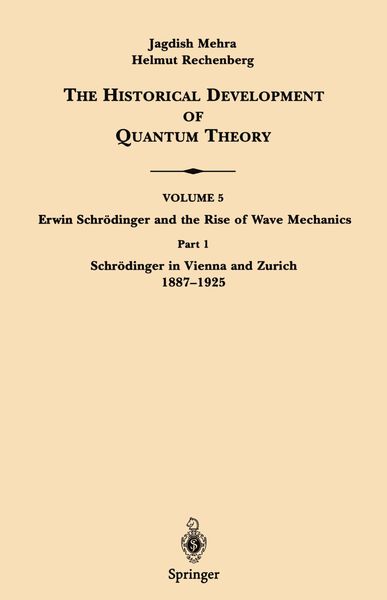
  • Produktbild: Part 1 Schrödinger in Vienna and Zurich 1887–1925
  • Produktbild: Part 1 Schrödinger in Vienna and Zurich 1887–1925

Part 1 Schrödinger in Vienna and Zurich 1887–1925

327,99 €

inkl. gesetzl. MwSt., Versandkostenfrei


Beschreibung

Produktdetails

Einband

Taschenbuch

Erscheinungsdatum

28.12.2000

Abbildungen

XVIII, 1 schwarzweisse Abbildungen, 1 Abbildungenton-Abb.

Verlag

Springer Us

Seitenzahl

366

Maße (L/B/H)

23,5/15,5/2,1 cm

Gewicht

608 g

Auflage

1st ed. 1987. 1st softcover printing 2000

Sprache

Englisch

ISBN

978-0-387-95179-9

Beschreibung

Rezension

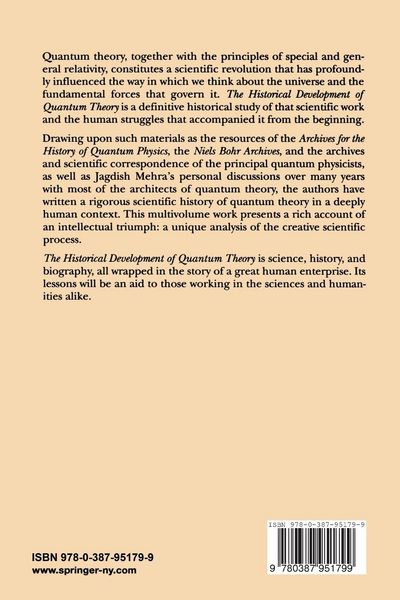
Comments by distinguished physicists on "The Historical Development of Quantum Theory":||"…the most definitive work undertaken by anyone on this vast and most important development in the history of physics. Jagdish Mehra, trained in theoretical physics under Pauli, Heisenberg, and Dirac, pursued the vision of his youth to write about the historical and conceptual development of quantum theory in the 20th century…This series of books on the HDQT has thus become the most authentic and permanent source of our knowledge of how quantum theory, its extensions and applications developed. My heartfelt congratulations."|-Hans A. Bethe, Nobel Laureate||"A thrilling and magnificent achievement!"|-Subrahmanyan Chandrasekhar, FRS, Nobel Laureate||"…capture(s) precisely, accurately, and thoroughly the very essence and all the fundamental details of the theory, and that is a remarkable achievement…I have greatly enjoyed reading these books and learned so many new things from them. This series of books will remain a permanent source of knowledge about the creation and development of quantum theory. Congratulations!"|-Paul A. Dirac, FRS, Nobel Laureate||"The wealth and accuracy of detail in 'The Historical Development of Quantum Theory' are breathtaking."|-Richard P. Feynman, Nobel Laureate

Produktdetails

Einband

Taschenbuch

Erscheinungsdatum

28.12.2000

Abbildungen

XVIII, 1 schwarzweisse Abbildungen, 1 Abbildungenton-Abb.

Verlag

Springer Us

Seitenzahl

366

Maße (L/B/H)

23,5/15,5/2,1 cm

Gewicht

608 g

Auflage

1st ed. 1987. 1st softcover printing 2000

Sprache

Englisch

ISBN

978-0-387-95179-9

Herstelleradresse

Springer-Verlag GmbH
Tiergartenstr. 17
69121 Heidelberg
DE

Email: ProductSafety@springernature.com

Kundinnen und Kunden meinen

0 Bewertungen

Informationen zu Bewertungen

Zur Abgabe einer Bewertung ist eine Anmeldung im Konto notwendig. Die Authentizität der Bewertungen wird von uns nicht überprüft. Wir behalten uns vor, Bewertungstexte, die unseren Richtlinien widersprechen, entsprechend zu kürzen oder zu löschen.

Die Bewertungen sind nach Format, Anzahl Sterne und Datum sortiert.

Verfassen Sie die erste Bewertung zu diesem Artikel

Helfen Sie anderen Kund*innen durch Ihre Meinung

Kundinnen und Kunden meinen

0 Bewertungen filtern

  • Produktbild: Part 1 Schrödinger in Vienna and Zurich 1887–1925
  • Produktbild: Part 1 Schrödinger in Vienna and Zurich 1887–1925
  • Contents—Part 1.- General Introduction.- From the Bohr-Sommerfeld Theory to Quantum Mechanics.- The Göttingen Matrix Mechanics and Its Extensions.- Status of Quantum Mechanics in Early 1926.- Schrödinger’s Work in Physics Prior to 1926.- Schrödinger’s Personality and Method of Work.- Schrödinger and Wave Mechanics.- of this Volume.- I Schrödinger in Vienna (1887–1920).- 1.1 The Viennese Background.- An Aperçu of Austrian and Viennese History.- The Viennese Culture.- Austrian Science up to the Middle of the Nineteenth Century.- The Foundation of Physics in Vienna.- Pioneers in Medicine and Psychoanalysis, Biology and Physiology.- Physiology, Physics and Cognition: Ernst Mach.- A Giant in Theoretical Physics: Ludwig Boltzmann.- Do Atoms Really Exist: Boltzmann or Mach?.- 1.2 The Young Erwin Schrödinger, His Youth and Study at the University of Vienna.- Schrodinger’s Family and School Education.- Student at the University of Vienna.- Franz Exner and His School.- Fritz Hasenöhrl and Theoretical Physics.- Felix Ehrenhaft and Other Viennese Experimentalists: The Search for Subelectrons.- Two Pioneers of Radioactivity: Stefan Meyer and Egon von Schweidler.- The Institut für Radiumforschung in Vienna.- Relativity and Quantum Theory in Vienna.- Schrödinger as a Graduate Student.- 1.3 The Early Scientific Work of Erwin Schrödinger.- Assistant at the II. Physikalisches Institut.- Schrodinger’s Paper on the Kinetic Theory of Magnetism.- Ambitious Speculations on the Kinetics of Dielectric Substances and on the Theory of Solids.- The Review Article on Dielectrics and a Paper on Anomalous Dispersion.- Research on Atmospheric Electricity in Vienna.- The Penetrating Radiation and a Paper of Schrödinger.- The Hasenöhrl School.- Schrödinger and the Atomic Structure of Solids.- Lattice Dynamics and a Proof of the Atomic Structure of Solids.- 1.4 From Brilliant Pre-War to Dark War Days.- The Discovery of Cosmic Radiation (Höhenstrahlung).- The 85th Versammlung Deutscher Naturforscher und Ärzte.- Einstein’s Talk at Vienna and Its Consequences.- Schrödinger as Privatdozent.- World War I and the Physicists.- Artillery Officer Erwin Schrödinger.- Heavy Losses.- The Later War Years.- 1.5 Schrödinger’s Scientific Work in World War I.- An Analysis of Smoluchowski’s Work on Fluctuations.- On the Evaluation of Statistical Data.- The Ultimate Proof of Schweidler’s Fluctations.- Schrödinger and Quantum Statistical Theory in Vienna.- Problems and Ideas Connected with General Relativity.- Physics and Philosophy.- Atomic and Quantum Theory.- II Waves and Quanta: Preludes to Wave Mechanics.- II.1 The Dual Nature of Light.- The Origin of the Classical Concepts of Particles and Waves.- X- and ?-Rays.- Bragg’s Corpuscular-Pair Theory of ?-Rays.- Heat Radiation and Its Description (1777–1900).- The Hypothesis of Light-Quanta (1905–1909).- Proof of the Light-Quantum (1916–1922).- II.2 The Side-Stages of the Development in Quantum Theory.- Early Centres of Quantum Theory: Berlin, Berne, Copenhagen, Munich.- Post-World War Centres and the Sommerfeld School.- Side-Stages: Breslau and Vienna.- Adolf Smekal and Quantum Theory in Vienna (1919–1923).- The Physikalische Berichte and the Encyklopädie Article; Start of Otto Halpern.- Paris and Modern Physics from 1900.- Quantum Theory in Post-War Paris: Dauvillier, L. Brillouin and L. de Broglie.- II.3 A Newcomer to Zurich: Erwin Schrödinger.- The Zurich Background: History of the City, University and E.T.H..- Mathematics and Physics at the E.T.H. (1855–1900).- Einstein, Debye and von Laue at the University of Zurich (1909–1914).- Physics in Zurich until 1920: Greinacher, Meyer, Bär, Ratnowsky, Wolfke.- Environment after World War I: Weyl, Debye, Scherrer, Schrödinger.- Development of Colour Theory from Newton to Schrödinger.- Colour Metric.- Causality and Chance: The Nature of Physical Laws.- II.4 Atomic Structure and Physiological Optics: General Research.- Programme of Schrödinger in Zurich (1922–1925).- Getting into the Theory of Atomic Structure.- Schrödinger’s First ‘Student’: Erwin Fues.- A Letter from Fritz London Concerning an Extension of Weyl’s Theory.- A Notable Property of Quantum Orbits.- Light-Quantum, Doppler Effect and Compton Effect.- Statistical Energy and Momentum Conservation.- Scientific Exchange with Sommerfeld.- Work on Colour Vision.- Last Papers on Colour Theory.- II.5 Problems and Extensions of Statistical Mechanics.- Isotopes and Gibbs’ Paradox.- Extension of the Theory of the Specific Heats of Solids.- Thermal Equilibrium Between Light and Acoustic Rays.- Outlines of a Book on ‘Molecular Statistics’ and Related Unpublished Notes.- Handbook Article on Specific Heats and a Scattered Publication.- Specific Heat of the Hydrogen Molecule.- The Problem of Gas Degeneracy.- Planck’s Problematic Division by N!.- Towards a New Statistics?.