Gutscheinbedingungen

**Gültig am 28.06.2026 auf Spielzeug, Schreibwaren, Filme, Geschenke & Trends, Musik, tolino eReader & Zubehör, Hörbücher und Hörbuch-Downloads (außer Abo), nicht preisgebundene Bücher und Kalender online auf thalia.at und in der Thalia App. Einzelne Artikel können ausgeschlossen sein. Aufgrund der Buchpreisbindung sind deutschsprachige Bücher und eBooks ausgenommen. Zusätzlich ausgenommen sind preisgebundene Artikel, Abos & Flatrates, eBooks, Games, Geschenkkarten/-boxen, Shelfies, Software, Zeitschriften sowie einzelne Artikel von tonies®. Pro Einkauf einmal einlösbar. Click & Collect nur bei Onlinevorabzahlung möglich. Keine Barauszahlung. Nicht kombinierbar mit anderen Aktionen und Gutscheinen. Gutschein wird auf max. 500€ Bestellwert angerechnet. Nicht gültig für Versandkosten und Services.

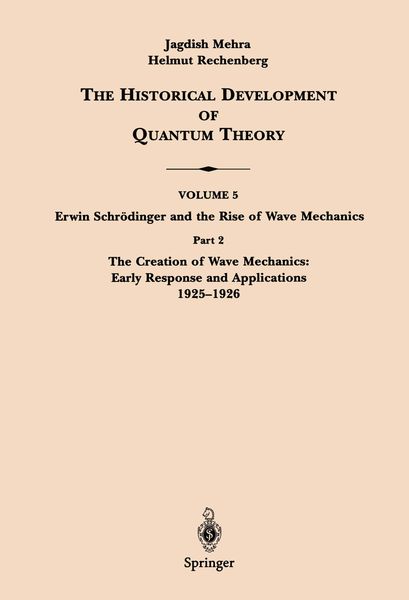
Produktbild: Part 2 The Creation of Wave Mechanics; Early Response and Applications 1925–1926

Part 2 The Creation of Wave Mechanics; Early Response and Applications 1925–1926 The Creation of Wave Mechanics; Early Response and Applications 1925-1926

297,99 €

inkl. gesetzl. MwSt., Versandkostenfrei


Beschreibung

Produktdetails

Einband

Taschenbuch

Erscheinungsdatum

28.12.2000

Abbildungen

VIII, 1 schwarzweisse Abbildungen, 1 Abbildungenton-Abb.

Verlag

Springer Us

Seitenzahl

614

Maße (L/B/H)

23,5/15,5/3,4 cm

Gewicht

967 g

Auflage

1st ed. 1987. 1st softcover printing 2000

Sprache

Englisch

ISBN

978-0-387-95180-5

Beschreibung

Rezension

Comments by distinguished physicists on "The Historical Development of Quantum Theory": "the most definitive work undertaken by anyone on this vast and most important development in the history of physics. Jagdish Mehra, trained in theoretical physics under Pauli, Heisenberg, and Dirac, pursued the vision of his youth to write about the historical and conceptual development of quantum theory in the 20th century. This series of books on the HDQT has thus become the most authentic and permanent source of our knowledge of how quantum theory, its extensions and applications developed. My heartfelt congratulations." -Hans A. Bethe, Nobel Laureate "A thrilling and magnificent achievement!" -Subrahmanyan Chandrasekhar, FRS, Nobel Laureate "capture(s) precisely, accurately, and thoroughly the very essence and all the fundamental details of the theory, and that is a remarkable achievement. I have greatly enjoyed reading these books and learned so many new things from them. This series of books will remain a permanent source of knowledge about the creation and development of quantum theory. Congratulations!" -Paul A. Dirac, FRS, Nobel Laureate "The wealth and accuracy of detail in he Historical Development of Quantum Theory'are breathtaking." -Richard P. Feynman, Nobel Laureate

Produktdetails

Einband

Taschenbuch

Erscheinungsdatum

28.12.2000

Abbildungen

VIII, 1 schwarzweisse Abbildungen, 1 Abbildungenton-Abb.

Verlag

Springer Us

Seitenzahl

614

Maße (L/B/H)

23,5/15,5/3,4 cm

Gewicht

967 g

Auflage

1st ed. 1987. 1st softcover printing 2000

Sprache

Englisch

ISBN

978-0-387-95180-5

Herstelleradresse

Springer-Verlag GmbH
Tiergartenstr. 17
69121 Heidelberg
DE

Email: ProductSafety@springernature.com

Kundinnen und Kunden meinen

0 Bewertungen

Informationen zu Bewertungen

Zur Abgabe einer Bewertung ist eine Anmeldung im Konto notwendig. Die Authentizität der Bewertungen wird von uns nicht überprüft. Wir behalten uns vor, Bewertungstexte, die unseren Richtlinien widersprechen, entsprechend zu kürzen oder zu löschen.

Die Bewertungen sind nach Format, Anzahl Sterne und Datum sortiert.

Verfassen Sie die erste Bewertung zu diesem Artikel

Helfen Sie anderen Kund*innen durch Ihre Meinung

Kundinnen und Kunden meinen

0 Bewertungen filtern

Weitere Artikel finden Sie in

  • Produktbild: Part 2 The Creation of Wave Mechanics; Early Response and Applications 1925–1926
  • Contents—Part 2.- III The Creation of Wave Mechanics.- III.1 Scientific Exchange with Planck and Einstein.- Interaction with Colleagues in Zurich.- Growing Reputation and the Solvay Conference of 1924.- The Innsbruck Naturforscherversammlung.- Planck’s Lecture and Other Interesting Lectures.- Einstein, the Nature of Light and Bose Statistics.- First Correspondence with Einstein.- Planck’s Preliminary Response to Einstein.- Schrödinger’s Analysis of Entropy Definitions.- Planck’s Last Word.- A New Stimulus from Einstein.- The Energy States of the Ideal Gas.- Continued Scientific Exchange with Berlin.- III.2 First Steps Towards the Hydrogen Equation.- Philosophical Interlude: Consciousness and Continuity.- Lecture Course on Spectra.- Obtaining the Thesis of Louis de Broglie.- Phase Waves and Stationary Orbits of Atoms.- New Description of Radiation and Exchange with Landé.- The Zurich Kolloquium.- Memorandum on the Eigenvibrations of the Hydrogen Atom.- Solution of the Relativistic Hydrogen Equation.- The Failure of the Relativistic Hydrogen Equation.- On Einstein’s Gas Theory.- Application of the Darwin-Fowler Method.- Phase Waves in Gas Theory.- Relations Between Gas Theory and the Hydrogen Equation.- III.3 The Nonrelativistic Hydrogen Equation.- An Important Correspondence with Wien.- On the Nature of Radiation and a Repetition of the Michelson Experiment.- A Breakthrough During the Christmas Vacation.- The Notebook on ‘Eigenwertproblem des Atoms. I’ (First Part).- Assistance from Colleagues in Zurich.- Quantization as a Variational Principle.- Discrete and Continuous Eigenvalues of the Nonrelativistic.- Hydrogen Equation.- III.4 Sources of Undulatory Mechanics.- Preliminary Arguments Given in the First Paper.- Louis de Broglie’s Mechanical-Optical Analogy.- Hamilton’s Optical-Mechanical Analogy.- Relations Between Wave and Geometrical Optics.- A Hertzian Formulation of General Relativity and the Mechanical-Optical Analogy.- III.5 Foundations of Undulatory Mechanics.- First Response from Munich.- Relation to the Old Theory of Ritz?.- Preparations for the Second Communication.- Does the Scheme Presented Exhaust the Undulatory Content?.- The Mechanical Analogue of the Debye-Laue Construction.- Undulatory Mechanics and the Wave Equation.- IV Early Response and Applications.- IV. 1 The Scheme Starts to Work.- The Discovery of ‘Hilbert’s Mathematics’.- The Oscillator in Wave Mechanics.- Several Degrees of Freedom and Degeneracy.- The Rotator and the Diatomic Molecule in Wave Mechanics.- Undulatory Perturbation Theory.- The Transcription of Epstein’s Calculation of the Stark Effect.- Perturbation Theory for Many Degrees of Freedom.- IV.2 Response to Wave Mechanics I. The Early Phase.- Continuation of the Correspondence with Wilhelm Wien and Arnold Sommerfeld.- Letters to and from Berlin.- Some Penetrating Questions by Hendrik Lorentz.- IV.3 Formal Equivalence of Wave Mechanics and the Quantum Mechanics of Born, Heisenberg, Jordan and Dirac.- First Hints of a Relation of Wave Mechanics to Quantum Mechanics.- A Paper by Lanczos on the Field-like Representation of Quantum Mechanics.- Operators and Equivalence of Wave and Matrix Equations.- A Letter by Wolfgang Pauli.- Pauli, Lanczos’ Field-like Formulation and the Born-Wiener Approach.- A Combination of Schrödinger’s and Lanczos’ Theory.- The Solution of the Equations of Quantum Dynamics: Carl Eckart’s Equivalence Demonstration.- IV.4 Response to Wave Mechanics II. Applications and Extensions.- The Stuttgart Meeting: Talks by Fues and Wentzel.- Band Spectra in Undulatory Mechanics.- Intensity Calculations of Schrödinger, Pauli, Wentzel and Fues.- European-American Competition on the Stark Effect and the Hydrogen Spectrum.- Collision Processes in Wave Mechanics.- Cracking the Helium Problem.- The Advent of Fermi Statistics.- Symmetry Properties of Wave Functions and Quantum Statistics.- IV.5 Towards an Undulatory Interpretation of Atomic Phenomena.- Early Expressions of Schrodinger’s Undulatory View of Atomic Processes.- Return to ‘Anschaulichkeit’ in Atomic theory.- The ‘Real’ Wave Equation: Time-Dependent Theory, Perturbation Scheme and Application to Dispersion Phenomena.- The Physical Meaning of the Field Scalar and Schrödinger’s Talks in Berlin and Munich.- The Relativistic and Magnetic Field Equation.- Schrödinger’s Visit to Copenhagen.- Two Crucial Problems: The Compton Effect and the Photoelectric Effect.- Further Successes of Wave Mechanics in the Second Half of 1926.- Schrödinger’s Rising Fame: Continuing Problem of Interpretation, Visit to America and Berlin Professorship.- References.- Author Index.