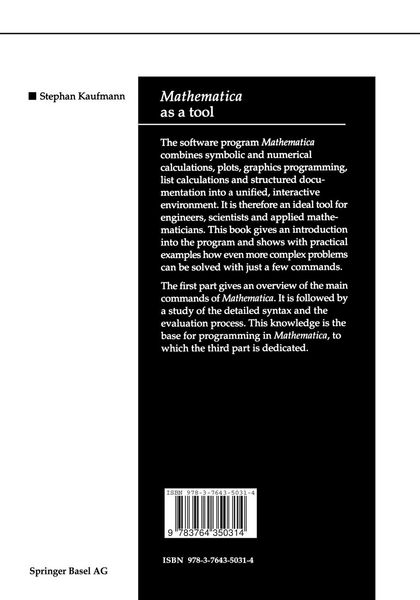
• Produktbild: Mathematica as a Tool
  • Produktbild: Mathematica as a Tool

Mathematica as a Tool An introduction with practical examples

46,99 €

inkl. gesetzl. MwSt., Versandkostenfrei


Beschreibung

Produktdetails

Einband

Taschenbuch

Erscheinungsdatum

01.09.1994

Verlag

Springer Basel

Seitenzahl

430

Maße (L/B/H)

25,4/17,8/2,5 cm

Gewicht

836 g

Auflage

1. Auflage

Sprache

Englisch

ISBN

978-3-7643-5031-4

Beschreibung

Rezension

"Provides engineers, scientists, and applied mathematicians with a compact introduction to Mathematica, a software program combining computer algebra, graphics, animations, an elegant programming language, and numerical tools. Helps readers gain the skills necessary to use the program as a tool in their work."

-- Journal of Economic Literature


"This book is a valuable introductory textbook on Mathematica and is very useful to scientists and engineers who use Mathematica in their work."

-- Zentralblatt Math


"This book is very nicely written and recommended to everybody."

-- EMS Newsletter

Produktdetails

Einband

Taschenbuch

Erscheinungsdatum

01.09.1994

Verlag

Springer Basel

Seitenzahl

430

Maße (L/B/H)

25,4/17,8/2,5 cm

Gewicht

836 g

Auflage

1. Auflage

Sprache

Englisch

ISBN

978-3-7643-5031-4

Herstelleradresse

Springer-Verlag GmbH
Tiergartenstr. 17
69121 Heidelberg
DE

Email: GPSR Kontakt

Noch keine Bewertungen vorhanden

Verfassen Sie die erste Bewertung zu diesem Artikel

Helfen Sie anderen Kundinnen und Kunden durch Ihre Meinung.

Kundinnen und Kunden meinen

Bewertungen (0)

  • Produktbild: Mathematica as a Tool
  • Produktbild: Mathematica as a Tool
  • 1. Basics.- 1.1 Getting Started.- 1.1.1 Starting and Quitting.- 1.1.2 Interrupting and Quitting.- 1.2 Help!.- 1.3 Numerical Calculations.- 1.3.1 Simple Examples.- 1.3.2 External Packages: Units.- 1.3.3 Large Numbers: The RSA Public-Key Cryptosystem.- 1.4 Symbolic Calculations.- 1.4.1 Polynomials.- 1.4.2 Equations.- 1.4.3 Calculus.- 1.5 Plots: Different Pendulums.- 1.5.1 Two-Dimensional Plots.- 1.5.2 Example: The Triple Pendulum.- 1.5.3 Three-Dimensional Graphics and Animation: A Rotating Double Pendulum.- 1.5.4 Parametric Plots: A Rotating Double Pendulum.- 1.5.5 Plotting Data: The Random Generator.- 1.6 Lists.- 1.6.1 Creating and Formatting Lists.- 1.6.2 Calculations with Lists, Pure Functions.- 1.6.3 List Manipulation: The Cross Product.- 1.6.4 Vectors, Matrices, Tensors: The Jacobian.- 1.6.5 Eigenvectors and Eigenvalues: An Oscillator.- 1.7 Graphics Programming.- 1.7.1 The Structure of Graphics.- 1.7.2 Example: Animation of the Triple Pendulum.- 1.7.3 Example: The Oscillator.- 1.8 More Selected Tools.- 1.8.1 Graphics and Sound.- 1.8.2 Complex Numbers.- 1.8.3 Sums, Products, Series.- 1.8.4 Data Analysis,Interpolation.- 1.8.5 Transformations.- 1.8.6 Mathematical Functions.- 1.8.7 Polynomials.- 1.8.8 Linear Algebra, Linear Programming.- 1.8.9 File Manipulation.- 1.8.10 Custom Configuration.- 1.8.11 Resources.- 2. Structure.- 2.1 Expressions.- 2.1.1 The Structure of Expressions.- 2.1.2 Working with Parts of Expressions.- 2.2 Patterns.- 2.2.1 Simple Patterns.- 2.2.2 Restricted Patterns.- 2.2.3 More Complicated Patterns.- 2.2.4 Example: A Simple Integrator.- 2.3 Transformation Rules and Definitions.- 2.3.1 Transformation Rules.- 2.3.2 Definitions.- 2.3.3 Attributes.- 2.4 Evaluation and Tools for Programming.- 2.4.1 Standard Evaluation.- 2.4.2 Special Evaluation.- 2.4.3 Conditionals, Loops, and Control Structures.- 2.5 Modularity.- 2.5.1 Local Variables and Constants.- 2.5.2 Contexts and Packages.- 2.6 Strings, Text, Messages.- 2.6.1 Printing Text.- 2.6.2 Arranging Text.- 2.6.3 Built-in Formats.- 2.6.4 Formats for Numbers.- 2.6.5 Subscripts and Superscripts.- 2.6.6 Custom Formats.- 2.6.7 Strings.- 2.6.8 Messages.- 3. Programming.- 3.1 Programming Methodologies.- 3.1.1 Procedural Programming.- 3.1.2 Recursive Programming.- 3.1.3 Functional Programming.- 3.1.4 Rule-Based Programming.- 3.1.5 Programming with Constraint-Propagation.- 3.1.6 Data Types, Object-Oriented Programming.- 3.2 Developing Programs.- 3.2.1 Debugging.- 3.2.2 Example: NonNegativeQ?.- 3.2.3 Example: AbsArg?.- 3.2.4 Example: RSA?.- 3.2.5 Example: Perturbation?.- 3.3 Numerics.- 3.3.1 Compiling Expressions: Fractals.- 3.3.2 Precision and Accuracy.- 3.3.3 Controlling Numerical Built-in Functions.- 3.4 Long Calculations: RSA.- 3.4.1 Primes for RSA.- 3.4.2 Saving Results in a File.- 3.4.3 External Programs, Calculations in the Background.- References.