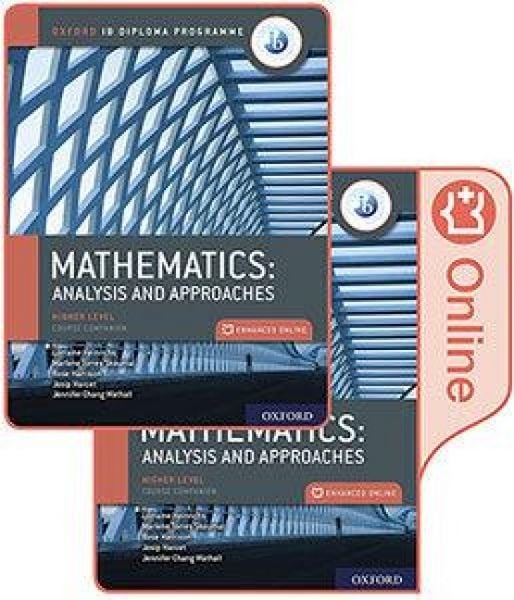
Produktbild: Oxford IB Diploma Programme: IB Mathematics: analysis and approaches

Oxford IB Diploma Programme: IB Mathematics: analysis and approaches

87,99 €

inkl. gesetzl. MwSt., Versandkostenfrei


Produktdetails

ISBN

978-0-19-842716-2

Erscheinungsdatum

21.03.2019

Bundesländer

Baden-Württemberg + weitere

Unterrichtsfächer

Mathematik

Klassenstufen

11. Klasse + weitere

Schulformen

Gesamtschule + weitere

Einband

Taschenbuch

Verlag

Oxford Children's Books

Seitenzahl

832

Maße (L/B/H)

20/25,7/3,6 cm

Gewicht

1760 g

Sprache

Englisch

Produktdetails

ISBN

978-0-19-842716-2

Erscheinungsdatum

21.03.2019

Bundesländer

  • Baden-Württemberg
  • Bayern
  • Berlin
  • Brandenburg
  • Bremen
  • Hamburg
  • Hessen
  • Mecklenburg-Vorpommern
  • Niedersachsen
  • Nordrhein-Westfalen
  • Rheinland-Pfalz
  • Saarland
  • Sachsen
  • Sachsen-Anhalt
  • Schleswig-Holstein
  • Thüringen

Unterrichtsfächer

Mathematik

Klassenstufen

  • 11. Klasse
  • 12. Klasse
  • 13. Klasse

Schulformen

  • Gesamtschule
  • Gymnasium

Einband

Taschenbuch

Verlag

Oxford Children's Books

Seitenzahl

832

Maße (L/B/H)

20/25,7/3,6 cm

Gewicht

1760 g

Sprache

Englisch

Herstelleradresse

Libri GmbH
Europaallee 1
36244 Bad Hersfeld
DE

Email: gpsr@libri.de

Dazu passende Produkte

Noch keine Bewertungen vorhanden

Verfassen Sie die erste Bewertung zu diesem Artikel

Helfen Sie anderen Kundinnen und Kunden durch Ihre Meinung.

Kundinnen und Kunden meinen

Bewertungen (0)

Weitere Artikel finden Sie in

  • Produktbild: Oxford IB Diploma Programme: IB Mathematics: analysis and approaches
    • From patterns to generalizations: sequences and series
    • 1.1: Sequences, series and sigma notation
    • 1.2: Arithmetic and geometric sequences and series
    • 1.3: Proof
    • 1.4: Counting principles and the binomial theorem
    • Representing relationships: introducing functions
    • 2.1: Functional relationships
    • 2.2: Special functions and their graphs
    • 2.3: Classification of functions
    • 2.4: Operations with functions
    • 2.5: Function transformations
    • Expanding the number system: complex numbers
    • 3.1: Quadratic equations and inequalities
    • 3.2: Complex numbers
    • 3.3: Polynomial equations and inequalities
    • 3.4: The fundamental theorem of algebra
    • 3.5: Solving equations and inequalities
    • 3.6: Solving systems of linear equations
    • Measuring change: differentiation
    • 4.1: Limits, continuity and convergence
    • 4.2: The derivative of a function
    • 4.3: Differentiation rules
    • 4.4: Graphical interpretation of the derivatives
    • 4.5: Applications of differential calculus
    • 4.6: Implicit differentiation and related rates
    • Analysing data and quantifying randomness: statistics and probability
    • 5.1: Sampling
    • 5.2: Descriptive statistics
    • 5.3: The justification of statistical techniques
    • 5.4: Correlation, causation and linear regression
    • Relationships in space: geometry and trigonometry
    • 6.1: The properties of 3D space
    • 6.2: Angles of measure
    • 6.3: Ratios and identities
    • 6.4: Trigonometric functions
    • 6.5: Trigonometric equations
    • Generalizing relationships: exponents, logarithms and integration
    • 7.1: Integration as antidifferentiation and definite integrals
    • 7.2: Exponents and logarithms
    • 7.3: Derivatives of exponential and logarithmic functions; tangents and normals
    • 7.4: Integration techniques
    • Modelling changes: more calculus
    • 8.1: Areas and volumes
    • 8.2: Kinematics
    • 8.3: Ordinary differential equations (ODEs)
    • 8.4: Limits revisited
    • Modelling 3D space: vectors
    • 9.1: Geometrical representation of vectors
    • 9.2: Introduction to vector algebra
    • 9.3: Scalar product and its properties
    • 9.4: Vector equations of a line
    • 9.5: Vector product and properties
    • 9.6: Vector equation of a plane
    • 9.7: Lines, planes and angles
    • 9.8: Application of vectors
    • Equivalent systems of representation: more complex numbers
    • 10.1: Forms of a complex number
    • 10.2: Operations with complex numbers in polar form
    • 10.3: Powers and roots of complex numbers in polar form
    • Valid comparisons and informed decisions: probability distributions
    • 11.1: Axiomatic probability systems
    • 11.2: Probability distributions
    • 11.3: Continuous random variables
    • 11.4: Binomial distribution
    • 11.5: The normal distribution
    • Exploration