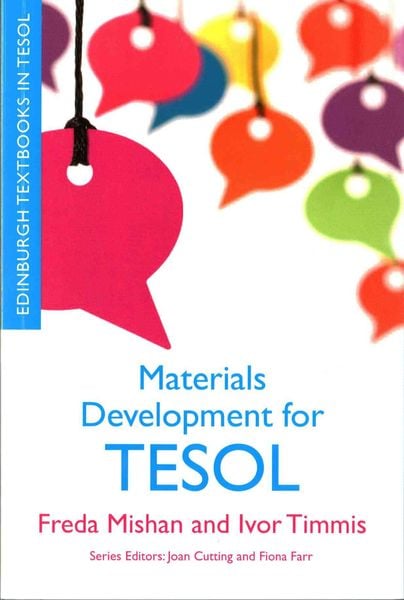
Produktbild: Materials Development for TESOL

Materials Development for TESOL

31,99 €

inkl. gesetzl. MwSt., Versandkostenfrei


Produktdetails

ISBN

978-0-7486-9136-4

Erscheinungsdatum

03.06.2015

Einband

Taschenbuch

Verlag

Edinburgh University Press

Seitenzahl

232

Maße (L/B/H)

23,3/15,4/2 cm

Gewicht

409 g

Sprache

Englisch

Produktdetails

ISBN

978-0-7486-9136-4

Erscheinungsdatum

03.06.2015

Einband

Taschenbuch

Verlag

Edinburgh University Press

Seitenzahl

232

Maße (L/B/H)

23,3/15,4/2 cm

Gewicht

409 g

Sprache

Englisch

Herstelleradresse

Libri GmbH
Europaallee 1
36244 Bad Hersfeld
DE

Email: gpsr@libri.de

Noch keine Bewertungen vorhanden

Verfassen Sie die erste Bewertung zu diesem Artikel

Helfen Sie anderen Kundinnen und Kunden durch Ihre Meinung.

Kundinnen und Kunden meinen

Bewertungen (0)

Weitere Artikel finden Sie in

  • Produktbild: Materials Development for TESOL
  • Series Editors' Preface; Acknowledgements; Abbreviations; List of Figures; Chapter 1: Introduction; 1.1.Why do we need a book about Materials Development?; 1.2. What are Materials?; 1.3. What do we need Materials for?; 1.4. The Purpose of this Book; 1.5. The Structure of the Book; Chapter 2: Principled Materials Development; 2.1. Introduction; 2.2. The Importance of Affective and Cognitive Challenge in Language Learning Materials; 2.3. Input and Output in Language Learning Materials; 2.4. Awareness-raising and Language Learning Materials; 2.5. Further Reading One; 2.6. Further Reading Two; 2.7. Conclusion; 2.8. Additional Readings; Chapter 3: Materials, Methods and Contexts; 3.1. Introduction; 3.2. English Language Teaching and the Global Diversification of English; 3.3. Pedagogy and English Language Teaching Materials; 3.4. English Language Teaching Coursebooks; 3.5. Further Reading One; 3.6. Further Reading Two; 3.7. Conclusion; 3.8. Additional Readings; Chapter 4: Materials Evaluation and Adaptation; 4.1. Introduction; 4.2. The Need for Principled Evaluation;4.3. The Nature of Evaluation; 4.4. Materials Adaptation; 4.5. Further Reading One; 4.6 Further Reading Two; 4.7. Conclusion; 4.8. Additional Readings; Chapter 5: Reconceptualising Materials for the Technological Environment; 5.1. Introduction; 5.2. The Context: Normalisation of Technology; 5.3. Reconceptualising Materials for the Technological Environment: Materials as Products and Materials as Processes; 5.4. A Template for Materials using Technology; 5.5. Further Reading One; 5.6. Further Reading Two; 5.7. Conclusion; 5.8. Additional Readings; Chapter 6: Materials to Develop Reading and Listening Skills; 6.1. Introduction; 6.2. Materials to Develop Reading Skills; 6.3. Materials to Develop Listening Skills; 6.4. Further Reading One; 6.5. Further Reading Two; 6.6. Conclusion; 6.7. Additional Readings; Chapter 7: Materials to Develop Speaking and Writing Skills; 7.1. Introduction; 7.2 Materials to Develop Speaking Skills; 7.3. Materials to Develop Writing Skills; 7.4. Further Reading One; 7.5. Further Reading Two; 7.6. Conclusion; 7.7 Additional Readings; Chapter 8: Materials for Vocabulary and Grammar; 8.1. Introduction; 8.2. Materials for Vocabulary; 8.3. Materials for Teaching Grammar; 8.4. Further Reading One; 8.5. Further Reading Two; 8.6. Conclusion; 8.7. Additional Readings; Chapter 9: Materials Design: From Process to Product; 9.1. Introduction; 9.2. The Production Sequence; 9.3. The Production Sequence in Action; 9.4. The Creative Process; 9.5. Further Reading One; 9.6. Further Reading Two; 9.7. Conclusion; 9.8. Additional Readings; Chapter 10: Conclusion