Gutscheinbedingungen

**Gültig nur für Bestellungen an die Wunsch-Poststation bis 10.06.2026 auf Spielzeug, Schreibwaren, Filme, Geschenke & Trends, Musik, tolino eReader & Zubehör, Hörbücher und Hörbuch-Downloads (außer Abo), nicht preisgebundene Bücher und Kalender online auf thalia.at und in der Thalia App. Einzelne Artikel können ausgeschlossen sein. Aufgrund der Buchpreisbindung sind deutschsprachige Bücher und eBooks ausgenommen. Zusätzlich ausgenommen sind preisgebundene Artikel, Abos & Flatrates, eBooks, Games, Geschenkkarten/-boxen, Shelfies, Software, Zeitschriften sowie einzelne Artikel von tonies®. Pro Einkauf einmal einlösbar. Kein Click & Collect möglich. Keine Barauszahlung. Nicht kombinierbar mit anderen Aktionen und Gutscheinen. Gutschein wird auf max. 500€ Bestellwert angerechnet. Nicht gültig für Versandkosten und Services.

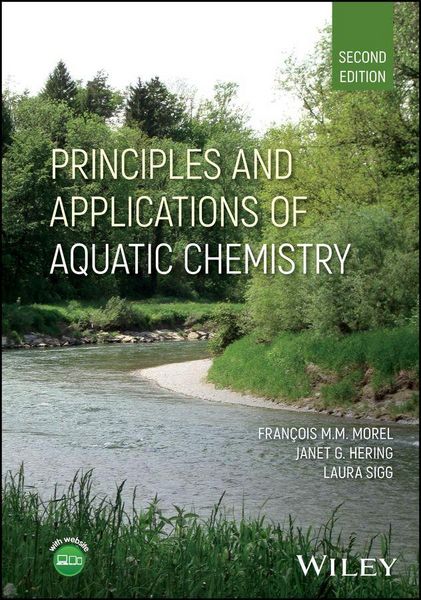
Produktbild: Principles and Applications of Aquatic Chemistry

Principles and Applications of Aquatic Chemistry

149,99 €

inkl. gesetzl. MwSt., Versandkostenfrei


Beschreibung

Produktdetails

Einband

Gebundene Ausgabe

Erscheinungsdatum

17.09.2025

Verlag

Wiley

Seitenzahl

400

Maße (L/B/H)

25,7/18,3/2,5 cm

Gewicht

953 g

Auflage

2nd edition

Sprache

Englisch

ISBN

978-1-119-80236-5

Beschreibung

Produktdetails

Einband

Gebundene Ausgabe

Erscheinungsdatum

17.09.2025

Verlag

Wiley

Seitenzahl

400

Maße (L/B/H)

25,7/18,3/2,5 cm

Gewicht

953 g

Auflage

2nd edition

Sprache

Englisch

ISBN

978-1-119-80236-5

Herstelleradresse

Libri GmbH
Europaallee 1
36244 Bad Hersfeld
DE

Email: gpsr@libri.de

Kundinnen und Kunden meinen

0 Bewertungen

Informationen zu Bewertungen

Zur Abgabe einer Bewertung ist eine Anmeldung im Konto notwendig. Die Authentizität der Bewertungen wird von uns nicht überprüft. Wir behalten uns vor, Bewertungstexte, die unseren Richtlinien widersprechen, entsprechend zu kürzen oder zu löschen.

Die Bewertungen sind nach Format, Anzahl Sterne und Datum sortiert.

Verfassen Sie die erste Bewertung zu diesem Artikel

Helfen Sie anderen Kund*innen durch Ihre Meinung

Kundinnen und Kunden meinen

0 Bewertungen filtern

  • Produktbild: Principles and Applications of Aquatic Chemistry
  • Preface xi

    About the Companion Website xiv

    1 Introduction to the Chemistry of Natural Waters 1

    1.1 Water: Its Properties and Global Cycle 1

    1.2 Chemical Processes in Natural Waters 6

    1.3 Conservation, Thermodynamics, and Kinetics 13

    References 16

    2 Conservation Principles and Equilibrium Calculations 17

    2.1 Mole Balance Equations 18

    2.2 Properties of Components 21

    2.3 Solving Chemical Equilibrium Problems 25

    2.4 Some Practical Considerations 34

    2.5 Notation, Symbols, and Units 35

    2.6 Components: A Matter of Terminology and History 38

    Problems 40

    References 42

    3 Thermodynamics and Kinetics in Natural Waters 43

    3.1 The Free Energy of Chemical Systems 45

    3.2 Energetics of Chemical Reactions 48

    3.3 Reaction Rates and Mechanisms 50

    3.4 Effects of Ionic Strength on Equilibrium 56

    3.5 Effect of Ionic Strength on Kinetics 62

    3.6 Effect of Pressure on Equilibrium 63

    3.7 Effect of Pressure on Kinetics 65

    3.8 Effect of Temperature on Equilibrium 66

    3.9 Effect of Temperature on Kinetics 68

    3.10 Concentration Gradients in Equilibrium Systems 69

    Problems 73

    References 77

    4 Acids and Bases: Alkalinity and pH in Natural Waters 79

    4.1 Natural Weak Acids and Bases 80

    4.2 Alkalinity and Related Concepts 82

    4.3 Acid-Base Calculations for Natural Waters 91

    4.4 Equilibrium with the Gas Phase 97

    4.5 Mixing of Two Waters 110

    4.6 Effects of Biological Processes on pH and Alkalinity 113

    4.7 Humic Acids in Natural Waters 118

    4.8 Exchange Between Natural Waters and the Atmosphere 123

    Problems 131

    References 135

    5 Solid Dissolution and Precipitation: Acquisition and Control of Alkalinity 138

    5.1 The Chemical Nature of Rocks 140

    5.2 The Solubility of the Major Elements in the Upper Continental Crust: Si, Al, and Fe (+O) 147

    5.3 Alkalinity in Freshwaters: The Solubility of Ca, Mg, Na, and K 150

    5.4 The Control of Alkalinity in the Oceans 161

    5.5 Solubility of Trace Metals 166

    5.6 The Phase Rule 176

    5.7 Kinetics of Precipitation and Dissolution 178

    Problems 189

    References 192

    6 Complexation 195

    6.1 Aqueous Complexes 196

    6.2 Interactions Among Major Ions in Natural Waters 204

    6.3 Inorganic Complexation of Trace Metals 207

    6.4 Organic Complexation 217

    6.5 Complexation Kinetics 236

    6.6 Trace Metal Bioavailability to Microorganisms: The Case of Zn 247

    Problems 253

    References 255

    7 Oxidation-Reduction 262

    7.1 Definitions, Notations, and Conventions 264

    7.2 Comparison Among Redox Couples 274

    7.3 Energetics of Microbial Processes 280

    7.4 Redox Equilibrium Calculations 293

    7.5 pe-pH Diagrams 300

    7.6 Reactive Redox Species in Natural Waters 309

    7.7 Redox Kinetics 319

    7.8 The Bioavailability of Iron in Natural Waters 326

    Problems 330

    References 331

    8 Reactions on Solid Surfaces 336

    8.1 Aquatic Particles 337

    8.2 Coordinative Properties of Surfaces 340

    8.3 Chemical Reactions at (Conceptually) Isolated Surface Sites 345

    8.4 Electrostatic Interactions on Surfaces 351

    8.5 Acid-Base Reactions on Hydrous Ferric Oxide (HFO) 357

    8.6 Adsorption of Metals and Ligands on Hydrous Ferric Oxide (HFO) 364

    8.7 Other Reactions Involving Solid Phases 367

    8.8 Kinetic Considerations 369

    Problems 371

    References 372

    Index 377