Gutscheinbedingungen

**Gültig nur für Bestellungen an die Wunsch-Poststation bis 10.06.2026 auf Spielzeug, Schreibwaren, Filme, Geschenke & Trends, Musik, tolino eReader & Zubehör, Hörbücher und Hörbuch-Downloads (außer Abo), nicht preisgebundene Bücher und Kalender online auf thalia.at und in der Thalia App. Einzelne Artikel können ausgeschlossen sein. Aufgrund der Buchpreisbindung sind deutschsprachige Bücher und eBooks ausgenommen. Zusätzlich ausgenommen sind preisgebundene Artikel, Abos & Flatrates, eBooks, Games, Geschenkkarten/-boxen, Shelfies, Software, Zeitschriften sowie einzelne Artikel von tonies®. Pro Einkauf einmal einlösbar. Kein Click & Collect möglich. Keine Barauszahlung. Nicht kombinierbar mit anderen Aktionen und Gutscheinen. Gutschein wird auf max. 500€ Bestellwert angerechnet. Nicht gültig für Versandkosten und Services.

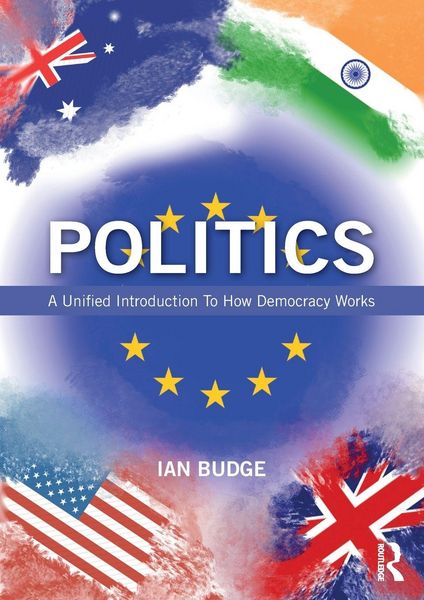
  • Produktbild: Politics
  • Produktbild: Politics

Politics A Unified Introduction to How Democracy Works

55,99 €

inkl. gesetzl. MwSt., Versandkostenfrei


Beschreibung

Produktdetails

Einband

Taschenbuch

Erscheinungsdatum

29.05.2019

Abbildungen

schwarz-weiss Illustrationen, Zeichnungen, schwarz-weiss, Tabellen, schwarz-weiss

Verlag

Taylor & Francis

Seitenzahl

476

Maße (L/B/H)

24,6/17,4/2,6 cm

Gewicht

850 g

Sprache

Englisch

ISBN

978-0-367-02509-0

Beschreibung

Rezension

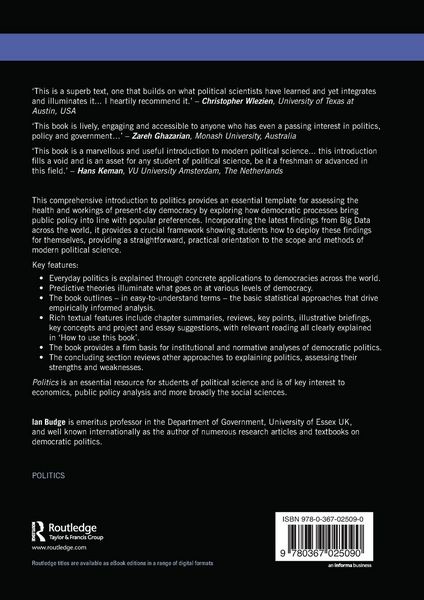
"This is a superb text, one that builds on what political scientists have learned and yet integrates and illuminates it. Politics: A Unified Introduction to How Democracy Works makes sense of the political world and how it really works in modern democratic politics, and I heartily recommend it." - Christopher Wlezien, University of Texas at Austin, USA.

"This book is lively, engaging and accessible to anyone who has even a passing interest in politics, policy and government. The chapters cover a wide range of important issues, concepts and foundational ideas in politics." - Zareh Ghazarian, Monash University, Australia.

"This book is a marvellous and useful introduction to modern political science. Professor Ian Budge has produced a fresh approach to study and analyse 'Democratic Politics'. By means of 'predictive theory' the student can understand and explain the political process in full. I am convinced that this introduction fills a void and is an asset for any student of political science, be it a freshman or advanced in this field." - Hans Keman, VU University Amsterdam, The Netherlands.

"For any student interested in a systematic and rigorous introduction to a science of politics, this book is a must-read" - Edoardo Bressanelli, King's College London, UK.

"Terrific systematic presentation which specifies the conditions under which contemporary democracies operate clearly and concisely both for students and the general public." - Jean Blondel, Founding Professor, Department of Government, University of Essex, UK, and Founding Director of the European Consortium for Political Research (ECPR).

Produktdetails

Einband

Taschenbuch

Erscheinungsdatum

29.05.2019

Abbildungen

schwarz-weiss Illustrationen, Zeichnungen, schwarz-weiss, Tabellen, schwarz-weiss

Verlag

Taylor & Francis

Seitenzahl

476

Maße (L/B/H)

24,6/17,4/2,6 cm

Gewicht

850 g

Sprache

Englisch

ISBN

978-0-367-02509-0

Herstelleradresse

Libri GmbH
Europaallee 1
36244 Bad Hersfeld
DE

Email: gpsr@libri.de

Kundinnen und Kunden meinen

0 Bewertungen

Informationen zu Bewertungen

Zur Abgabe einer Bewertung ist eine Anmeldung im Konto notwendig. Die Authentizität der Bewertungen wird von uns nicht überprüft. Wir behalten uns vor, Bewertungstexte, die unseren Richtlinien widersprechen, entsprechend zu kürzen oder zu löschen.

Die Bewertungen sind nach Format, Anzahl Sterne und Datum sortiert.

Verfassen Sie die erste Bewertung zu diesem Artikel

Helfen Sie anderen Kund*innen durch Ihre Meinung

Kundinnen und Kunden meinen

0 Bewertungen filtern

Die Leseprobe wird geladen.
  • Produktbild: Politics
  • Produktbild: Politics
  • Preface: Explaining Politics Systematically.  Introduction: Politics and Policy What Do We Want to Explain and How?  Part I: Processes. Elections alternate party-based governments with different preferences and priorities thus bringing public policy into line with centrist popular preferences in the long run: Overview  1. Why Politics? Making Policies to Provide Public Goods  2. How Popular Preferences Develop  3. Measuring Electoral Preferences  4. Electors' Policy Thinking: From a Joined Up Left-Right Perspective to Issue-by-Issue Reactions  5. Party Policy Thinking: Framing Policy Targets and Election-Based Estimates of Majority Preferences  6. Matching Public Policy to Popular Preferences  7. The 'Web of Explanation': Relating Process Theories to each other Within a General Political Science Context.  Part II: Rules.  Rules designate - but may misrepresent - majority preferences, thus biasing policy outcomes: Overview  8. Majority Choice of Policies: Voting Paradoxes and Attempted Solutions  9. General Elections and Election Systems: Finalizing Collective Choice of Policies.  Part III: Protagonists.  Parties and governments shape popular preferences and reflect them in public policies: Overview  10. Citizens, Parties and Governments: Interactive Preference Formation  11. Parties: Ideological Policy-Carriers  12. Governments: Prime Participants in Policy Making  13. Ministries: Separating out Policy Areas.  Part IV: States.  Collective action without binding rules: Overview  14. Globalization and World Democracy.  Part V: Explanation.  Explaining politics by specifying its processes so as to predict outcomes.  Overview: Theory-Driven Data-Analysis  15. Generating 'Big Data': Sources, Procedures, Error Checks  16. Simplifying 'Big Data': Dimensions, Majorities and the (Missing?) Middle  17. Managing 'Big Data': Theoretical Explanation and Statistical Analysis  18. Developing Political Science by Explaining Democracy